Global Social and Solidarity Economy Forum 2025
The social and solidarity economy offers an essential pathway to decent work and social justice
Human-Centred Economic Transitions Grounded in Cooperation and Solidarity.
3 November 2025
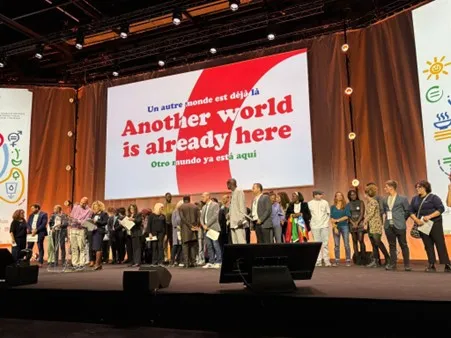
Bordeaux (ILO News) - At the Global Social and Solidarity Economy Forum (GSEF 2025) held in Bordeaux, France from 29 to 31 October 2025, the International Labour Organization (ILO) urged to advance decent work and social justice through the SSE. The Forum convened over 10,000 participants from more than 100 countries, underscoring global commitment to the SSE as a driver of inclusive, sustainable development. As a key partner, the ILO shared institutional perspectives on how SSE principles align with international labour standards and the organization's mandate to promote social justice and decent work for all.
Human-centred transitions grounded in social justice
Opening the sessions, Simel Esim, Head of the ILO's Cooperative, Social and Solidarity Economy Unit and Chair of the UN Inter-Agency Task Force on SSE, highlighted how the SSE's core principles of cooperation, collective ownership, and solidarity reflect the ILO's fundamental commitment to social justice. She made clear that human-centred economic transitions are critical for addressing the interconnected challenges of inequality, climate change, and social fragmentation. The SSE, she emphasized, is not a "parallel" economy but an essential pathway for transformative change within planetary boundaries, offering practical approaches to centre people and communities in economic transformation.

Key pillars of decent work
A major ILO message at GSEF was that advancing decent work through the SSE requires progress in three priority areas: governance, ensuring democratic participation and worker voice in SSE enterprises; protection, extending labour protections and social security to SSE workers; and financing, providing patient capital, supportive public procurement and solidarity-based trade for SSE enterprises. The ILO stressed that an enabling environment across these pillars is essential, meaning upholding labour rights, giving SSE organizations legal recognition and a level playing field, while integrating them into social protection and financing systems that prioritize inclusion and care. Participants were urged to back commitments with concrete resources and accountability.
Empowering workers and fostering inclusion
Discussions showcased how the SSE empowers workers, especially those in informal and precarious sectors, and contributes to inclusive growth. In a plenary on decent work, it was shown that the SSE enables vulnerable groups such as domestic and gig workers to organize collectively, improve working conditions and gain economic voice. ILO experts emphasized that advancing decent work through the SSE means achieving democratic governance giving workers real voice, social protection reaching those left out, and financing serving collective well-being rather than short-term profit. The SSE provides a model of enterprise that puts people over profit, offering marginalized workers greater security, dignity and voice.
The SSE for resilient communities and peace
GSEF 2025 also showcased the SSE's role in fostering peace. A "Declaration for Lasting Peace," co-drafted with ILO support, calls for democratic governance and collective solidarity as foundations for sustainable peace and social cohesion, recognizing the SSE as a transformative force in times of conflict and crisis.