

Social and solidarity economy highlighted at high-level conference on Global Roadmap for a New Economy
At a high-level conference on Global Roadmap for a New Economy, participants discussed policy approaches to eradicating poverty and advancing well-being. The social and solidarity economy was highlighted as a pathway for decent work, social justice and sustainable development.
27 April 2026
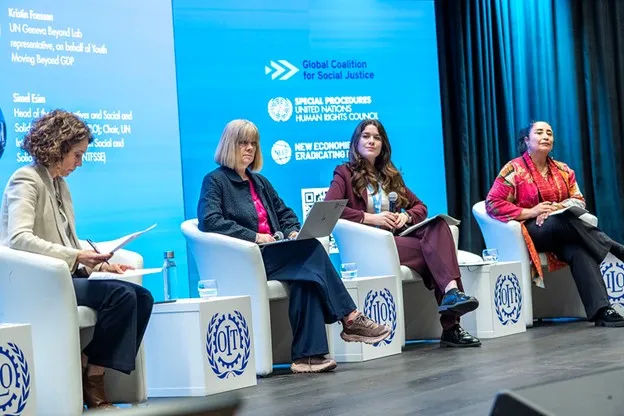
Geneva (ILO News) – Eradicating Poverty Beyond Growth: A Global Roadmap for a New Economy, a high-level international policy conference, was held on 22 April 2026 under the mandate of the United Nations Special Rapporteur on extreme poverty and human rights, Olivier De Schutter. Convened at ILO headquarters in Geneva as a contribution to the Global Coalition for Social Justice, and opened by senior representatives of the ILO and OHCHR, the event brought together UN entities, governments, employers’ and workers’ organizations, academia and civil society to discuss proposals for eradicating poverty and advancing social progress and well-being.
With two thirds of Sustainable Development Goal targets lagging, the conference linked the need to accelerate action on the Goals with emerging discussions on the post-2030 global development framework. Against the backdrop of the United Nations Beyond GDP initiative, discussions focused on policy approaches centred on well-being, social justice and care for people and planet, with the social and solidarity economy (SSE) highlighted as a policy pathway within the Roadmap.
The SSE, the SDGs and the post-2030 framework
During the session “Creating the momentum: Post-growth and the 2030 development goals”, chaired by Clara Cabrera, Ambassador and Deputy Permanent Representative of Spain to the United Nations in Geneva, included perspectives from UN DESA, the UN Geneva Beyond Lab, academia and the ILO. Simel Esim, Head of the ILO Cooperative, Social and Solidarity Economy (COOP/SSE) Unit and Chair of the UN Inter-Agency Task Force on Social and Solidarity Economy (UNTFSSE), highlighted lessons from the SDG experience for the post-2030 global development framework, stressing the need to bring a wider range of local, national and regional actors into the process from the outset. She also underlined that building momentum for the Roadmap and for post-2030 discussions will depend on alliances across levels, including engagement with governments, social partners through social dialogue and United Nations country teams, so that local and national experience can inform wider multilateral processes.
She noted that the 2030 Agenda acknowledged cooperatives among the diverse actors involved in implementation, while the wider SSE was not named. However, that visibility did not carry through into the global indicator framework, which did not identify cooperatives, other SSE entities or their governance models as distinct institutional actors. Since then, the ILO Guidelines concerning Statistics of Cooperatives have provided an international reference point, while work is advancing on statistical guidance for the wider SSE. These methodological developments provide a stronger basis for future measurement approaches that recognize institutional diversity, including differences in governance, participation, representation and ownership models.
Drawing on the tripartite definition adopted in the Resolution concerning decent work and the social and solidarity economy at the 2022 International Labour Conference, she highlighted elements that make the SSE directly relevant to a human rights economy centred on well-being within planetary boundaries. She pointed in particular to economic, social and environmental activities that serve the collective or general interest; principles such as democratic or participatory governance and the primacy of people and social purpose over capital; values such as care for people and planet, equality and fairness, and decent work and livelihoods; and aspirations to long-term viability and sustainability and to the transition from the informal to the formal economy. She also emphasized that the definition recognizes the diversity of SSE entities according to national circumstances, avoiding a single institutional template for how economic activity can be organized in line with SSE values and principles.
Ms Esim emphasized that the SSE can help advance a human rights economy when supported by coherent policy frameworks, as set out in the joint policy brief Advancing a human rights economy through the social and solidarity economy, prepared by the UNTFSSE and the Special Rapporteur with the Global Coalition for Social Justice, and carried forward in the Roadmap.

Growing momentum around policy development, implementation and coherence
The session highlighted growing momentum around the SSE across global, regional and national processes, spanning policy development, implementation, monitoring and coherence. This includes policy work by the ILO, the OECD, the European Union, the African Union and the Ibero-American Network for the Promotion of the Social and Solidarity Economy, as well as follow-up to United Nations General Assembly resolutions on the SSE. It also linked this momentum to the role of locally rooted SSE entities in times of crisis, when they can help sustain jobs, maintain essential services and support local economies.
Recent developments show how this momentum is taking shape at the country level. These include newly adopted legislation in Costa Rica and Spain, progress towards framework legislation in the Republic of Korea, and Senegal’s designation of 2026 as the Year of Employment and the Social and Solidarity Economy, alongside preparations to host a continental SSE forum.
United Nations follow-up is also advancing through the UNTFSSE, which is supporting the preparation of the second report of the United Nations Secretary-General on the SSE. In parallel, a number of governments are advancing preparations for the launch of a Group of Friends on the SSE to support cooperation and follow-up in multilateral processes.
The conference and the session can be viewed on ILO Live.