

Shaping the future of occupational safety and health for young workers
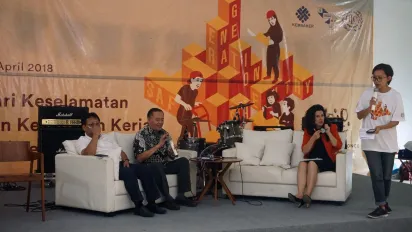
The world of work is undergoing major changes that will continue, and potentially intensify, in the future. The ILO seminar provided a venue for Indonesian millennial and the older generations to work together in dealing with the future of work and, at the same time, improving the protection of young workers in the country.
7 March 2019
Other recommendations included efforts to strengthen social dialogues, awareness raising, including self-awareness, role models programme and information dissemination. The participants also came to an agreement that there was an urgent need for mind-set and work-ethic changing, particularly in anticipating and preventing occupational hazards.
The event was attended by around 125 participants who were a mixed balance between the millennial generation and the older generation. It was expected that the seminar strengthened the capacity and build a better understanding between these two generations about future of work initiatives that were linked to the sustainable progress towards a national culture of workplace prevention.Valentine Offenloch, Technical Specialist of the ILO’s Safe Youth at Work
In relations to the OSH and youth, it focuses on lifelong learning and skills development, support for people in work transitions and lifelong universal protection including during illness and disability. We also need to raise the OSH awareness for young workers so that they could better protect themselves and be part of the OSH preventive culture at the workplace."
The seminar marked the kick-off event for the celebration of the ILO Centenary in Indonesia. Established in 1919, for 100 years, the ILO has advanced social justice and promote decent work. The seminar also marked the launch of the ILO 100’s icons in the country: Nusa and Tara, a young man and woman of human standing banners representing the Indonesian youth. Names of Nusa and Tara were taken from the other name of Indonesia: Nusantara (a unified region).
Future of work, youth and OSH
The event began with an introduction from a young entrepreneur about the characteristics of the digital workforce. Bernard Satiadi, 22 years old, shared his millennial experiences working as an entrepreneur and Youtuber. “I used to work in the company, but only lasted for two years. I decided to become an entrepreneur and together with a friend, I also manage a Youtube account, focusing on youth issues,” he told, adding that he worked independently without the need to have an actual office, definite working hours and job structures.“In relations to the OSH and youth, it focuses on lifelong learning and skills development, support for people in work transitions and lifelong universal protection including during illness and disability. We also need to raise the OSH awareness for young workers so that they could better protect themselves and be part of the OSH preventive culture at the workplace,” she said.
From the perspective of the policy maker, Roostiawati, Director on Development of Job Market, Ministry of Manpower, highlighted the national strategy and policy in relations to the future of work. She underlined initiatives taken by the Ministry of Manpower in response to the future of work such as the development of innovation room, digital-based vocational education and training, entrepreneurship and socio-preneurship as well as youth incentives.
Understanding the millennial generation at the workplace
Meanwhile, Ratih Ibrahim, a psychologist, revealed the key results of the Millennials at the Workplace Survey. The survey examined different perspectives between milllennials and non-millennials about employment. It covered topics related company demands, job expectations, workplace main problems, job values, leadership and so forth.The study found that millennials put their passions for their jobs as their top priority when looking for employment. They also focused on learning and development opportunities. Thus, they valued experiences over money as they valued the journey and not the job. However, they have a lifestyle that could lead to higher risk of health and emotional problems.By having a good understanding about these characteristics, we can develop a better transition between the millennial and the older generations and can find effective measures to mainstream OSH issues in the lives of young workers."
Ratih Ibrahim, a psychologist
“To be able to create the decent future of work, we need to understand the characteristics of the millennial generation as in the year of 2020, they will make up over a third of the global workforce. By having a good understanding about these characteristics, we can develop a better transition between the millennial and the older generations and can find effective measures to mainstream OSH issues in the lives of young workers,” Ratih stated.
Disclaimer
Funding is provided by the United States Department of Labor under cooperative agreement number IL-26690-14-75-K-11.
This material does not necessarily reflect the views or policies of the United States Department of Labor, nor does mention of trade names, commercial products, or organizations imply endorsement by the United States Government. One hundred percentage of the total costs of the project or program is financed with Federal funds, for a total of 11,443,156 dollars.
Related content
Building a Generation of Safe and Healthy Workers – Safe & Healthy Youth (Safeyouth@work)

ILO 100 on Future of Work
Future of Work Seminar: Its Impact to Youth and Occupational Safety and Health
Indonesian youth speak up about future of work and OSH
ILO 100
Celebrating the 100th anniversary of the ILO in Indonesia with Nusa and Tara
Today’s jobs and future of work
Relevant projects
Building a Generation of Safe and Healthy Workers – Safe & Healthy Youth (Safeyouth@work)
SafeYouth@Work Project: Building a Generation of Safe and Healthy Workers - Mongolia
SafeYouth@Work Project: Building a Generation of Safe and Healthy Workers