

Recognizing the dangers of asbestos
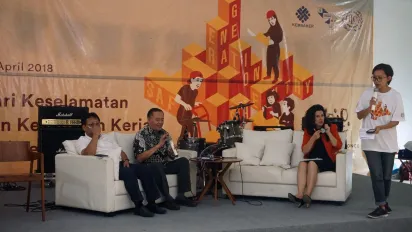
The ILO in collaboration with the Indonesia Ban Asbestos Network (INA-BAN) raised the public awareness about the danger of asbestos.
8 May 2019
Banned in more than 60 countries, including all members of the EU, the carcinogenic material is still widely used in numerous countries for construction, textiles, brake pads and cheap insulation. In Asia, asbestos use shows no sign of waning including Indonesia. The consumption in these countries remain at a very high-level, exposing many workers and the public at large.
Francisco Santos O’Connor, Senior ILO OSH Specialist, explained that the ILO has banned the use of asbestos through its international labour standards. The ILO’s Asbestos Convention No. 162 and its Recommendation No. 172 clearly prohibit the use of asbestos. As of today, only 35 countries ratified this convention.In 2015, one million workers died due to hazardous substances. Health care costs associated with the continued use of asbestos are estimated around US$2.4 billion to US$3.9 billion."
Francisco Santos O’Connor, Senior ILO OSH Specialist
“In 2015, one million workers died due to hazardous substances. Health care costs associated with the continued use of asbestos are estimated around US$2.4 billion to US$3.9 billion,” he said, adding that only three countries in Asia ratified the asbestos Convention: Australia, Japan and South Korea.
Dr Ana Suraya from INA-BAN said that illness due to asbestos was still considered a myth in the country. To date, only one case of illness due to asbestos was being admitted by the Government of Indonesia. A worker who worked for years using asbestos was found with an incurable disease that is likely to develop into cancer.I am now working on the research about the risks of asbestos to people’s health conditions. I hope by presenting the real facts about the dangers of asbestos, Indonesia would follow the steps of other countries that have already banned the use of asbestos."
Dr Ana Suraya from INA-BAN
“I am now working on the research about the risks of asbestos to people’s health conditions. I hope by presenting the real facts about the dangers of asbestos, Indonesia would follow the steps of other countries that have already banned the use of asbestos,” she said.
INA-BAN estimates that at least 4,000 people are directly involved in the manufacturing of asbestos products, but does not include contract and other non-permanent employees or construction workers. It also does not take into account the risk of secondary exposure among workers’ families as people can bring asbestos fibers home with them on their hands, hair, clothes, shoes or on tools.
The event was conducted in conjunction with the commemoration of the World Day for Safety and Health at Work. According to this year’s ILO report on “Safety and Health at the Heart of the Future of Work”, almost three million worker die each year from occupational accidents and work-related diseases. In addition, another 374 million workers suffer each from non-fatal occupational accidents. The report also highlighted that days lost at work globally represent almost 4 per cent of the world’s GDP and showed that these work-related deaths, injuries and diseases are not inevitable.
Related content

Youth 4 OSH: OSH for Young Workers and Young Employers in Global Supply Chains —Building a Culture of Prevention
Building a Generation of Safe and Healthy Workers – Safe & Healthy Youth (Safeyouth@work)
Relevant projects
Building a Generation of Safe and Healthy Workers – Safe & Healthy Youth (Safeyouth@work)
Youth 4 OSH: OSH for Young Workers and Young Employers in Global Supply Chains —Building a Culture of Prevention

SafeYouth@Work Project: Building a Generation of Safe and Healthy Workers - Mongolia
SafeYouth@Work Project: Building a Generation of Safe and Healthy Workers