

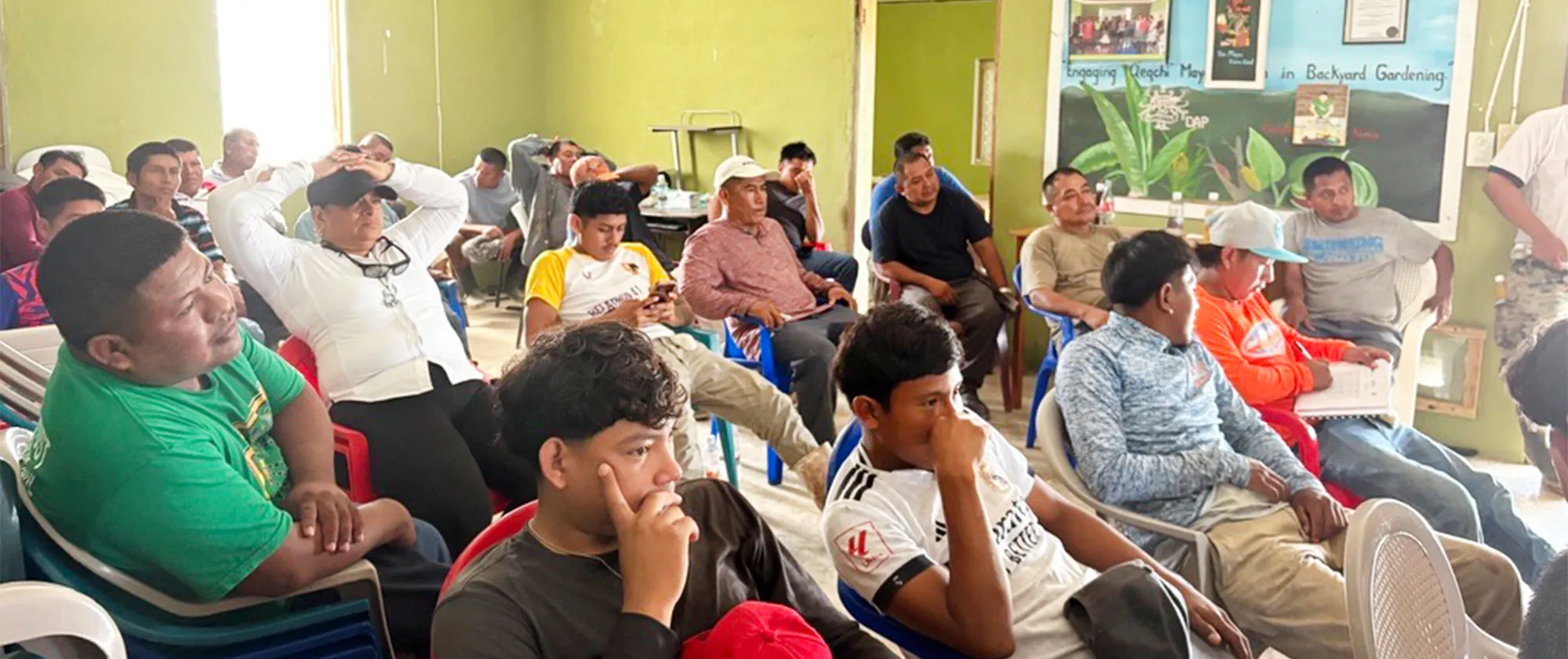
EU-funded ILO PROSPER Project initiative
PROSPER Project holds community consultation in San Miguel
The EU-funded PROSPER project engaged San Miguel village leaders and community members in a consultation to discuss proposed activities in cacao, tourism, and local economic development, while gathering feedback to shape community-led planning and next steps.
11 May 2026
San Miguel, Belize (ILO News) – On Saturday, 9 May 2026, the PROSPER team in Belize met with San Miguel village leadership and community members to introduce the EU-funded PROSPER initiative and consult on proposed project activities. The meeting was chaired by Mr. Jose Cus, Chairman and Mr. Kenny Cal, Alcalde of the village leadership.
Charting a path for local growth
Kylah Ciego, Project Implementation & Monitoring Officer for the EU-funded PROSPER project, introduced the core mission of PROSPER: Participation, Ownership for Sustainable Progress and Economic Resilience. She explained that the project will work closely with 15 indigenous communities across southern Belize, of which 13 Maya communities have already been identified.
It focuses on three key pillars:
- Cacao development: strengthening cultivation practices, post-harvest management, and pest control
- Tourism development: enhancing local hospitality services and eco-tourism structures
- Local economic development planning: establishing a 10-person Local Action Group in each participating village to guide community priorities
The project is also collaborating with regional secondary schools, including Julian Cho Technical High School, George Town Technical High School, Corazon High School, and Tumul’kin Learning Centre, to integrate cacao cultivation into agricultural education and encourage youth participation in the sector.
PROSPER’s offer to farmers
While the PROSPER project will not be offering cash subsidies to farmers, Ms. Ciego gave a detailed explanation of how the programme's support model centres on training, planning, technical assistance, and capacity building. She noted that equipment provision was a possibility down the line, but would likely be contingent on community action plans, additional funding, and the priorities that participating communities themselves identify.
Community feedback and key concerns
During the discussion, community members welcomed the initiative but raised several important concerns:
- Need for tangible outcomes: Participants stressed that training must translate into practical results, including processing equipment, packaging support, marketing assistance, and sustainable business opportunities with measurable livelihood benefits.
- Shared equipment challenges: Previous experiences with clustered or shared equipment across communities were described as largely unsuccessful due to weak leadership and management structures.
- Tourism potential: San Miguel’s strategic location between Maya archaeological sites, along the Rio Grande River and near the Port Honduras Marine Reserve, was highlighted as a strong foundation for reviving agro-tourism initiatives.
- Market competition: Questions were raised about whether small communities can compete effectively with larger cacao companies in processing and commercialization.
In the exchange, the PROSPER team explained that the project was designed based on national and regional assessments indicating that Belize’s cacao sector still has room for expansion, particularly in international and specialty markets. They also noted that national strategies emphasize value-added cacao products, increased local processing, and stronger youth participation.
Importantly, the PROSPER tabled as an honest and transparent message to the participants, that the project will only work if communities drive it. Local planning processes will determine development priorities, not decisions handed down from above. At the centre of that accountability structure sits the Local Action Group. Therefore, a functional and committed Local Action Group will be critical to ensuring accountability and sustainability.
“The PROSPER project is not about imposing solutions, but about working with communities to identify what is feasible, market-oriented, and sustainable for them,” said Kylah Ciego, Project Implementation & Monitoring Officer. “Your concerns about leadership, equipment management, and real economic impact are valid, and they are exactly why community-specific planning and continued dialogue are essential.”
From Consultation to Commitment
Village representatives expressed genuine interest in the project while being clear-eyed about the risks. Careful planning, they stressed, is non-negotiable, to ensure that the project achieves real and lasting impact. The consulting team from Humana People to People BZ, conducted on-the-ground surveys and interviews. The goal was to map interest across the farmers, youth, women, business owners in the community and determine how San Miguel can formally enter the project and establish its own Local Action Group.
The community representatives, after the discourse, voted to fully participate in the project. This means that San Miguel is committed to moving forward with its own Local Action Group at the helm. What is clear is that PROSPER - by design - places ownership squarely with the community.
Relevant projects

An ILO-EU Project
Participation, Ownership and Sustainable Progress for Economic Resilience (PROSPER)