

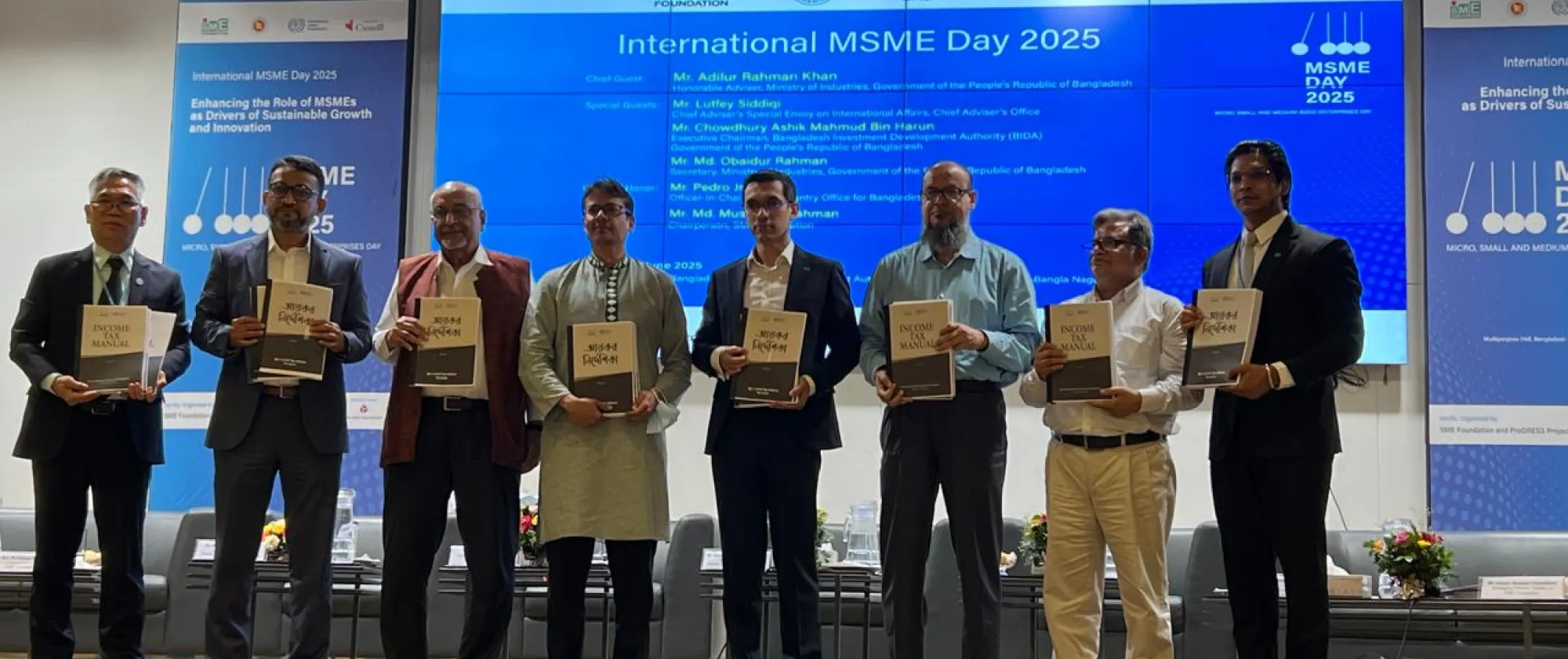
Micro, small and medium-sized enterprises (MSMEs) Day 2025
Policymakers and business associations call for clear SME definitions, formalization and inclusive finance in Bangladesh
On 30 June 2025, government officials, entrepreneurs, economists, and development partners met to discuss a new SME policy for Small and Medium Enterprises (SMEs). They highlighted the urgent need to clarify definition of SMEs and to establish a robust support system for their formalization and growth, with a particular emphasis on women-owned businesses.
1 July 2025
DHAKA (ILO News) – SMEs the backbone of Bangladesh’s economy and a key source of employment—took centre stage at a high-level seminar organized by the International Labour Organization (ILO) and SME Foundation, with funding support from the Government of Canada. Hosted under the ProGRESS project, the event brought together entrepreneurs, policymakers, economists, business leaders, and development partners to tackle pressing challenges such as limited access to finance, informality, low productivity, and economic vulnerabilities, while outlining a roadmap to strengthen the country’s SME ecosystem.
MSMEs: The engine of growth in Bangladesh
Speaking at the seminar, Anwar Hossain, Managing Director of SME Foundation, highlighted that Bangladesh’s SME sector provides employment to around 3.7 million people. He emphasized the importance of showcasing local products through a national display centre and introduced the newly developed Women Entrepreneurs Directory, a tools aimed at boosting visibility, supporting market access, and elevating local enterprises.
Safia Tasneem Dola from the Manikganj Women Chamber of Commerce stressed the need to bring grassroots voices, especially those of rural and women entrepreneurs into national policy discussions.
Nabin Kumar Karna, Specialist from the ILO’s ProGRESS project, opened the discussion by setting the context of MSMEs in Bangladesh, drawing comparisons with other countries in the region. He shared key recommendations on unlocking the sector’s full potential.

Structural barriers and policy gaps
Economist Dr Debapriyo Bhattacharya, keynote speaker at the event, highlighted key challenges including differing SMEs definitions across government institutions, high informality rate, weak social protection systems, and the sector’s heavy reliance on loans. He urged that the upcoming 2025 SME Policy focus on formalization and sustainability, rather than solely financing.
The forthcoming SME Policy, now in the formulation stage with support from the ProGRESS project, underscores the importance of green business practices and stronger measures to tackle climate vulnerability. It also calls for clearer policy definitions to guide implementation. Stakeholders highlighted that weak inter-agency coordination continues to hamper effective support for small and medium enterprises. They stressed that improving financial literacy, expanding access to finance including the use of movable assets as collateral and preparing the sector for Bangladesh’s upcoming LDC graduation are critical priorities.
Pedro Jr Bellen, Officer-in-Charge of the ILO Country Office for Bangladesh, echoed these concerns, calling for a coordinated effort to simplify regulations and strengthen value chains. He stated, “SMEs are vital for promoting decent work and inclusive economic growth, and that inclusive employment must be at the heart of every economic and social policies.”
Ashik Chowdhury, Executive Chairman of the Bangladesh Investment Development Authority (BIDA), added that improving logistics and strengthening backward linkages would position Bangladesh as a major player in global supply chains.

Call to Action: Are we doing enough?
Lutfey Siddiqi, Chief Adviser’s Envoy for International Affairs, delivered a powerful message to stakeholders: “SMEs are the drivers. We are just the facilitators. Are we doing enough to support the risk-takers who’ve built this employment engine?”
New tools to support SME formalization
A major highlight of the event was the launch of user-friendly Tax and VAT Manuals designed to help entrepreneurs navigate business regulations more easily. Developed jointly by SME Foundation and the Formalization initiative of ILO, these manuals aim to simplify what is often a complex and intimidating process for small business owners, helping protect their interests and promote formalization.
Celebrating entrepreneurs and showcasing innovation
The seminar also featured a vibrant product exhibition where 60 entrepreneurs showcased their work, with over 200 participants gathering to exchange ideas and connect with partners.
As Bangladesh marks MSME Day 2025, this event served as a timely reminder: when SMEs succeed, the economy thrives. The ILO remains committed to working alongside partners to promote decent work, inclusive growth, and an enabling environment where small businesses can unlock their full potential.
Related content

Project: Employability of women workers
Promoting Gender Responsive Enterprise Development and TVET Systems (ProGRESS)
Relevant projects
Project: Employability of women workers
Promoting Gender Responsive Enterprise Development and TVET Systems (ProGRESS)