


Nigeria Unites to End Child Labour: Children Lead the Call for Change
At the 2025 World Day Against Child Labour, Nigeria celebrated progress and amplified children’s voices in a powerful call to action. Through national conferences, creative performances, and policy dialogue, stakeholders renewed their commitment to protect every child’s right to a safe, educated, and empowered future.
30 July 2025
Abuja, Nigeria – Nigeria commemorated the 2025 World Day Against Child Labour (WDACL) with a powerful blend of celebration, reflection, and renewed commitment. Under the theme “Progress is Clear, But There’s More to Do: Let’s Speed Up Efforts!”, the Federal Ministry of Labour and Employment, in collaboration with the International Labour Organization (ILO) and key partners, hosted a series of impactful events in Abuja and across several states.
The national observance featured a Press Briefing and National Children’s Conference, organized by the National Steering Committee on the Elimination of Child Labour (NSCCL) and supported by the ILO’s Accelerating action for the elimination of child labour in supply chains in Africa (ACCEL Africa II) and Support to Free Movement of persons and Migration in West Africa, Phase II (FMM West Africa II) projects. Children took centre stage, delivering poetry, drama, and a powerful communiqué urging lawmakers to act decisively.
Rt. Hon. Muhammadu Dingyadi, Minister of Labour and Employment, called on stakeholders to envision a Nigeria where “every child is learning, not labouring; dreaming, not drudging.” He encouraged the children to use their voices to influence policy and pledged the Ministry’s support under President Tinubu’s Renewed Hope Agenda.
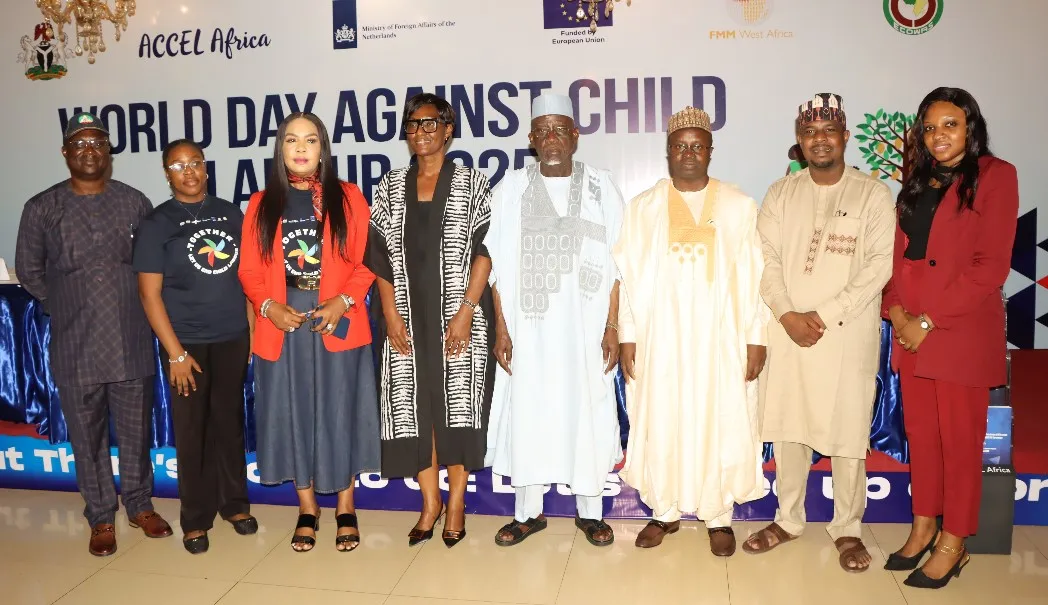
Ms. Vanessa Phala, ILO Country Director, emphasized the urgency of legislative reform, urging the National Assembly to pass the revised Labour Standards Bill. She welcomed the global decline in child labour—from 160 million to 138 million since 2020—but warned that 54 million children remain in hazardous work, with Sub-Saharan Africa bearing the highest burden. Abimbola Oyelohunnu of ECOWAS Commission urged member states to strengthen and enforce laws aligned with the ECOWAS Regional Action Plan to eliminate child labour.
Children from schools across the Federal Capital Territory (FCT), including Tithemi and Sesame International High Schools, delivered stirring messages. Edidiong Asita-Ebiti spoke of children hawking on the streets, calling it “a betrayal of childhood,” while Chira Camella and Primpath Cuddle urged leaders to “give every child the chance to become something great.”
The Children’s Parliament echoed these sentiments, calling for stronger enforcement of child protection laws and pledging to be champions of change in their communities.
Stakeholders including the Nigeria Employers’ Consultative Association (NECA), Nigeria Labour Congress (NLC), Trade Union Congress (TUC), and civil society organizations joined the call for urgent action. NECA’s Adewale-Smatt Oyerinde called for accelerated, sustained and collective action to eliminate child labour. Comrade Joe Ajaero of the NLC stressed that child labour is both a labour and social justice issue, urging full implementation of the Child Rights Act and expansion of social protection.
Across Nigeria, the day was marked with state-level activities including a novelty football match, road walk, and children’s parley in Niger, Ondo, and Osun States. These events fostered awareness, strengthened partnerships, and mobilized political will to eliminate child labour.
The celebration concluded with the presentation of sixteen Community Action Plans, farmers’ guide, and revised cooperative by-laws, and awareness tools to state governments. A nationwide campaign under the #EndChildLabourNow continues to amplify the message.
As Nigeria reflects on its progress, the voices of its children have made one thing clear: the end of child labour is not only possible—it is within reach.