

Nigeria advances review of National Policy and Action Plan to eliminate child labour
The EU-funded FMM (West Africa) II Project and the ACCEL Africa II Project, financed by the Ministry of Foreign Affairs of the Netherlands, supported Nigeria’s review of two key documents on the elimination of child labour: the National Policy and the 2026–2030 National Action Plan. Through social dialogue, government, workers’ and employers’ organizations continue to strengthen evidence-based, coordinated and results-oriented action against child labour.
1 May 2026
Abuja (ILO News) – Nigeria has taken a new step towards strengthening its national response to child labour through the review of its National Policy and the development of a new National Action Plan for the Elimination of Child Labour for the period 2026–2030.
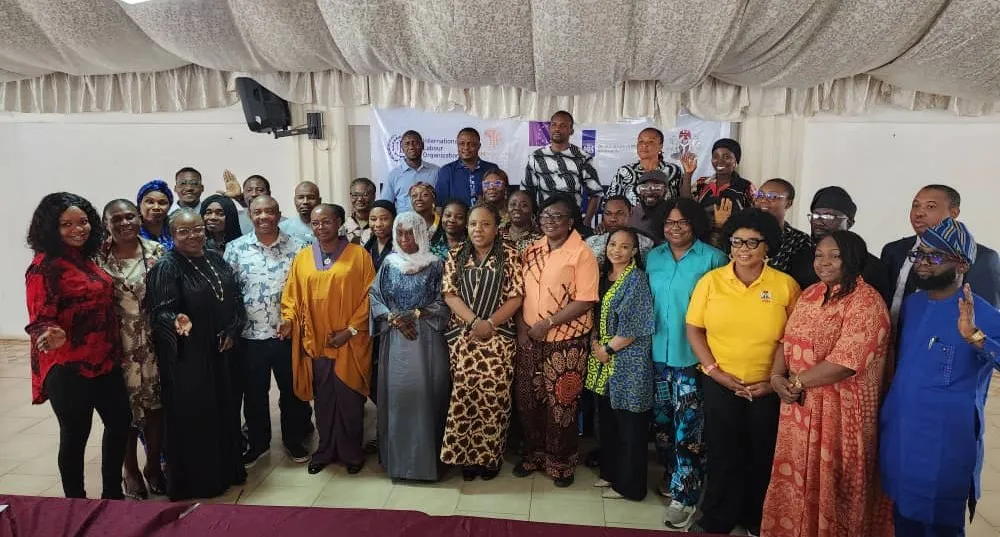
The International Labour Organization (ILO), in collaboration with the National Steering Committee on the Elimination of Child Labour (NSCCL), led by the Federal Ministry of Labour and Employment (FMLE), convened a four-day strategic development workshop from 27 to 30 April 2026 in Abuja. The workshop brought together key national stakeholders to assess progress, review evidence and define the priorities that will guide Nigeria’s next phase of action against child labour.
The new National Policy and National Action Plan are expected to build on the implementation of the 2021–2025 National Action Plan, while responding to emerging trends and current evidence on child labour in the country. The process also aims to ensure alignment with national priorities, regional frameworks and global commitments, including the Marrakech Global Framework for Action, the West African Regional Action Plan, the ECOWAS Child Protection Strategic Framework, the African Union Ten-Year Action Plan, and the fundamental principles and rights at work.
Over the four days, participants reviewed the existing National Policy, developed elements of the 2026–2030 National Action Plan, and worked on a Monitoring and Evaluation Plan to support implementation and track progress. Technical discussions were informed by the findings of the final evaluation of the 2021–2025 National Action Plan, the ILO/NBS National Child Labour Survey Report 2022, regional and global frameworks, and discussions on the Theory of Change and priority areas for the next phase.
At the opening ceremony, the Honourable Minister of Labour and Employment, represented by the Director of the Inspectorate Department, acknowledged the progress made in recent years, while stressing that child labour remains a serious socio-economic and human rights challenge in Nigeria. She noted that many children continue to be engaged in work that affects their childhood, dignity and future potential.
The Minister emphasized that eliminating child labour requires more than policy commitments. It calls for stronger enforcement of laws and policies, effective coordination across sectors, and action on the root causes of child labour, including poverty, limited access to education and weak social protection systems. She also underlined the importance of ownership and implementation at federal, state, local and community levels.
The workshop reflected the tripartite nature of Nigeria’s response to child labour, with participation and contributions from government, workers’ and employers’ organizations.
The Nigeria Labour Congress (NLC) described the review process as timely and important for Nigeria’s social and economic future. It reaffirmed its commitment to decent work and the protection of vulnerable children, and expressed readiness to work with stakeholders to develop a practical and inclusive framework that addresses the root causes of child labour.
The Trade Union Congress of Nigeria (TUC) also expressed support for the development of the 2026–2030 National Child Labour Policy and National Action Plan. It called for stronger enforcement of labour laws, expanded social protection, decent work for adults, and increased investment in education and child welfare.
Speaking on behalf of the organized private sector, the Nigeria Employers’ Consultative Association (NECA) welcomed the initiative and reaffirmed its commitment to safe and responsible workplace practices, compliance with labour laws, and active contribution to the elimination of child labour in Nigeria.
The ILO Country Director, represented by the FMM West Africa II National Project Coordinator, welcomed the workshop as an opportunity to consolidate progress and move towards an evidence-based national framework. She highlighted achievements under the 2021–2025 National Action Plan, including the launch of the ILO/NBS National Child Labour Survey Report 2022. She also noted that the National Bureau of Statistics is preparing to launch an updated National Child Labour Report using the child labour data set from the 2024 Labour Force Survey.
The ILO reiterated its continued technical support to Nigeria’s efforts to eliminate child labour and expressed optimism that the process would lead to the validation and official launch of a practical, inclusive and results-oriented National Action Plan for 2026–2030.
By bringing together government institutions, workers’ and employers’ organizations, and development partners, the workshop helped lay the foundation for a renewed national framework focused on evidence, coordination and implementation. The next phase will be critical to translating the revised policy and action plan into concrete measures that protect children, support families and promote decent work for adults.
Relevant projects

Support to Free Movement of persons and Migration in West Africa, Phase II (FMM West Africa II)

Accelerating action for the elimination of child labour in supply chains in Africa (ACCEL Africa)