

New cooperatives strengthen livelihoods and opportunities in Timor-Leste
Two newly established cooperatives in Timor-Leste bring communities together to share skills, pool resources and build stronger pathways to markets and sustainable livelihoods.
24 August 2026
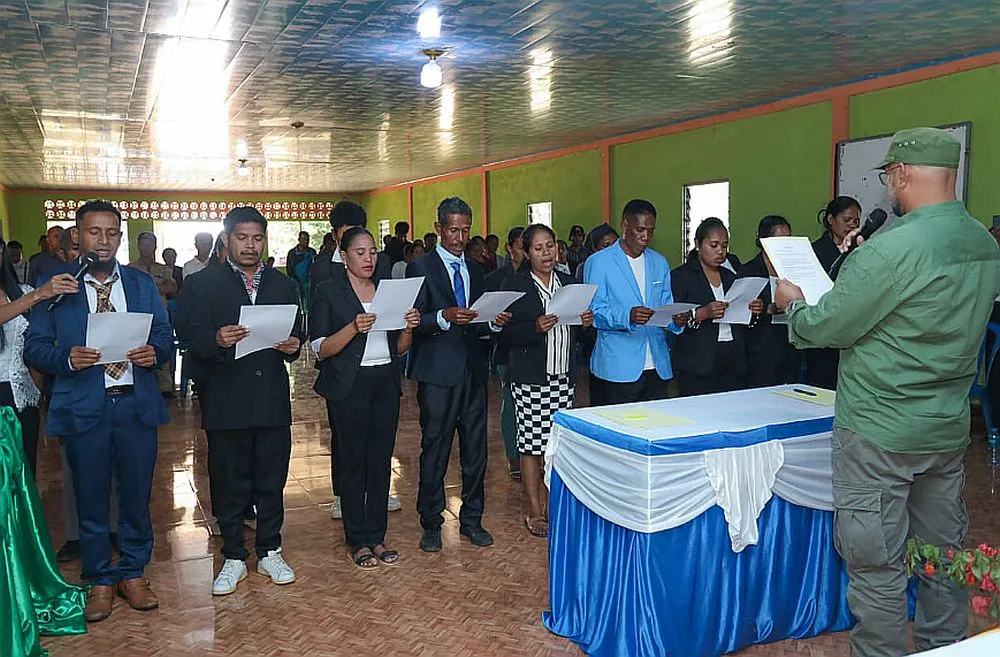
BAUCAU, Timor-Leste (ILO News) – Two new multisectoral cooperatives were officially launched on 19 August in Baucau Municipality, providing 40 community members with a formal, legally recognized structure through which they can pool resources, share skills and access markets collectively to improve their livelihoods.
The two cooperatives, from Buibau and Triloka villages, were established with support from the Agroforestry Skills for Employment and Resilience in Timor-Leste programme, funded by the European Union (EU) and implemented by the International Labour Organization (ILO) in collaboration with the Secretariat of State for Cooperatives (SECOOP) and the Baucau Community Development Centre (CDC).
Women make up the majority of the new membership. Of the Triloka cooperative’s 20 members, 11 are women, while 18 of the 20 members of the Buibau cooperative are women. The cooperatives provide members with an opportunity to participate in formally registered economic enterprises and work collectively to strengthen their livelihoods and access new economic opportunities.
This is only the beginning. The Secretary of State for Cooperatives is committed to accompanying and supporting these cooperatives throughout their journey.
Arsénio Pereira da Silva, Secretary of State for Cooperatives
Members of both groups participated in a series of awareness-raising sessions and technical training on cooperative governance, financial management and group decision-making – laying the groundwork for transforming informal producer groups into cooperatives that meet Timor-Leste’s legal registration requirements.
“Cooperatives are the backbone of the local economy. They bring people together, create opportunities for communities to improve their livelihoods and enable members to work collectively towards a stronger and more sustainable future,” said Arsénio Pereira da Silva, Secretary of State for Cooperatives. “This is only the beginning. The Secretary of State for Cooperatives is committed to accompanying and supporting these cooperatives throughout their journey.”
On behalf of both cooperatives, I would like to thank the ILO, the EU, and SECOOP for the training and support provided to our members. It helped strengthen our groups and unite us around a shared vision.
Cipriano da Costa, leader of the Buibau cooperative
For the ILO, the launch marks concrete progress under the wider Agroforestry Skills programme, which has already supported the formation of cooperatives in Ermera and Viqueque municipalities working in the vanilla and coconut value chains, while training hundreds of farmers in cooperative management alongside technical skills.
“A trained individual producer can improve their own harvest, but a cooperative can change what an entire community is able to negotiate, sell and invest in together. That is the difference we are aiming for in Baucau: not just new skills, but a lasting structure that the members themselves own and run,” said Richard Hanson, ILO Programme Manager for the Agroforestry Skills programme.
Speaking on behalf of both groups, Cipriano da Costa, leader of the Buibau cooperative, expressed pride in achieving legal recognition. “On behalf of both cooperatives, I would like to thank the ILO, the EU, and SECOOP for the training and support provided to our members. It helped strengthen our groups and unite us around a shared vision. We are proud of what we have achieved and are committed to continuing our work for the benefit of our communities,” he said.
The launch concluded with two formal steps that gave the cooperatives their legal standing. Members read aloud a set of commitments to one another, after which the Secretary of State for Cooperatives and board members of the two new cooperatives signed the cooperative deeds. With the deeds signed, the next chapter for Buibau and Triloka begins: turning their newly established legal structures into functioning enterprises that can create lasting opportunities for their members and communities.
Related content
EU Programme
Agroforestry skills for employment and resilience in Timor-Leste
Relevant projects
EU Programme
Agroforestry skills for employment and resilience in Timor-Leste