

Mutualist Conference spotlights role of cooperatives and mutuals in universal social protection
At the International Mutualist Conference, ILO officials highlighted the importance of recognizing cooperatives and mutuals as key Social and Solidarity Economy (SSE) actors, which can have the potential to contribute to achieving universal health coverage and social protection.
25 February 2025
GENEVA (ILO News) – Cooperatives and mutual societies are essential providers of healthcare and social protection services to millions worldwide, yet they remain under-recognized in national policy frameworks. At the International Mutualist Conference, held in Bujumbura, Burundi, and online on February 3-4, 2025, officials from the International Labour Organization (ILO) shared insights on the role of mutuals in social health protection systems and emphasized the need to better integrate them into international, regional, and national frameworks and systems.
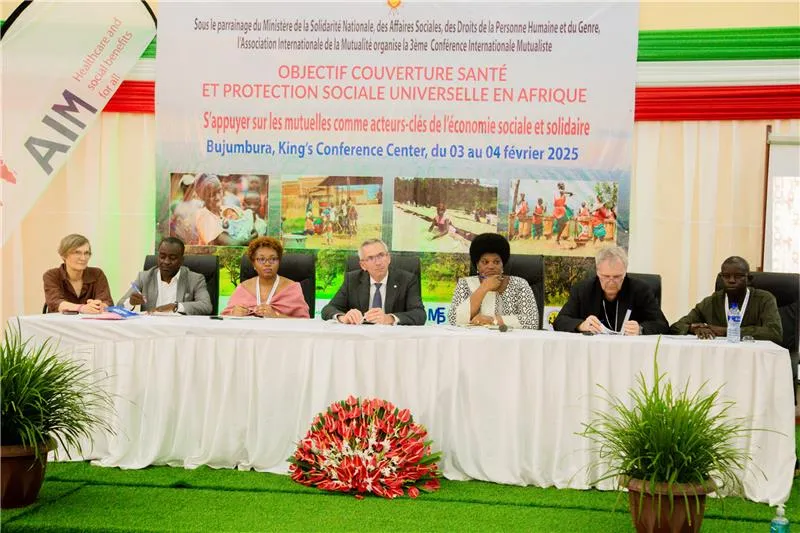
The event focused on the theme that mutuals can play a role as part of the social and solidarity economy in advancing decent work, social justice and sustainable development. Referring specifically to the International Labour Organization (ILO) resolution concerning decent work and the social and solidarity economy, and the United Nations General Assembly resolutions on promoting the social and solidarity economy for sustainable development (2023, 2024), include clear calls to governments. These resolutions provide mutuals with an opportunity to highlight their role as SSE entities in advancing the 2030 Agenda across the different goals, including SDG 3 (good health and well-being), 8 (decent work and economic growth) and 11 (sustainable cities and communities). Additionally, the European Union and African Union strategies around the SSE underline the role of SSE entities like mutuals in advancing decent work in general, and social protection in particular.
Speaking at the high-level panel, Simel Esim, Head of the ILO Cooperative, Social and Solidarity Economy (COOP/SSE) Unit and Chair of the UN Inter-Agency Task Force on the Social and Solidarity Economy (UNTFSSE), underscored mutuals’ democratic and participatory governance structures, and noted that as user owned entities they prioritize social purpose over capital. She highlighted that mutual societies are among the value and principle-based entities of the SSE as outlined in the international definition of the SSE in the 2022 ILO resolution on decent work and the SSE. They have long been key drivers of universal health coverage and social protection, particularly for informal workers and underserved populations. She called for lifting legal and administrative barriers to enable mutuals to scale up their contributions.
Simel Esim also emphasized that the ILO-chaired UNTFSSE provides an opportunity for mutual societies to strengthen their presence in and influence global policy discussions. “Through their engagement in regional and global multilateral platforms like this Task Force, mutual societies could gain greater recognition, expand partnerships, and improve their integration into national and international strategies and policies. They can also develop relations that facilitate their contributions to other multilateral initiatives, such as the Global Coalition for Social Justice and the Global Accelerator on Jobs and Social Protection for Just Transitions,” she stated.
The conference also featured a thematic workshop on the role of mutual societies in national social health protection systems, drawing on the ILO working paper on mutuals and community-based health insurance within social health protection systems.
Mathilde Mailfert, Technical Officer at the ILO, outlined five models of mutual participation in national social health protection systems:
- Management delegation: National agencies delegate key management functions for basic social protection coverage to mutual societies, which operate with limited autonomy.
- Decentralization: Public insurance schemes are implemented by autonomous mutual entities that target specific groups.
- De-concentration: Public or semi-public participatory entities are created to manage local or proximity functions, operating with only modest autonomy.
- Absorption: National social protection systems incorporate pre-existing mutual societies and community health insurance schemes, benefiting from their tools and expertise.
- Non-involvement: In contexts lacking a national scheme, mutuals step in to offer supplementary or even basic coverage independently.
She emphasized that no one-size-fits-all approach exists, and effective integration requires context-specific solutions.
The ensuing discussion underscored the importance of engagement of the mutual associations at the national, regional and global platforms around the SSE, and the need to amplify mutuals as a key SSE actor in the achievement of universal health coverage in cooperation with international institutions and national governments, with a call to build partnerships, policies, and institutional frameworks that will allow mutual societies to flourish.
Related content
ILO Working Paper 122
What role can health mutuals and community-based health insurance play in social health protection systems?