


Agriculture supply chains
Multi-stakeholder approach key to ending child labour in Telangana’s agriculture sector
Child Labour Platform (CLP) Programme launches the first state-level multi-stakeholder dialogue to tackle the root causes of child labour.
26 March 2026
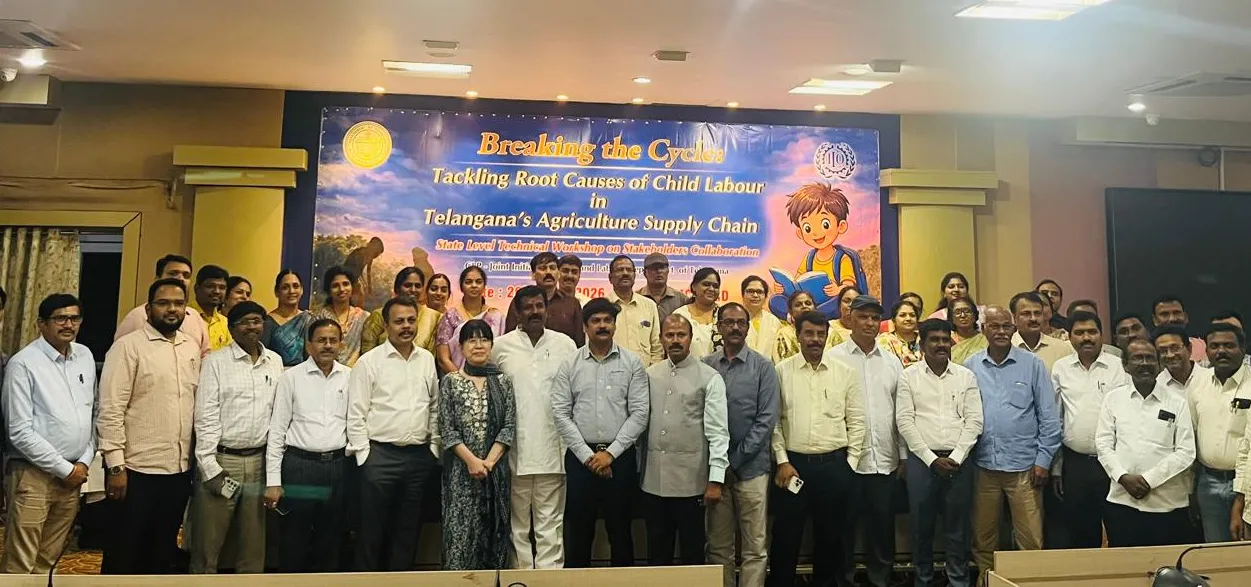
Hyderabad (ILO News) – A collaborative approach is necessary to address the root causes of child labour in cotton and spices-related farm activities in Telangana’s agriculture sector according to participants at a state-level technical workshop supported by the International Labour Organization (ILO) held in Hyderabad on 26 March 2026.
Titled “Breaking the Cycle: Tackling Root Causes of Child Labour in Telangana’s Agriculture Supply Chain - Multi-Stakeholder Collaboration,” the workshop was jointly organized by the ILO and the Labour Department, Government of Telangana.
It brought together representatives from key government departments, including Labour, Agriculture, Rural Development, Police, Women and Child Development, Education, and Revenue, whose active collaboration and support are essential for coordinated action to address the vulnerabilities of families and their children.
Speaking at the event, Special Labour Commissioner of Telangana, Pamela Satpathy, emphasised the importance of integrating state, district, and grassroots-level institutions. She noted the ILO’s strategy of a holistic area-based approach as a “very timely and relevant” strategy for achieving sustainable systemic results and inclusion in the government’s policy.
The technical provisions of ILO’s Conventions, national laws and businesses' responsibilities on addressing child labour issues, as well as nuances of integrating the key pillars of decent work to address child labour vulnerabilities holistically in the supply chain of the agriculture sector, were central to the full-day discussion.
Discussion also took place regarding the Child Labour Platform Implementation Action Plan, and the need to prioritise migrants, child labour hotspots, prevention strategy, businesses' involvement and effective due diligence, as well as workers’ voice, as part of a comprehensive ground level response to address child labour.
ILO Country Director for India, Michiko Miyamoto, underscored the critical role of responsible business practices and shared responsibility in addressing the root causes of child labour in the agriculture sector’s supply chains, especially when the majority of 138 million child labour still engaged in the agriculture sector worldwide.
“Decent work for adults, social protection for both adults and children – including migrants – as well as quality education for children, fair recruitment practices and responsible business conduct are essential to breaking the cycle of child labour,” added Ms Miyamoto.
For further details, please contact:
Mr Ranjit Prakash
National Project Coordinator, Child Labour Platform(CLP)
ILO DWT for South Asia and Country Office for India
T:+91 11 47509264
Related content
Child Labour
Child Labour Platform (CLP)- India