

Mozambique advances tripartite understanding of the SSE with ILO support
The ILO led an induction session for Mozambique’s Labour Consultative Commission to build shared tripartite understanding of the social and solidarity economy and support discussions toward a national social and solidarity economy strategy.
8 December 2025
MAPUTO, Mozambique (ILO News) – Members of Mozambique’s Labour Consultative Commission (CCT) took part in an induction and learning session on the social and solidarity economy (SSE) led by the ILO in Maputo on 8 December 2025, aimed at advancing a shared understanding of the concept and its relevance to labour policy and social dialogue.
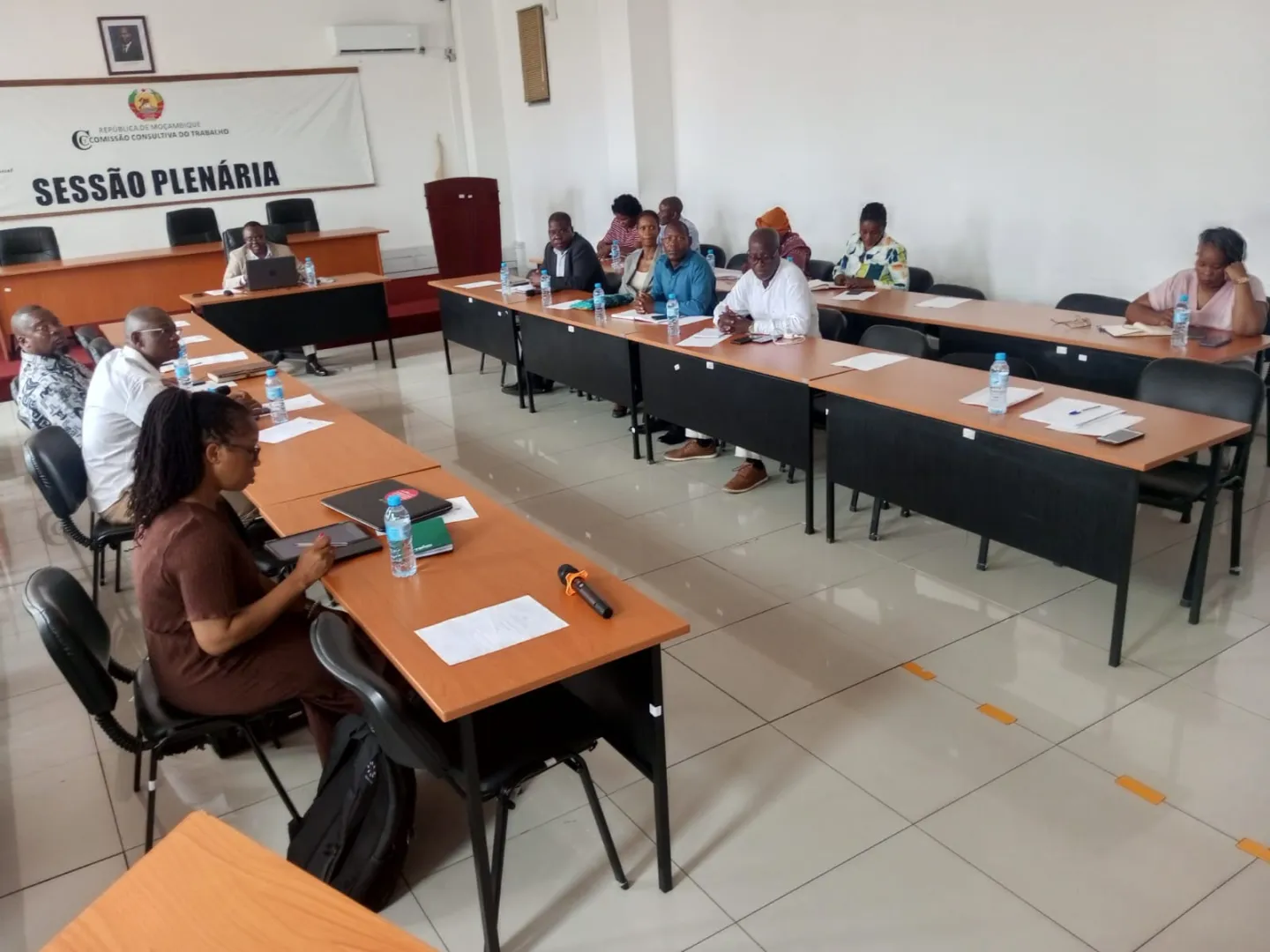
Held under the CCT – the country’s formal tripartite platform for dialogue on labour and social policy including representatives from the Ministry of Labour, Gender and Social Action, Workers’ organization of Mozambique (OTM) and the National Confederation of Independent and Free Trade Unions of Mozambique (CONSILMO) – the session brought together representatives of government, employers’ and workers’ organizations. It responded to constituents’ request for conceptual clarification and practical orientation on the SSE, as discussions advance on the possible development of a national strategy in this area. The learning session builds on earlier national policy dialogue initiatives, including a workshop held in May 2025 that first introduced the SSE as a potential lever for employment creation, inclusion and local development in Mozambique. By situating the discussion within the CCT, the induction marked an important step in embedding SSE considerations within established tripartite governance mechanisms.
The social and solidarity economy is extremely important in a context like our country's, since its entities are instruments for promoting employment opportunities and mobilizing and organizing society to promote social justice. Cooperatives are a pillar in strengthening the value chains of various agricultural subsectors. It is, therefore, important that the government, with the assistance of its cooperation partners, supports the development of a Strategy or a Policy for the promotion of the Social and Solidarity Economy in Mozambique in order to institutionalize the concept and create a legal framework for its promotion. João Motim, Secretary General of the Labour Advisory Commission (CCT),Ministry of Labour, Gender and Social Affairs.
The session included a technical presentation by the ILO introducing its definition and approach to the social and solidarity economy, grounded in international labour standards and recent global policy frameworks. The presentation highlighted the diversity of SSE entities and their potential contributions to decent work, social justice and sustainable livelihoods.
Natalie Laechelt, Technical Officer in the ILO’s Cooperative, Social and Solidarity Economy Unit, underscored that the SSE can support formalization, expand care services and contribute to a just transition towards environmentally sustainable economies. She stressed the need for a conducive environment for the SSE including coherent policy and institutional frameworks developed through social dialogue. She shared examples of SSE policy development processes from other countries, with technical support from the ILO, underlining the importance of participatory policy development.
The exchanges during the session reflected strong interest from CCT members in how SSE approaches could be applied in priority sectors such as agriculture, rural employment and care work, particularly in the context of ongoing efforts to strengthen regulation on rural and domestic labour and for different types of SSE entities, including associations. Participants also raised questions related to access to technical assistance and financing for SSE entities, as well as the role of capacity development tools in strengthening governance and sustainability.
Mozambique is advancing the social and solidarity economy as an agenda of the African Union’s ten-year SSE strategy (2023-2033). The ILO is pleased to be part of this process by providing technical assistance to the Government and the social partners in setting up strategic frameworks to achieve the operationalization of the SSE in Mozambique through the support from the ILO Cooperative, Social and Solidarity Economy unit. Paulo Romao, National Project Coordinator of the ILO.
The session concluded with an agreement that further learning and dialogue on the SSE will continue within the CCT, with the objective of consolidating a common tripartite understanding and defining next steps. The SSE was identified as a priority area for 2026, laying the groundwork for future technical cooperation and the elaboration of a National Strategy on the Social and Solidarity Economy.
Related content

ILO Guidance and resources
The social and solidarity economy: Law and policy