

The Ministry of Labour and the ILO Spotlight Decent Work and Corporate Sustainability at the Qatar CSR Summit 2025
Joint workshop delivers tools and dialogue to embed decent work and sustainability into core business strategies.
13 May 2025
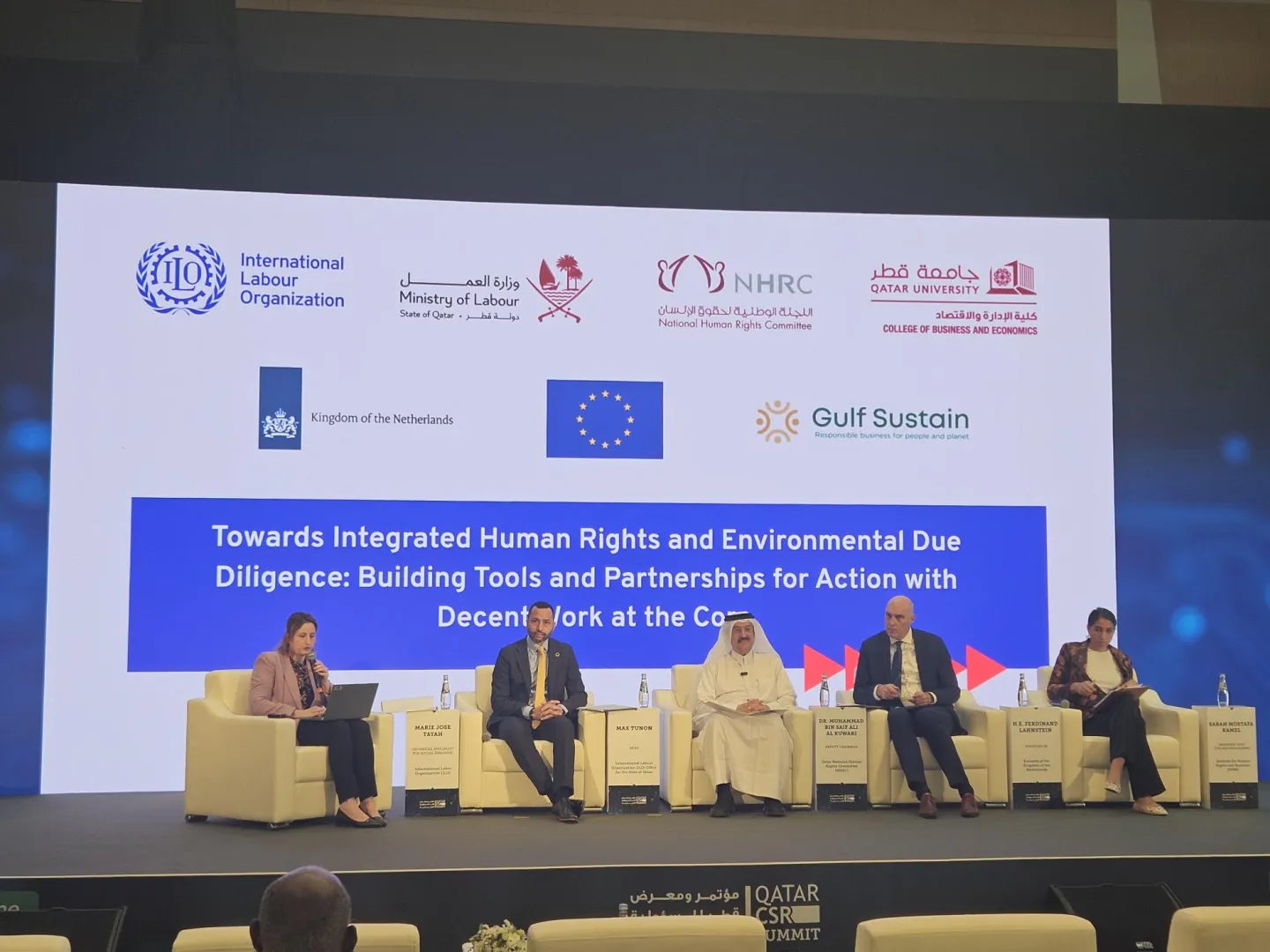
DOHA (ILO News) - The Ministry of Labour and the International Labour Organization (ILO) led a dynamic three-day workshop on “Maximizing Decent Work in Sustainability Strategies: From Planning to Impact” at the Qatar Corporate Social Responsibility (CSR) Summit that took place in Doha from 28–30 April. The workshop was held in close collaboration with the Delegation of the European Union to Qatar, Qatar University’s College of Business and Economics, Qatar’s National Human Rights Committee (NHRC), the Embassy of the Kingdom of the Netherlands to Qatar and the Institute for Human Rights and Business' Gulf Sustain Initiative.
Workshop sessions gathered top local and international voices from universities, industry, business development service providers and NGOs to share their expertise and experiences on the evolving regulatory landscape around corporate sustainability efforts.
In his keynote address, H.E. Cristian Tudor, the Ambassador of the European Union to Qatar, emphasized: “Across the world, we are witnessing how environmental degradation, supply chain vulnerability, and human rights issues are not isolated problems—they are deeply interconnected. In an era of heightened public expectations, evolving regulation, and rapid environmental change, businesses can no longer treat sustainability and human rights as external to their core operations. They are now becoming essential to competitiveness, resilience, and long-term success.”
H.E. Dr Muhammad bin Saif Al Kuwari, Deputy Chairman of the NHRC, presented his working paper on “The Role of the National Human Rights Committee in Advancing and Enhancing Environmental Sustainability,” where he stated: “There must be clarity on international recognition of the right to a clean, healthy, and sustainable environment in terms of the content and scope of the right, so that it does not remain dependent on non-legally binding guidelines and recommendations.”
The Director of Labour Relations at the Ministry of Labour, Abdallah Al-Doseri, also addressed the workshop and highlighted the need for regular and constructive dialogue at the enterprise level via joint labour-management committees to strengthen grievance mechanisms and ground sustainable principles in real-world practices.
ILO Technical Specialist for Social Dialogue, Marie-Jose Tayah, noted: “For the ILO, the Qatar CSR Summit has become a key platform for fostering collaboration and providing practical tools to help build a sustainable business ecosystem rooted in responsible conduct across government, academia, business development service providers, and the private sector.”
A high-level panel wrapped up the workshops with interventions from Mr. Max Tuñón, Head of the ILO Project Office in the State of Qatar, H.E. Ferdinand Lahnstein, Ambassador of the Kingdom of the Netherlands to Qatar, and Dr. Al Kuwari and Sarah Mostafa-Kamel from the Gulf Sustain Initiative. The panel relayed the key learnings of the three-day workshop to the wider audience of the Summit.
This workshop builds on the momentum from the Ministry of Labour and the ILO’s interventions in last year’s CSR Summit on decent work in the circular economy and sustainable supply chains. On the heels of this Summit, the Ministry and the ILO have rolled out free online resources including a Masterclass on sustainability and the circular economy in Qatar and a comprehensive teaching package on decent work in sustainable supply chain management for business schools in collaboration with the MENA Business Schools’ Alliance for Sustainability (MEBAS).