Advancing social justice, promoting decent work
ILO is a specialized agency of the United Nations
English
Making the most of remote work requires focus on the human dimension, says ILO
It is our collective responsibility to make the most of the opportunities created by remote working, while keeping our focus on the human dimension, the ILO Director-General has said at a High-level Conference on the Future of Work, organized by the Portuguese Presidency of the Council of the EU.
The ILO participated in a High-level Conference on the Future of Work entitled: “Remote work: challenges, risks and opportunities”, organized by the Portuguese Presidency of the Council of the EU.
In his opening address, the ILO Director-General congratulated the European Commission on its Action Plan on the European Pillar of Social Rights and welcomed the targets it establishes for 2030. The Action Plan encourages the social partners to work together to explore the measures needed to ensure fair telework conditions, and to ensure that all workers can effectively enjoy their right to disconnect.
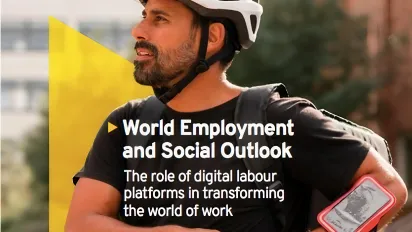
He pointed to the growth of remote work that has been made possible by digital platforms. According to the World Employment and Social Outlook 2021, the use of digital labour platforms has increased five-fold worldwide in the last ten years, and this figure does not include the massive growth that happened during the COVID-19 crisis. In the European Union, around 11 per cent of the workforce has already done work using digital platforms.
“Unsurprisingly, the type of remote work that saw the greatest increase during the pandemic was among workers who used to commute to an office and who shifted to working from home,” said Mr Ryder. “Clearly, telework has been a significant trend and many aspects of it will certainly stay with us after the pandemic as well.”
A recent Eurofound survey shows how widespread telework became in the EU during the pandemic: 34 per cent of employees surveyed were teleworking full-time, and almost half part-time.
“Remote work and telework can offer exciting opportunities - such as greater autonomy for workers in organizing their tasks, greater inclusion – allowing people with disabilities or other barriers to find work, and a better work-life balance – at least potentially. Certainly not automatically. And, of course, environmental gains - for example, the reduction in CO2 emissions from commuting. But we also see disadvantages,” said the Director-General.
These include the blurring of boundaries between work and private life, with workers expected to be constantly available. Digital labour platforms bring their own challenges. Many platform workers are classified as self-employed. This means that they lack the protection of labour and social security laws, including fundamental rights such as freedom of association and collective bargaining. They often have long and unpredictable working hours, unsafe work, and low pay.
Algorithms are increasingly replacing humans in allocating and evaluating work, and administering and monitoring workers. This raises many issues, including those of ethics and privacy.
“These issues need to be addressed, and soon,” said Mr Ryder. “It is more important than ever that, as we shape our path out of the pandemic, we put people front and centre. This is the human-centered approach to the world of work outlined in the ILO’s Centenary Declaration.”
Several EU Member States have made good progress on telework. Portugal has pioneered teleworking legislation and is currently drafting a Green Book on the Future of Work. Belgium and Luxembourg recently adopted collective labour agreements for teleworking.
The ILO Director-General also welcomed several EU initiatives, including the Social partners framework agreement on digitalization, and the European Parliament’s Resolution on the Right to Disconnect. Just last month, the Commission launched a social partner consultation process as part of a new initiative on improving the working conditions of platform workers.
The European Pillar of Social Rights’ Action Plan provides guidance, as do the Sustainable Development Goals, in particular Goal 8 on Decent Work.
“So there are many opportunities for the ILO and the EU to work together to ensure we get the best out of the growth in digital working, and I look forward to making the most of these,” he concluded.