


C169
Latin American governments strengthen public action to advance Indigenous Peoples' rights
Representatives from eight Latin American countries identified priorities to strengthen public institutions, consultation mechanisms and regional cooperation to support the implementation of the ILO Indigenous and Tribal Peoples Convention, 1989 (No. 169).
8 July 2026
LIMA (ILO News) – Government representatives from eight Latin American countries concluded a technical meeting organized by the International Labour Organization (ILO) with a renewed commitment to strengthen public action to advance the rights of Indigenous Peoples. Participants called for stronger public institutions, more effective consultation and participation mechanisms, and enhanced regional cooperation to support implementation of the Indigenous and Tribal Peoples Convention, 1989 (No. 169). The meeting identified priority areas that will guide future ILO technical assistance to promote more effective implementation of the Convention.
Held on 7–8 July 2026 at the ILO Regional Office for Latin America and the Caribbean, the meeting brought together representatives from Argentina, Bolivia, Brazil, Chile, Ecuador, Guatemala and Peru to exchange experiences on implementing Convention No. 169, the only legally binding international treaty specifically dedicated to the rights of Indigenous and tribal peoples. Representatives of employers' and workers' organizations, specialized agencies and international cooperation partners also participated as part of the partnership between the ILO and the Spanish Agency for International Development Cooperation (AECID).
Opening the meeting, Fabio Bertranou, ILO Deputy Regional Director for Latin America and the Caribbean, highlighted that Convention No. 169 provides an important framework for addressing today's challenges related to social justice, sustainable development and decent work, while fostering dialogue and solutions tailored to different national contexts.
"The Convention provides a solid framework for addressing both longstanding and emerging challenges related to peacebuilding, social justice, human rights and the rule of law, access to decent work for all, sustainable development, and advancing a just transition," Bertranou said.
Participants shared experiences on strengthening institutions responsible for Indigenous Peoples' policies, improving consultation and participation mechanisms, enhancing coordination across public institutions, and addressing implementation challenges in sectors such as mining, energy and infrastructure. While recognizing that institutional arrangements vary across countries, participants agreed that they face many common challenges and can benefit from greater regional cooperation and knowledge sharing.
"The region is exploring new approaches to implementing Convention No. 169. We are seeing progress in the development of permanent participation mechanisms, as well as national policies and development plans for Indigenous Peoples. In this context, it is essential to strengthen the professional capacity of public administrations through a rights-based approach," said Hernán Coronado, ILO Indigenous Peoples Specialist for Latin America and the Caribbean.
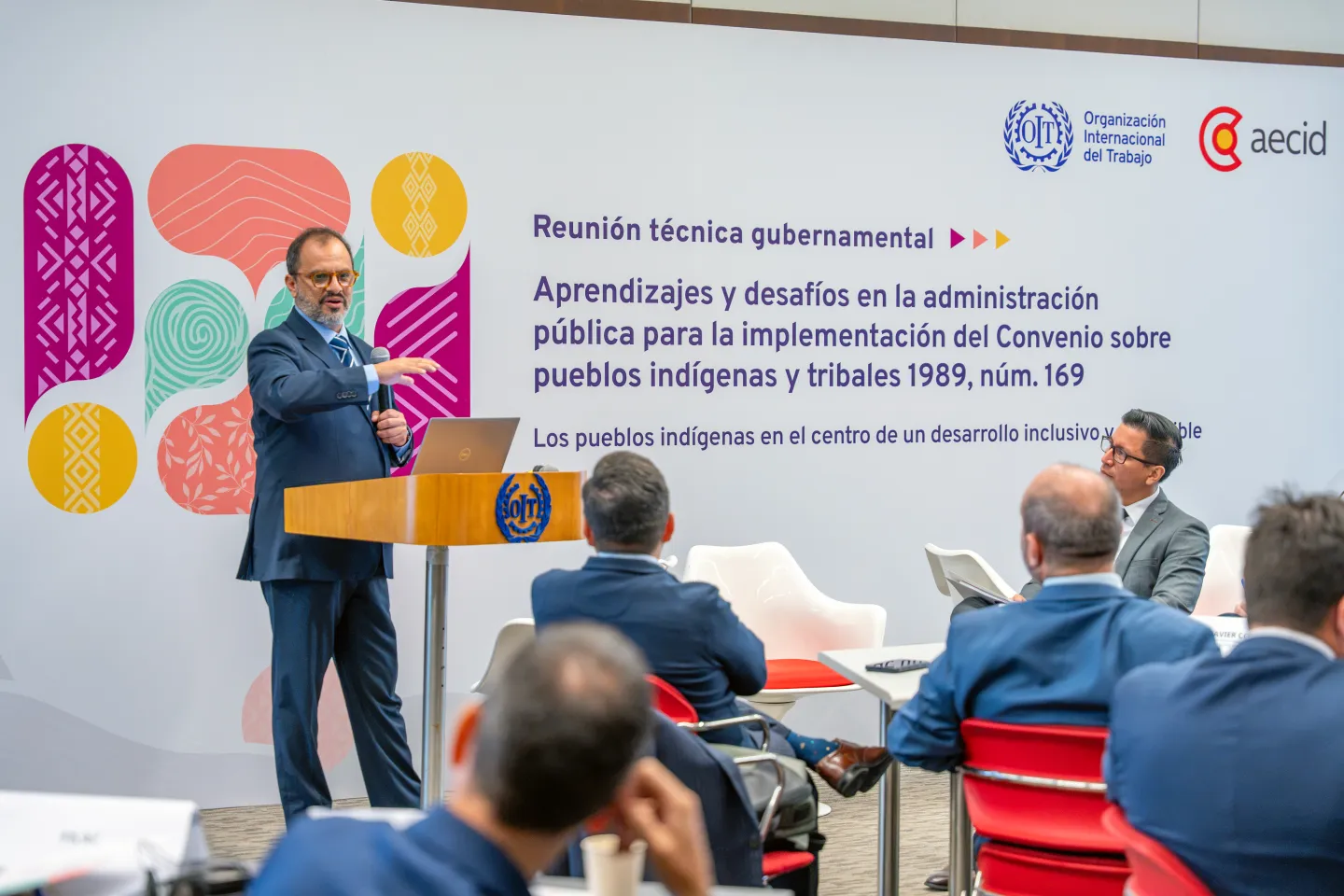
Among the meeting's main conclusions was the need to strengthen the technical capacities of public institutions, consolidate consultation mechanisms that reflect the region's territorial and cultural diversity, improve coordination across public institutions, and mainstream the rights of Indigenous Peoples across public policies. Participants also underscored that effective implementation of the Convention not only helps ensure rights but also contributes to preventing conflicts, strengthening legal certainty and promoting more inclusive and sustainable development.
The meeting also reaffirmed the value of South-South cooperation and peer learning among public administrations as important tools for accelerating implementation of the Convention and strengthening States' capacity to respond to current challenges. The priorities identified will help guide future ILO technical cooperation initiatives across the region.
Closing the meeting, Bertranou reiterated the Organization's commitment to continue supporting Member States in the effective implementation of Convention No. 169.
Convention No. 169 is a living instrument. The regular review and evaluation of the measures adopted, together with the lessons learned from their implementation, support a continuous process of learning and improvement
Fabio Bertranou, ILO Deputy Regional Director for Latin America and the Caribbean
"The Convention is a living instrument. The regular review and evaluation of the measures adopted, together with the lessons learned from their implementation, support a continuous process of learning and improvement," Bertranou said. "The ILO remains, and will continue to remain, committed to providing technical assistance and support for Convention No. 169, fully aware of its responsibility as the Organization that is its custodian."
The meeting's conclusions will be used to strengthen knowledge-sharing among countries and to guide future ILO technical cooperation initiatives, with the aim of supporting increasingly effective implementation of the Indigenous and Tribal Peoples Convention, 1989 (No. 169), and advancing more inclusive, democratic and equitable societies.
Video highlights
Related content
Topic portal
Indigenous and tribal peoples