

Forced labour
Kidnapped: the forgotten history of children of war in Peru
Indigenous girls and boys who disappeared during the most violent phase of Peru's internal armed conflict ended up in the hands of the military, who subjected them to servitude in their homes and, in some cases, changed their identities. Four decades later, this investigation by OjoPúblico and Connectas exposes the forgotten history of a country that has yet to investigate these abuses against minors.
7 July 2024
This report was produced by Elena Miranda as part of the 2nd edition of the practical workshop 'Reporting on Forced Labour and Other Forms of Slavery', organized by the ILO through the BRIDGE Project in Peru. The report was published on the Connectas and OjoPúblico platforms. The ILO was not involved in the creation, development, fact-checking, or evaluation of this journalistic piece. The opinions, conclusions, and statements expressed are the sole responsibility of the authors and do not necessarily reflect the views, positions, or policies of the ILO.
For nearly 18 years, Lucio and Claudia Orihuela were on the list of people who disappeared during Peru's internal armed conflict. The siblings were taken from their indigenous community by members of the Armed Forces in 1986. The 10-year-old boy was raised by a military nurse, whom he still calls "daddy"; the 13-year-old girl was forced by a Peruvian Army colonel to be his daughters' "nanny" until she was able to escape.
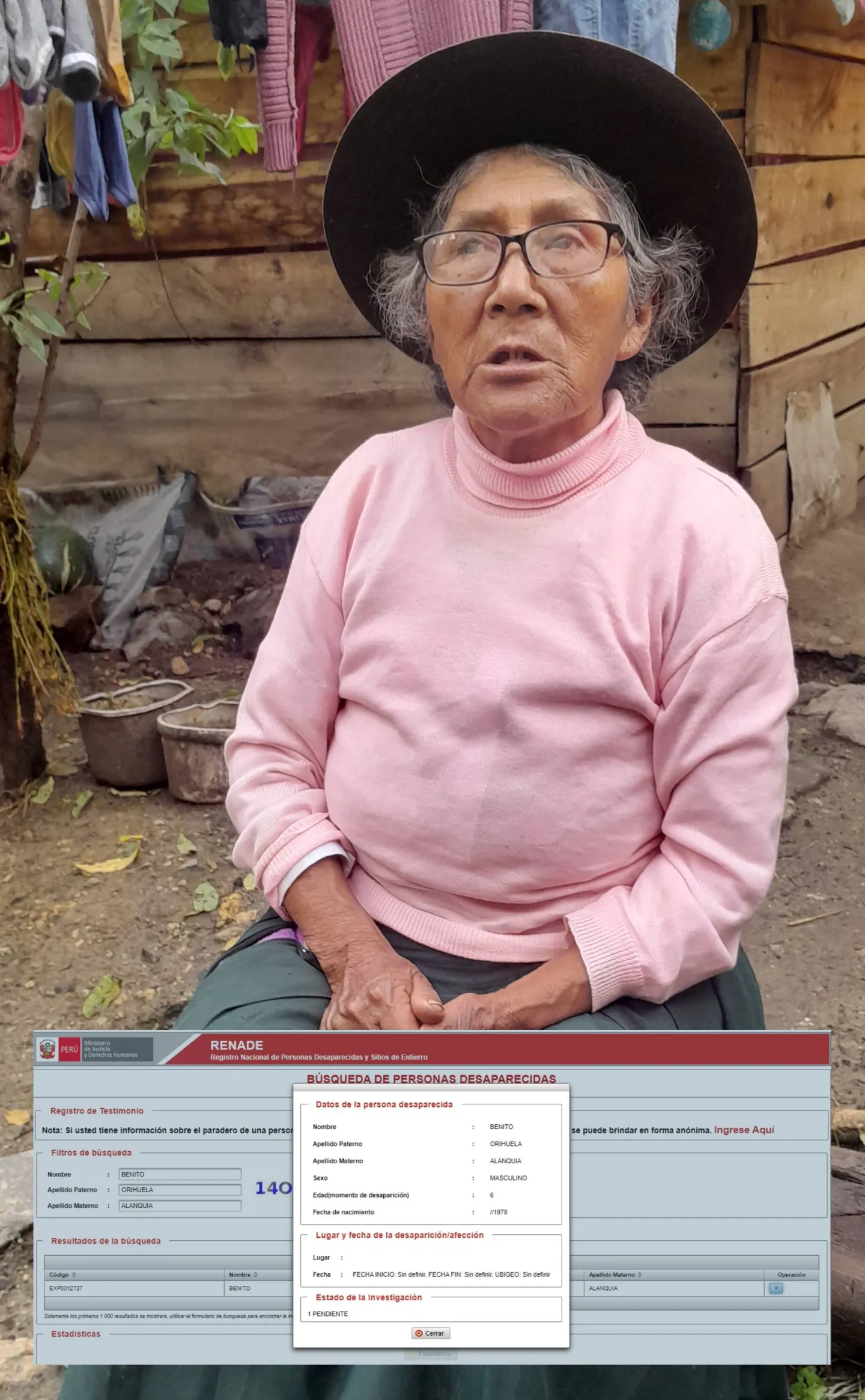
In 2004, Lucio and Claudia were reunited with their parents and siblings, whom they thought were dead. They had a history of family and cultural uprooting, as well as abuse and mistreatment. Their mother, Facunda Alanguia, recovered two of her children, but her suffering persists. She is missing another one: Benito, who disappeared at the same time, when he was six years old.
The woman has been asking for Benito for four decades. She does not lose hope of finding him alive, with another identity. She suspects that the military also took him, but she believes that, because he was so young, he does not remember his real family and cannot search for them, as his older brothers did.
Like Lucio and Claudia, other Quechua-speaking children were taken from indigenous communities in Ayacucho, the region that concentrates almost half of the dead and disappeared victims of the Shining Path and Tupac Amaru Revolutionary Movement (MRTA) terrorist groups, the Armed Forces and police, and the self-defense committees, according to the Final Report of the Truth and Reconciliation Commission.
OjoPúblico and Connectas identified and reconstructed the stories of 11 child victims of these abductions. For several years, they were on lists of missing persons. Based on their testimonies, it was identified that the fate of the girls was unpaid domestic work in the homes of military personnel or civilians who requested this type of servitude; and that of the boys was raising them in the homes of military personnel or civilians after convincing them that they would be treated as if they were their children.
As happened in Argentina, where the military stole the babies of women detained and disappeared during the last dictatorship four decades ago, in Peru members of the Armed Forces appropriated an undetermined number of children from peasant communities located in the high Andean zones and the jungle during the internal armed conflict.
These cases were never investigated by the Peruvian justice system, despite the fact that forced disappearance and slavery are considered crimes against humanity, according to the Rome Statute of the International Criminal Court, and are not subject to any statute of limitations. The victims, now adults, have not obtained justice or reparations. The perpetrators live in anonymity and impunity.
"A colonel forced her to work as the ‘nanny’ for his daughters until she escaped from his home, located inside a military barracks.
The testimonies of adults collected for this investigation state that the military took them when they were children to raise them as their own children or to do domestic work in their homes and those of their relatives or acquaintances. They were also given to other families who needed help with their crops or livestock.
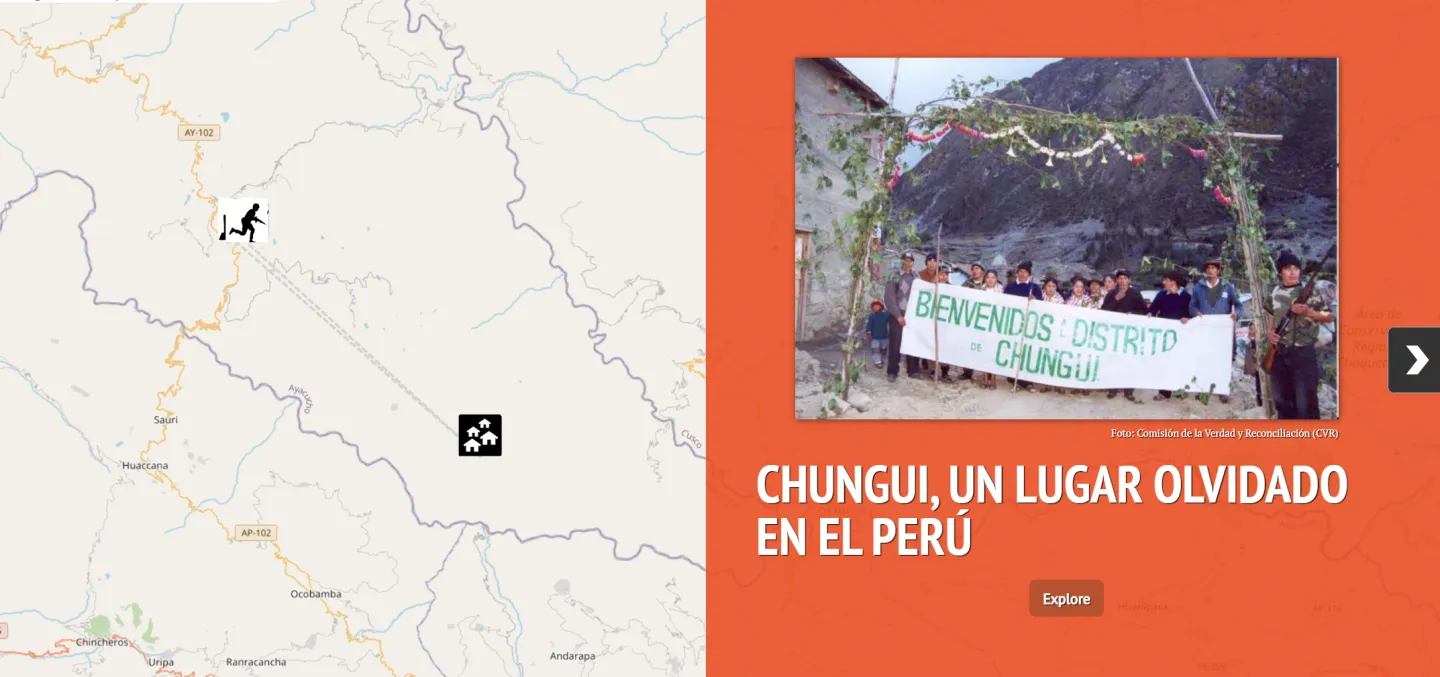
Interviewees have given names and clues to more children who suffered the same horrors, but whose fate they do not know. Most of the victims identified here were taken from peasant communities located in Chungui, a difficult-to-access district between the highlands and the jungle of Ayacucho, in southern Peru.
Three missing siblings
In 1986, the family of Facunda Alanguia and Emiliano Orihuela lived in the peasant community of Oronccoy, in Chungui, Ayacucho. Faced with armed attacks by terrorists, military and civilians, they took refuge in the bush, as they called the jungle.
At different times, Claudia, 13, and Lucio, 10, were illegally detained and taken by Armed Forces agents from the bush to the military base located in the community of Mollebamba, along with other minors and adults. Neither of them spoke Spanish. Weeks later, the children were taken from these facilities by members of the Army stationed there. This is what they told for this investigation, as they did before commissioners from the Ombudsman's Office in 2004.
Lucio was taken by a military nurse who served at the Mollebamba base between January and March 1986. The non-commissioned officer offered to raise him with his family, who lived in the city of Puno, more than 900 kilometers away, so that he would not continue to suffer the mistreatment of some uniformed personnel and would not be a military target of the terrorists for living in the barracks. The boy accepted, as he was told that if his parents were alive, they would have looked for him by now.
Both Facunda, the mother, and her two reappeared sons gave their testimony for this report. "Lucio disappeared when he went to pick cassava in the bush and found with an Army patrol. Claudia was taken by the military after they captured us and took us to the Mollebamba base," says Facunda.
"It was difficult to be at the Army base because we had to be hiding during the day. We only came out at noon to have lunch. The rest of the day we were hidden on the roof of the pavilions, because it was forbidden for children to be there," recalls Lucio.
Already taken in by the military nurse's family, Lucio was registered under another name: Luis Alberto, and with the surnames of the Peruvian Army non-commissioned officer Victor David Loayza Meza and his wife, Professor Juana Rukoba Nadier Alvarez.
The victims, now adults, have not received justice or reparation. The perpetrators continue to live under the protection of anonymity and impunity.
Unlike the children of the military, at the age of 13, Lucio went to school at night and, during the day, he sold candy on the street. Those were the days when the family moved to Lima, between 1989 and 1992. Why did he work? "I'm not a son. I had to work because I had to contribute to the family," he answers.
No matter how hard he worked, Lucio could not pay for college. It was only enough to pay for a technical career in electricity. His five adopted siblings, on the other hand, did have access to a university education. Two are engineers and three are lawyers. Four of them hold high positions in the public sector, such as Cintia Loayza, current mayor of the Lima district of Surquillo for the Renovación Popular party, led by the mayor of Lima, Rafael López Aliaga.
Lucio's older sister, Claudia, was also taken by a soldier. But, in her case, under threat of death, taking advantage of the fact that she had been separated from her mother at the Mollebamba base. The colonel forced her to work as a nanny for her two daughters in his house, located inside barracks No. 51 Domingo Ayarza, known as Los Cabitos, in the city of Huamanga, Ayacucho. She suffered so much mistreatment that one day she decided to escape.
It’s just that I wasn’t a child. I had to work because I had to contribute to the family."
"When they took me from Mollebamba, they took me by helicopter to Ayacucho. A colonel took me. If you don't go with me," he said, threatening us, "we are going to kill you," recalled Claudia, who said that the soldier and his family insisted that she learn to speak Spanish on her own and forced her to work until after 10 p.m. Her hands cracked and bled from washing clothes. Her hands cracked and bled from washing clothes. The name of the officer who abducted her is not published here at Claudia's request, to avoid reprisals from him or his family.
Claudia and Lucio met again 18 years later, in 2004. He had a different name and a stubbornness motivated by memories of his family, which led him to search for his sister and parents with the help of the Ombudsman's Office. Today, Lucio is 47 years old, lives in Lima and works in the service sector. Claudia is 50 years old, lives in Arequipa and works in the agro-industrial sector.
Military nurse Victor Loayza Meza, who raised Lucio, retired from the Army in 2003 after 22 years of service. Consulted for this investigation, he said he could not speak because he was in the process of rehabilitation from surgery. "I would be grateful if you could guide your investigation with the main character of the event, Luis Alberto or Lucio, who is an older person, no longer a child, and, at present, is a good citizen, with all his faculties and rights in force," wrote the ex-military officer in a text message.


Girls: domestic workers
The Peruvian Truth and Reconciliation Commission published in its Final Report in 2003 that "children constituted only 12.8% of the total cases of human rights violations" between 1980 and 2000. It recorded 2,952 cases of crimes and violations that violated the rights of children, committed by State agents, members of the self-defense committees, the Shining Path and the Tupac Amaru Revolutionary Movement (MRTA).
Given these figures, the Commission considered that there was no systematic or generalized policy of terrorists, military, police and civilians aimed at attacking minors. It did not delve into the investigations of these cases.
However, as part of their work, the commissioners collected stories of citizens who, during their childhood, in the 1980s "were handed over to various families as employees and who continue to search for their relatives," according to the Commission's Final Report, published in 2003.
Today, official figures reveal that the universe of minors affected during the two decades of violence was larger than initially estimated by the Truth Commission and government authorities: 47,767 children and adolescents are included in the Unified Registry of Victims of the Violence that occurred between May 1980 and November 2000. This list was created in 2005 and is in charge of the Reparations Council of the Ministry of Justice and Human Rights.
The minors are listed as affected by "deaths", forced disappearances, rape, kidnapping, arbitrary detentions, torture, among other human rights violations. They themselves were entered in the registry when they became adults or were listed by their relatives, in the case of those who did not survive or whose whereabouts are still unknown.
In addition to these figures, there are 47,716 orphans between the ages of 0 and 17 left by the conflict, according to information provided by the Ministry of Justice for this investigation. Some of them are also registered in the Unified Registry of Victims. Their parents were killed or disappeared by terrorists, agents of the Armed Forces and police or civilians who were members of self-defense committees.
The Final Report of the Truth Commission refers particularly to the situation of children in Chungui and points out that, once "recovered" by the Army agents, they were offered and distributed to families in the district. "In some places, children were trafficked and used as servants," the document states.
The minors were affected by extrajudicial executions, enforced disappearances, and abductions, among other human rights violations.".
A testimony contained in this report, given by a woman, states: "When I arrived here, at the Chungui base, Mrs. Emilia took me away. When we were at the base they offered the villagers who wanted to take one of us". A similar statement from another woman reinforces this version of how the members of the Army acted with the minors: "The military had said that there were several children at the base and that if they wanted to, they could take us out (...). He took me out so that I could help him in his work".
For more than 20 years, sociologist Sofia Macher, former executive secretary of the National Human Rights Coordinating Committee (which brings together several non-governmental organizations) and former member of the Truth Commission, has insisted that it was common practice for the military to take girls home as domestic servants and that numerous orphans were taken from their communities in this way.
"We have been finding testimonies of girls and boys who ended up in the barracks and, once there, the military distributed them among their relatives. They brought them to Lima and distributed them in the houses. And there is no record of that," the former commissioner told OjoPúblico and Connectas.
Macher recalls a conversation he had with a military chief in a declared emergency zone, to whom he asked why they were taking the girls as employees, without any documentation or registration. His response was that they were doing it to "save them" because they were more at risk in the barracks.
The story of Silvia Flores Zevallos was rescued from oblivion by the former commissioner, who was one of the editors of a book, published in 2023 by the Ministry of Culture, on the occasion of the 20th anniversary of the delivery of the Final Report of the Truth Commission. In 2002, Silvia gave her testimony at a public hearing organized by this commission, but, as she spoke in Quechua, her denunciation went almost unnoticed.
Today, Silvia lives on the outskirts of Lima. OjoPúblico and Connectas spoke with her. She said that when she was nine years old, in 1984, she was detained by the military along with her sister Celestina in the peasant community of Chapi, in Chungui. Both were taken in a helicopter to a nearby military base, like other indigenous girls separated from their parents after operations carried out by the Army or who were orphaned because their families were killed.
"In the Ayacucho barracks we lived in one room. I don't know how long [we stayed]. From there they took me to a house. We were three girls who were taken to a private house. From there, one by one, they made us disappear. I was the last one. The military came and took us away," Silvia recounted.
Days later, an Army commander, whose name she does not remember, put her on a plane and took her to Lima to take care of her mother. The old woman forced the girl to sleep with the dogs in a courtyard of her well-to-do home and blamed her for the fact that her son had to work far away. She also threatened her life and would not let her leave the house. "He hit me hard. He never called me by my name. He only said that I was a 'terruquita'," she recalls, referring to the term used by the military to derogatorily call terrorists.
Silvia recalls that one day, when she was 12 years old, the woman pushed her from the second floor of the house and when she fell, she dislocated her hip. In the interview for this report she gave details about this incident that she could not tell in her brief participation in the Truth Commission hearing, where she did not specify the reasons for her fall.
Hearing her cries and screams of pain, a young man who lived in a neighboring house slid a ladder into the yard and rescued her. He dropped her off at a hospital as a Jane Doe, where she underwent surgery and rehabilitation for almost a year. After leaving the hospital, Silvia was adopted by a family that gave her a new identity, as she never revealed her name and surname to them, fearing that the military would locate her.
When he came of age in 1996, he returned to Ayacucho and then to Chungui, where he was reunited with his mother, Candelaria, and his siblings. His disappearance had added to the family's grief over the murder of his brothers Valerio and Saturno, his maternal grandmother, his grandfather judge, and the rape and pregnancy of his sister Celestina, crimes attributed to police, military and ronderos.
He used to beat me badly. He never called me by my name. He only said I was a ‘little terrorist’.
"They told my relatives that the military threw me out of the helicopter," says Silvia. This version was credible because, according to her, when she was being transported in this Peruvian Army aircraft, she saw how the soldiers threw the children, who were crying a lot, into the void. "Shut up, shut up," she recalls a soldier telling them, "And we kept quiet."
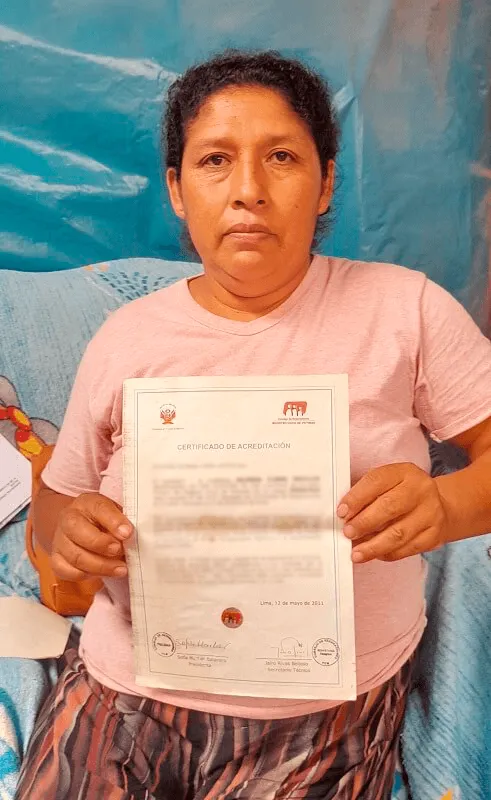
After the reunion, Silvia returned to using her real name. In 2010, she received her accreditation certificate from the Single Registry of Victims of the Ministry of Justice and Human Rights, where more than 249,535 people are registered. This allows them to exercise their rights as beneficiaries of the Comprehensive Reparations Plan. Silvia signed up as a victim of kidnapping. She received from the Peruvian government a symbolic amount of 10,000 soles (about 3,000 dollars), which she used to improve the rented house where she lived.
Silvia is a single mother. She has four children. She cannot work because she needs to have another hip operation, but she has no money for the surgery and no money for her children to study.
The orphan who became mayor
Elvin Ccaicuri was taken by the military with his family's permission when he was 12 years old and living in Chungui. José, his father and vice-president of the Civil Defense Committee of his community, and his sister, Filiberta, were killed by the military in 1985, witnesses told the Public Prosecutor's Office, which is currently investigating these crimes and those of 40 other people.
To avoid the same fate, Maria Isabel Santi, his illiterate mother, accepted an Army lieutenant's offer to take her son to Ica, a region more than 600 kilometers away, and raise him as her family.
Elvin recalls that Lieutenant Felix Neri Aguilar Reyes offered to change his name, but he refused. Soon after, he ran away from his home in the Ica city of Palpa because of the mistreatment he was receiving.
He grew up with relatives of the military, in the city of Ica, and studied at the university to become an agricultural engineer. A decade later, in 1995, he returned to Chungui, where he was reunited with his mother. Between 2015 and 2018 he was mayor of this district. Currently, he is 51 years old, lives in Ayacucho and works as a consultant in the agroservices sector.
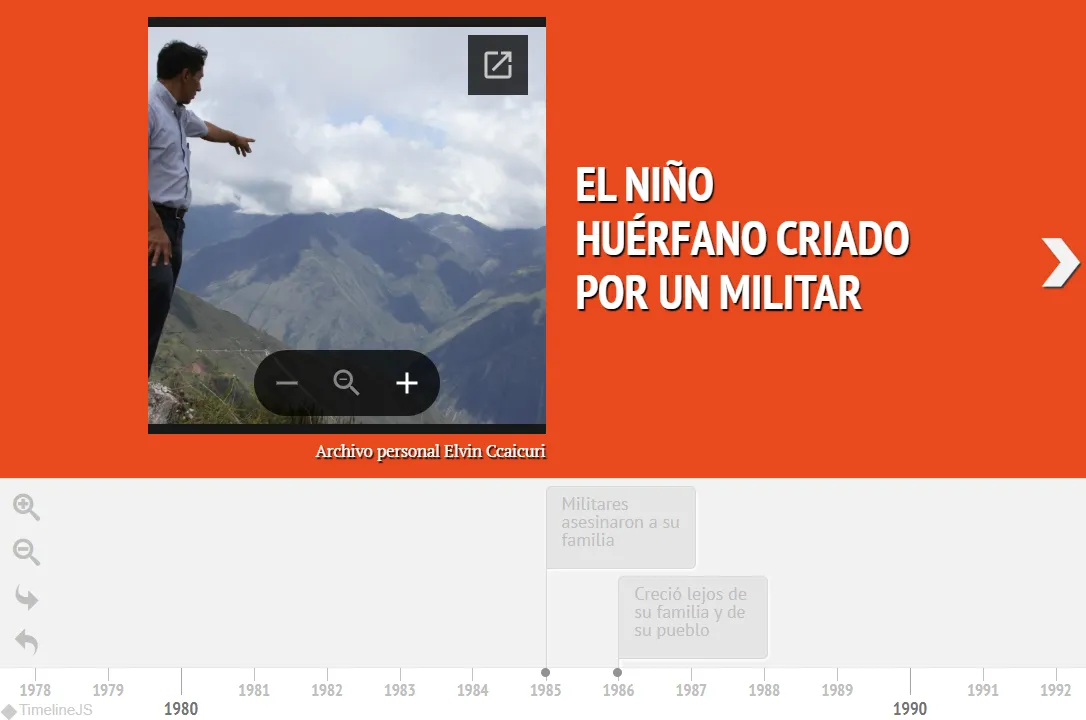
En 2011, 26 años después de los asesinatos, Elvin recuperó los restos de su padre y su hermana cuando la Fiscalía ordenó la exhumación de una fosa común en la zona de Chuschihuaycco, en Chungui, donde hallaron los cadáveres de más de 40 personas, entre los cuales había niños, ancianos y mujeres embarazadas.
In 2011, 26 years after the murders, Elvin recovered the remains of his father and sister when the Prosecutor's Office ordered the exhumation of a mass grave in the Chuschihuaycco area of Chungui, where they found the bodies of more than 40 people, including children, the elderly and pregnant women.
For these crimes, the Public Prosecutor's Office is only now investigating the alleged perpetrators. One of the soldiers under investigation is retired Brigadier General Said Amand Pinedo, known as "Major Samuray", who was assigned to Chungui between January and May 1985. Another person under investigation is retired Captain Felix Aguilar, who took Elvin. Amand could not be located to get his version of these events, while Aguilar was contacted, but did not respond to messages sent to him.
Since 2006, the Human Rights Commission (Comisedh), a non-governmental organization, has filed complaints with the Public Prosecutor's Office for the crimes that terrorists and military committed in the communities of Chungui. One of the highest-ranking defendants is the then Army Major Pedro Baca Doig, political and military chief in that district during the armed conflict. This position was created by the government in 1983, when it gave the Armed Forces control of the areas under a state of emergency.
Under the command of Pedro Baca, agents of the Armed Forces and the police carried out five operations between January 27 and May 20, 1984, which resulted in dozens of deaths and human rights violations, according to one of the criminal complaints filed by the Comisedh before the Public Prosecutor's Office. Baca and other soldiers are accused of the murder of at least 114 citizens from different communities of Chungui, whose remains were found in 50 burial sites.
"What was denounced at that time were murders or extrajudicial executions and disappearance of people. But the kidnapping or disappearance of children was not considered. There were records, but they were not understood," explains Gustavo Campos, a Comisedh lawyer.
It has been 40 years since the crimes in Chungui and 18 since the Human Rights Commission filed the first criminal complaint against the military and terrorists. The prosecutorial investigation has progressed slowly and has had more delays and problems since 2020, when the covid-19 pandemic broke out, according to a report prepared by the Comisedh.
Until his death in 2019, retired Brigadier General Pedro Baca denied the accusations of the survivors and the relatives of the victims. He claimed that he was only in charge of the military base in Chungui for one month, so he could not have committed these crimes.
However, his service record and the ratings made by his superiors about his "outstanding work", included by Comisedh in the criminal complaint, showed that he was in the military operations that resulted in the murder of civilians, according to this organization.
Reunions after several years
Orihuela is such a common surname in southern Peru, and particularly in the Ayacucho region, that 97 citizens with this surname on the paternal side and 54 on the maternal side are listed as missing in the National Registry for the Search of Missing Persons and Burial Sites (Renade). This does not mean that there are kinship ties between all of them.
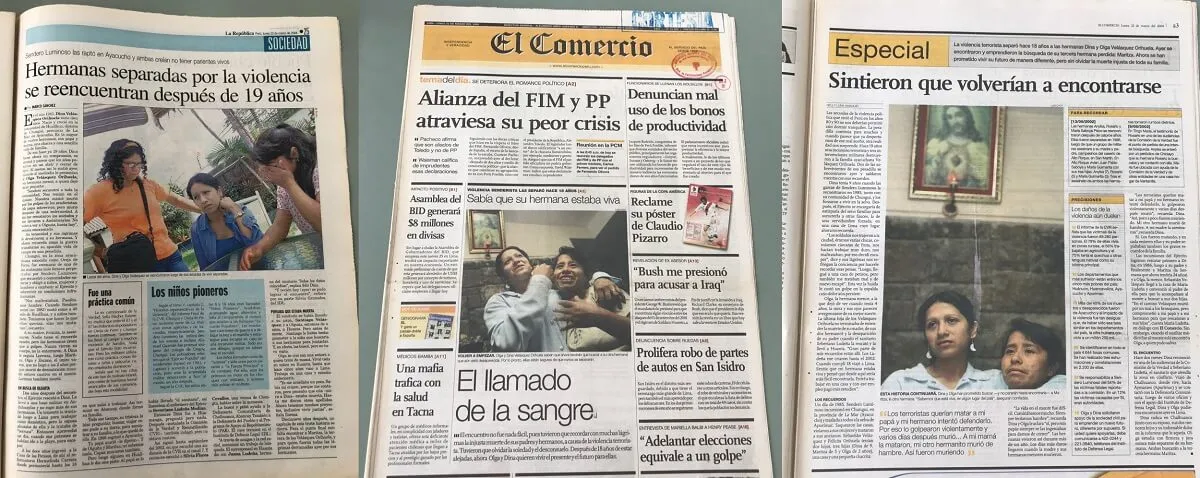
That is the case of Dina Velásquez Orihuela, who has no blood relationship with siblings Claudia and Lucio. However, her story is similar. Dina was nine years old in 1983, when terrorists forced her family to move from the community of Huallhua, in Chungui, to the Apurimac jungle. Her mother, Felicitas, was killed by her captors; her father, Santiago, died of a bronchial disease, and her two younger sisters disappeared in the jungle.
Two years later, Dina was rescued by Army agents and taken to the Andahuaylas military base. A lieutenant took her as a maid to his home in Lima. Dina recalled that the military man's wife abused her and treated her as a "terruca". She ran away one day when her employers went to the beach.
In 2004, Dina was reunited with her two sisters who had disappeared in the jungle, Olga and Maritza, after participating in the Truth Commission's public hearings and obtaining assistance from the Instituto de Defensa Legal (IDL). The reunion and the details of their disappearance were published in various media.
"Sendero [Shining Path] kidnapped the whole community. They had us in the bush. Our mother died from the Shining Path's beatings. My father survived, but died after an illness. The soldiers rescued me and took me to Andahuaylas. I never saw Olguita again, until today," Dina told journalists.
Eva Orihuela was also taken by the military when she was 13 years old, in 1983. She was taken in a helicopter to a barracks in Ayacucho along with her cousin, after her parents and neighbors in the community of Tastabamba, in Chungui, were killed by the military, according to witnesses of the crime. The soldiers also burned all the houses. Salvador, her brother, fled.
The military held her captive for two years and abandoned her in another town, whose name does not appear in the report of the Ombudsman's Office, which heard her case. She did not return to her town because she feared for her life, she told the Ombudsman's Office. Eva was on the Truth Commission's list of disappeared persons, drawn up in 2003. In 2004, 21 years after her disappearance, she was reunited with her brother Salvador.
Eva's story of reunion continued in 2021, when she recovered her nephew Carlos Lima Orihuela, who had disappeared in 1981. The boy was seven years old and fled the community of Chapi, in Chungui, after terrorists murdered his mother and younger sister, and his father disappeared. He then fell into the hands of the military.
Carlos told the Ombudsman's Office that a family asked members of the Army to give him up for adoption. For this reason, he carries the surnames of his adoptive parents, Acuña Díaz, with whom he stayed until he was 12 years old. After that, he lived in different regions, until a sister of Eva, that is, his aunt, found out about his whereabouts and asked the Ombudsman's Office for help in contacting him.
A very representative case is that of Alfredo Orihuela, who at the age of 12 saw his father, Martín, and his uncle murdered by the military in the community of Oronccoy, in Chungui, at the end of 1984. Months later, he was captured in the bush by civilians who were part of the self-defense patrols, who handed him over to the Army.
Alfredo recalled that he was taken to the counter-subversive base in Chungui, where the military tortured him for six months, without caring that he was only 12 years old. "I slept hanging, tied up, they put dynamite on my body, they lit the fuses from afar. They did a lot of things to me," he told a television station in 2004. When he was transferred to the Los Cabitos barracks in Ayacucho, he was also tortured.
Alfredo spent almost two years in the military bases, suffering torture and forced to do domestic work, until an army officer took him to Lima. Like other children who disappeared during the internal armed conflict, he did not return to his village because he believed his relatives were dead; he did not know that three of his siblings were alive. "If they weren't killed by bullets, they must have died of hunger," he told the TV station.
In 2004, with the help of the Ombudsman's Office, Alfredo saw again Sonia, Vilma and Diomedes, who had met again four years earlier and believed him to be dead, as he had been missing for 20 years.

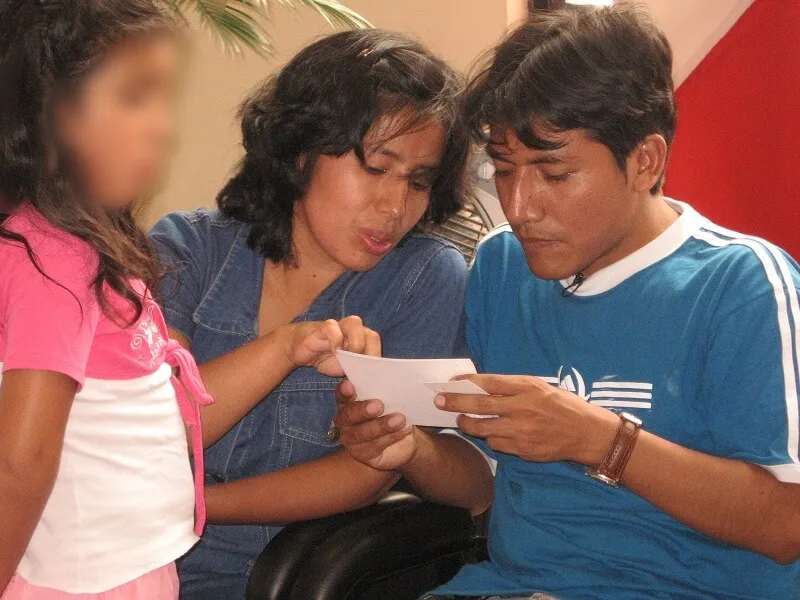
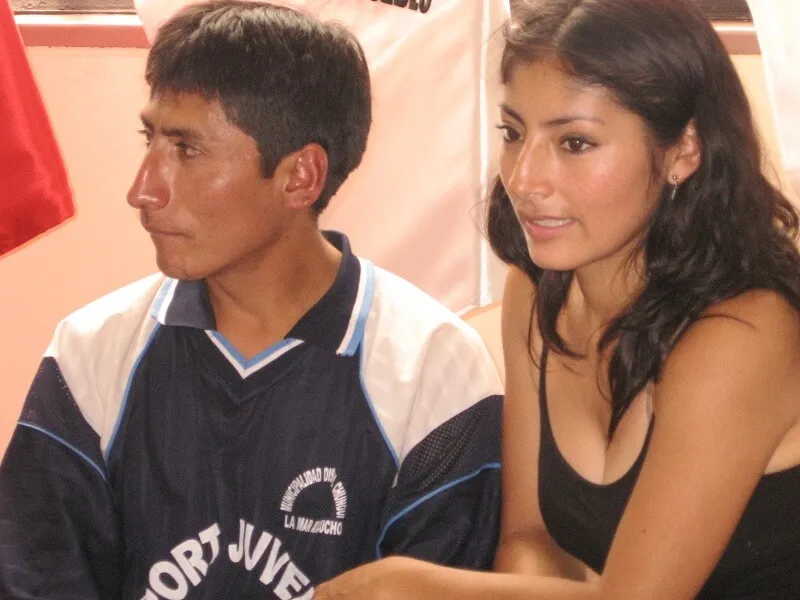
The story of these siblings is as hard as all those included in this investigation. Sonia Orihuela left the town of Oronccoy when she was eight years old because an Army officer tricked her by saying he was going to help her find Alfredo. The girl served as a maid in the house of the military officer, who tried to sexually abuse her several times, until she fled.
"I always wanted to get revenge on that man because he cheated me, because I know that they killed my parents. Then I got over it," she told the television station that reported the reunion in 2004.
If they weren’t killed by bullets, they must have died of hunger.
His sister Vilma fled the community of Mollebamba, in Chungui, at the age of 13, leaving her brother Diomedes and her grandparents behind. Years earlier, her mother, Marcela, and her two younger siblings, Marcelina and Nicolás, had died in her arms, from illness and lack of food, while living as refugees in the bush.
Alfredo blames his family's suffering on the governments of the 1980s and 1990s. During the two decades of internal armed conflict, Peru was governed by Presidents Fernando Belaunde, Alan García and Alberto Fujimori. At the end of Fujimori's term, in 1999, the State created the National Program for the Care of Orphans of Terrorist Violence, which centralized information and assistance to these children.
An "orphan fair" for adoption
The Peruvian military assumed powers that did not correspond to them by illegally adopting children who were orphaned or separated from their parents. At the time of the internal armed conflict, adoptions of minors in Peru were done through the Judicial Power.
As of 1996, this procedure is administrative and is carried out at the Adoption Office of the Ministry of Women and Vulnerable Populations. This agency does not have files or records of persons adopted before that date, as these should be in the archives of the Family Courts throughout Peru.
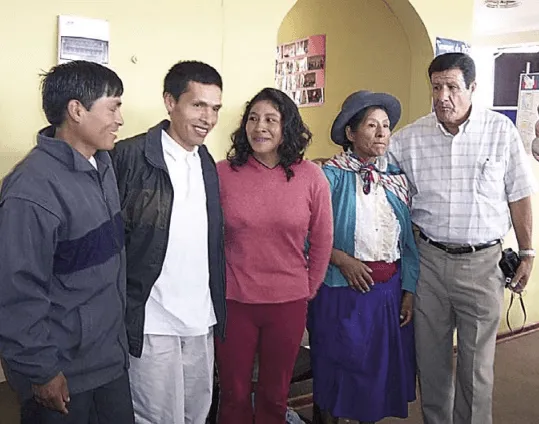
These records could include the brothers Fidel and Orlando Castro Baldeón. They were 10 and eight years old, respectively, when, in 1985, Army agents found them in the Ayacucho jungle while they were fleeing a confrontation between terrorists and the Army.
They were taken to the military base in Andahuaylas, where they were separated. Fidel was handed over by the military to a family who took him to Trujillo, in northern Peru, where he grew up with the name Alex Escalante Rivera. Orlando was handed over to a prosecutor and was reunited with Fidel and another sister, Marlene, 19 years later, in 2004.
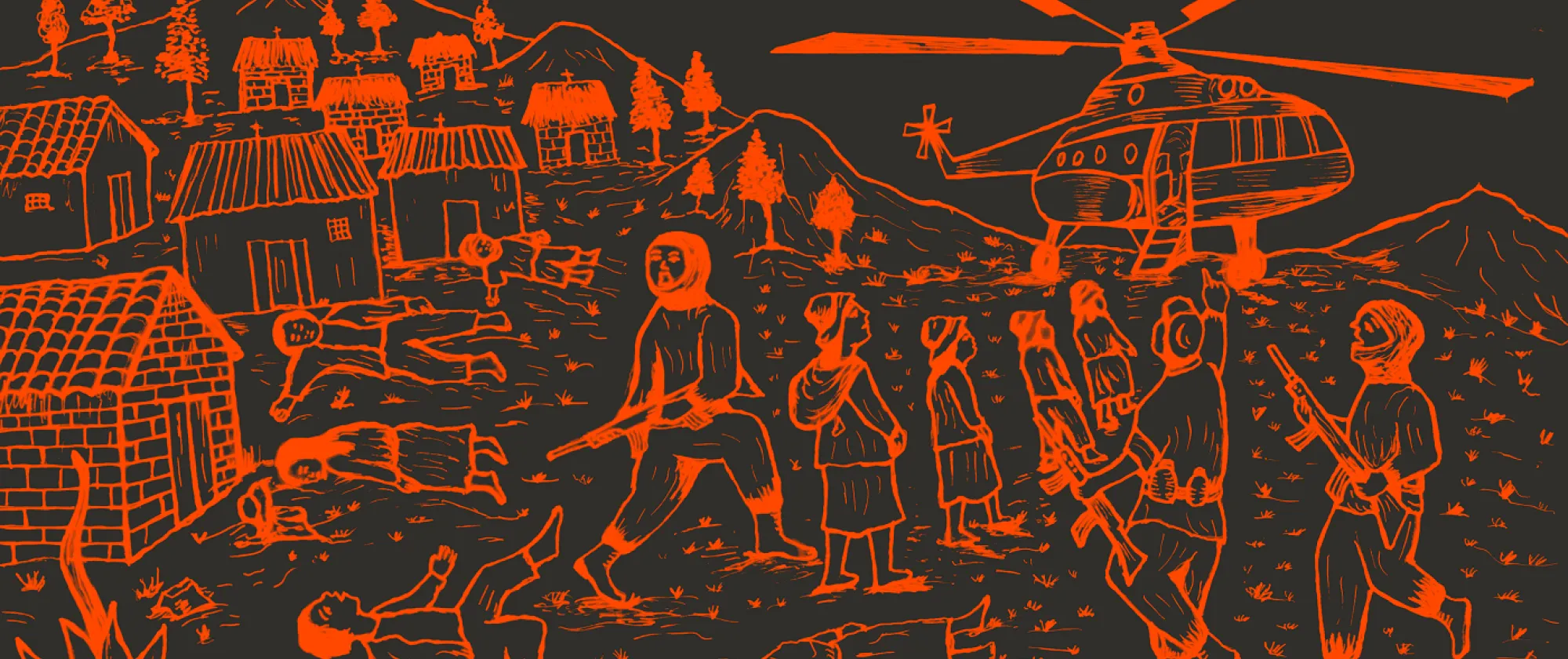
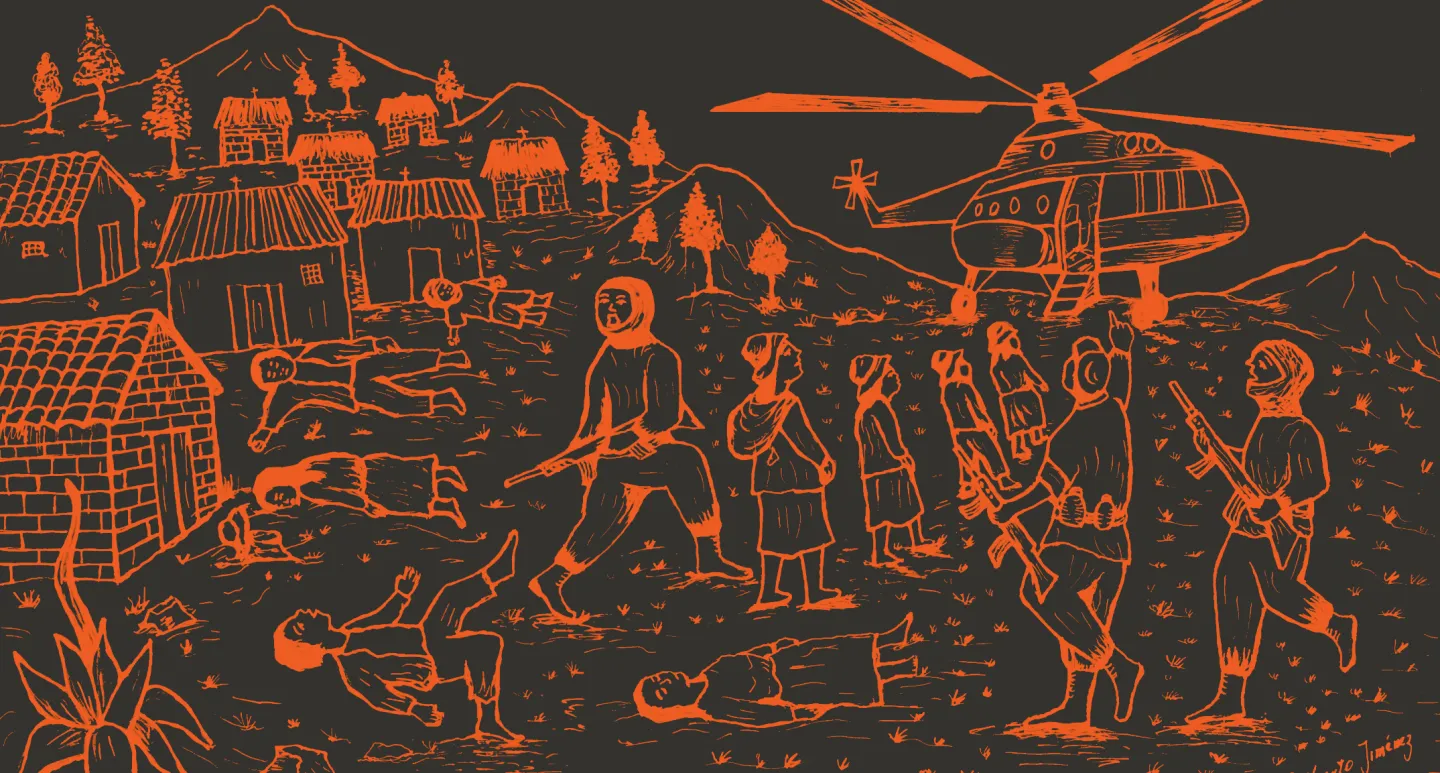
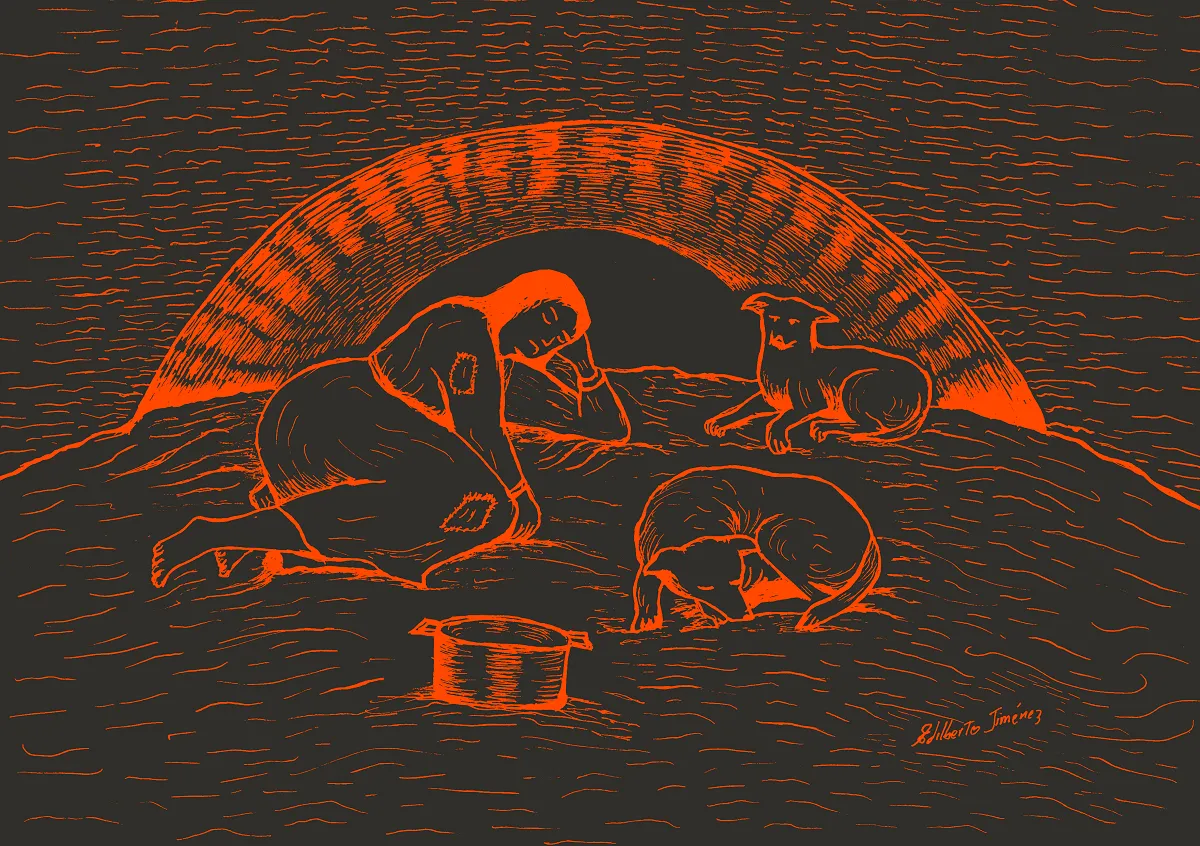
Since 1996, the Ayacucho anthropologist and artist Edilberto Jiménez (also the author of the illustrations in this report) has traveled through the district of Chungui. There he collected reports from citizens about orphaned minors who were offered by the military in the town square.
He recalls that he was told that they were like slave fairs, of Quechua-speaking girls and boys. Based on these testimonies and interviews conducted as a Quechua translator for the Truth Commission, he included an illustration in his book Chungui, violencia y trazos de memoria (Chungui, violence and traces of memory), published in 2005.
A testimony that appears in Jiménez's book is that of E.J.B. When she was a child, she was given to a woman. "The military would take us out during the day to the square and there we would stay, big and small, like at a fair, waiting for someone to take us to their house to be their servant for a plate of food."
The woman then added: "They chose us as they pleased, then they told the military that they wanted this or that person and signed a guarantee paper and took the detainee to help them with their work in planting, caring for the livestock, etc.". In addition, "other children were taken by the military to Andahuaylas, to Lima, and we don't know anything about them," she said as an adult.
Four decades of silence and injustice
"Such is the helplessness of the families that a strong voice has not been achieved. The social fabric that has been attacked is very weak," says anthropologist José Carlos Flores Lizana, who worked in shelters for orphaned children during the internal armed conflict. Between 1988 and 1991 he lived in Ayacucho as a member of the Jesuit religious order.
Flores Lizana published an article in 2012 and a book in 2014 warning about the uncertain fate of minors during the internal armed conflict and referred to "the children cared for" by the military in the barracks: orphans as "the result of confrontations and killings by Sendero or of killings made by themselves."
In these publications, he regretted that there were no organizations of relatives searching for these children, as happened in Argentina (with the Mothers and Grandmothers of Plaza de Mayo) and also in Chile.
In Ayacucho, a group of women founded the National Association of Relatives of the Kidnapped, Detained and Disappeared of Peru (Anfasep) in 1983 to search for their missing relatives. Lidia Flores, its president, told how, in the 1980s, they concentrated on searching for their husbands and children, young and old. "We took care of many orphaned children in the dining room," she recalled when asked in the Ayacucho city of Huamanga.
In 2003, the Truth Commission participated in the campaign Para que no te olvides, within the framework of the Missing Persons Initiative, to consolidate a list of missing persons and joined efforts with the Ombudsman's Office, the International Committee of the Red Cross and human rights organizations to search for the missing.
For this reason, 2004 was the year of reunions. Some cases were presented in the media, which published that these people were "separated by political violence" when they were children, despite the fact that the testimonies they cited clearly indicated that the military took them away from their communities.
Lawyer Gustavo Campos, from Comisedh, warns that the appropriation of the children by the military can be classified as a temporary forced disappearance, since in the 1980s the crime of human trafficking was not typified in Peru, as it is today.
"The important thing is to look at the individual cases, the circumstances, the conditions... Even changes of surnames, names, identity of the persons. The crime of forced disappearance persists in time until the person is identified, as long as those children at that time, now adults, are registered as disappeared. Each case and the context in which they occurred must be evaluated individually in order to typify the crime," says Campos.
For this report we formally requested the versions of the Ministry of Justice and the Peruvian Army, but they did not respond to our inquiries.
Of the 47,768 children and adolescents listed in the Unified Registry of Victims of the Ministry of Justice and Human Rights, 2,929 were registered as victims of kidnapping or forced disappearance. The National Registry of Missing Persons and Burial Sites (Renade) has registered 2,622 missing minors, of which the fate and location of 1,278 are still unknown.
The names of the minors who have not been found are listed under "pending investigation", such as that of Benito Orihuela Alanguia, Facunda's son, who disappeared 38 years ago.
The military personnel who took the children are now over 60 years old and retired, after having been promoted in the military career. Their names remain anonymous. Death is catching up with them, but justice is not.
On July 4, 2024, the Congress of the Republic approved in a second vote a bill that favors terrorists, military and police officers prosecuted and sentenced for war crimes and crimes against humanity, as it declares the statute of limitations for these crimes committed before July 1, 2002, when the Rome Statute was not yet in force for Peru.
The Inter-American Commission on Human Rights, the Inter-American Court of Human Rights and the United Nations Committee on Enforced Disappearances have spoken out against this new Amnesty Law because they consider that it contravenes international law.
Meanwhile, the adults, who as children were kidnapped, mistreated, abused, tortured and stripped of their identity, await justice. And, by giving their testimony for this investigation, 40 years later, they can help those who remain missing, have another identity or believe their relatives are dead, to follow the same path of reunion with their families.
If you suspect you are one of the missing children, if you have been reunited with your family after a similar situation, or if you know someone who has gone through the same thing, share your story by emailing [email protected]