

Forced labour
Keep coming back to Las Malvinas
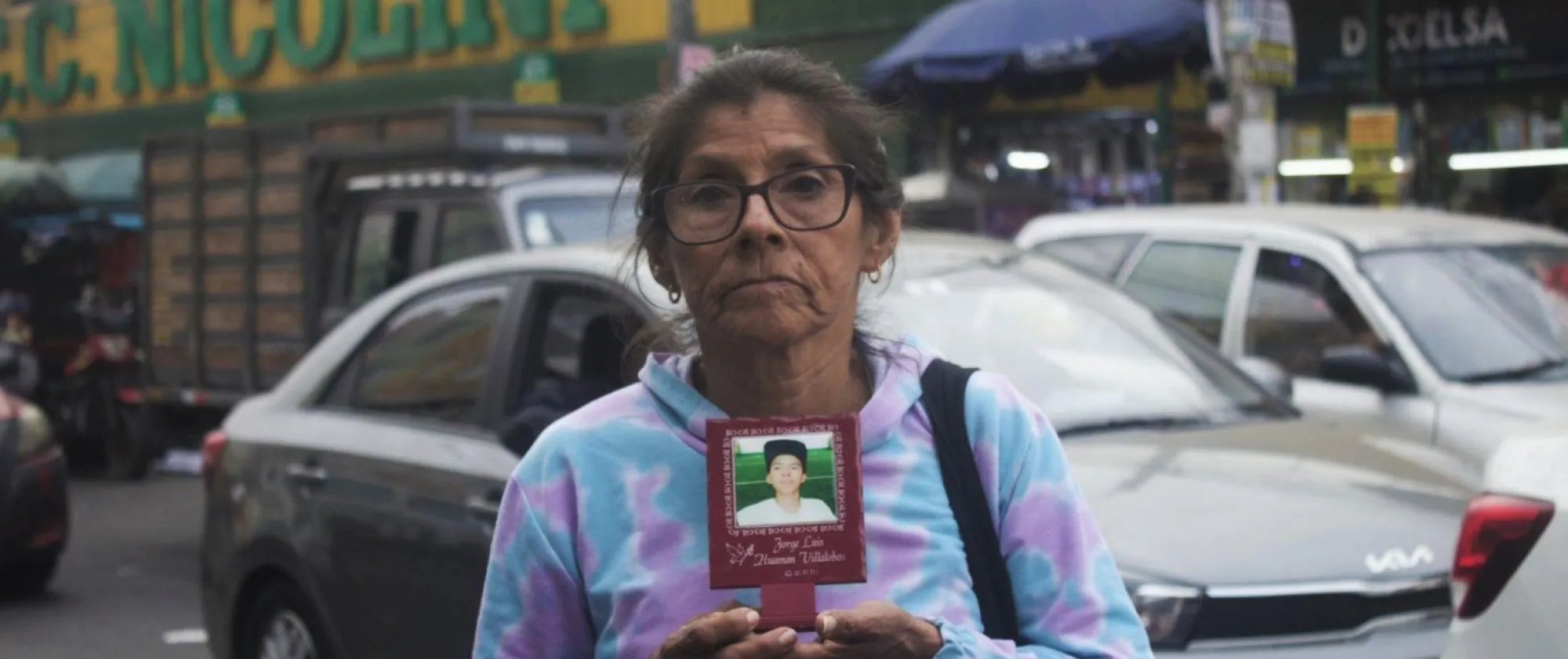
The Las Malvinas tragedy is an emblematic case of the vulnerabilities that make human trafficking, slavery and forced labor possible. Bertha Villalobos, 57, persists in her search for justice for the death of her son, one of the young workers who died in the fire.
20 October 2024
This report was produced by Lucero Ascarza as part of the 2nd edition of the practical workshop 'Reporting on Forced Labour and Other Forms of Slavery', organized by the ILO through the BRIDGE Project in Peru. The report was published on La Encerrona platform. The ILO was not involved in the creation, development, fact-checking, or evaluation of this journalistic piece. The opinions, conclusions, and statements expressed are the sole responsibility of the authors and do not necessarily reflect the views, positions, or policies of the ILO.
Luis Huamán Villalobos (19) and Jovi Herrera Alania (20) burned to death in June 2017, when they were working in irregularly constructed containers on top of a building in Cercado de Lima, and from which they could not get out because their employers locked them in. Their deaths were the result of a fire, but their primary cause was labor exploitation. Although the perpetrators were convicted in 2018, the families are still struggling for reparations and for answers from the institutions that should have prevented the deaths. Both victims of trafficking and forced labor still have no real justice after 7 years.
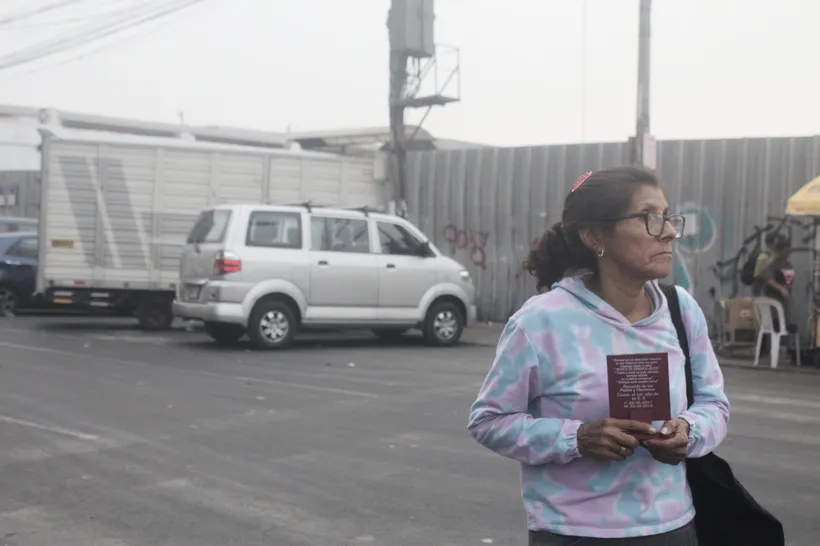
Despite the passage of seven years, Bertha Villalobos continues to walk and look for familiar faces among the vendors in the Las Malvinas commercial-industrial area in the district of Cercado de Lima (Peru).
At the junction of Avenida Guillermo Dansey and Jirón Huarochirí there is nothing left, just an empty space surrounded by cars and street vendors, but in 2017 there was the building of the former Galería Nicolini and on the roof metal containers had been piled up in an irregular way so that workers could operate in precarious conditions behind closed doors and with poor lighting. In that space, the young people ate and also urinated in a bottle. The owner of the business, Jonny Coico Sirlopu, whom they only knew as 'Gringo', put chains and padlocks on the doors with the excuse that this way they wouldn't steal his merchandise.
Bertha's son, Luis Huamán Villalobos (19) worked in one of those 'containers' with his friend from the Vista Alegre Human Settlement neighborhood, Jovi Herrera Alania (20). The two of them sanded down the Duratel brand from the fluorescent tubes, and then sealed them with the popular Phillips brand. They worked from 8:00 a.m. to 7:00 p.m. from Monday to Saturday. For doing this work that took them the whole afternoon they only received S/ 25 to S/ 30 a day.
Luis and Jovi were a couple of boys who had a life where they didn't have many job options. Necessity makes one more practical and unconcerned about risks. Neither of them could have imagined that one day a fire would start that would last more than a whole day, and from which neither of them would emerge alive. Their bodies were recovered five days after that June 22, 2017, when the flames had already subsided.
This year, 2024, marked seven years since that workplace catastrophe and the families of the two young workers who died cannot grieve because justice has still not been done for their deaths.
The state reduced the prison sentences of the exploitative businessmen, although one of them is still on the run. The municipal officials continue their public careers and the relatives of the victims have not received the compensation that was established in the sentence. In addition, the civil lawsuit they filed directly was dismissed this year.
Before the building disappeared, Bertha went there constantly to seek justice for Luis. The demolition of the former Nicolini Gallery building began in 2022, leaving a vacant lot. A building that served as a reminder of how vulnerable labor rights are in Peru was destroyed, but the memory, like Bertha's, remains intact.
Imprisoning workers is a practice of modern slavery that continues to this day. If you search the internet, you can find several similar reports in other regions of the country. Last year, 2023, two workers from Cicsa, a contractor for América Móvil Perú (Claro), died in the same way.
The story of the Las Malvinas fire is the story of the current Peruvian labor framework.
The wait
That June 2017, Bertha found out from watching the news that there was a fire near Plaza Dos de Mayo, in what was then the Nicolini gallery. She was distressed, and so she called Luis, her son, but he told her that he was away and would return soon. However, twenty minutes later, a second call would reveal the truth to her.
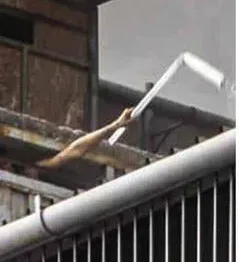
“Mum, I'm in the fire. I'm locked in. Don't worry, they're coming to get me. The owner is coming to get me now,” Luis told her.
Bertha, her husband, her daughters and other relatives began to mobilize, but there was not much they could do. They called to Luis and asked him to stick his hand out through a crack in the container so that the rescuers could locate him. Despite their efforts, the voracity of the flames prevented the firefighters from reaching the containers.
A quiet, shy and calm young man, that's how Bertha Villalobos remembers Luis. The depression into which she fell after the untimely death of her son meant that she could no longer continue working in the shoe shop where she worked.
Bertha Villalobos left her house, moved to another district and immersed herself in a whirlwind of paperwork, documents and hearings in search of justice. It was not easy. She is a 57-year-old woman who is not used to technology and sometimes finds it difficult to find the files her lawyers send her by WhatsApp, especially since she does not have their numbers saved by name in her cell phone.
Two public defenders are handling the human trafficking case and the arson case, while a private lawyer — whom Bertha and her family pay for with great difficulty — is handling the case for the compensation they are demanding from employers and state institutions.
In 2018, the Judiciary convicted the owners of this informal business, the married couple Jonny Coico Sirlopu and Vilma Zeña Santamaría, of the crime of aggravated human trafficking for the purposes of labor exploitation and slavery. However, the following year the Fourth Criminal Chamber for Prisoners reduced the sentence against Coico from 35 to 30 years in prison; and from 32 to 15 years for Zeña, a fugitive for whom the Ministry of the Interior only set a reward of S/ 50,000 in July 2023 for information leading to her capture. But currently, her details no longer appear on the rewards portal. Vilma Zeña filed a habeas corpus lawsuit against the Judicial Power chamber that convicted her and has a hearing scheduled before the Constitutional Court on October 16.
In terms of administrative responsibilities, Lima City Council officials Cristian Rosenthal Ninpaytan and Mario García Martínez were convicted of allowing work to be carried out in breach of municipal regulations at the former Nicolini Gallery, despite the high risk. The first instance sentence for the crime against the public administration in the form of omission in the performance of their duties was published in September 2018. Months later, in March 2019, the sentence was confirmed: suspended sentence, disqualification from public office and rules of conduct for one year, in addition to paying compensation of S/ 10,000 each. By then, both were pursuing their careers in the State, as officials of the Municipality of Chiclayo (Lambayeque). Cristian Rosenthal was general manager and right-hand man to the mayor, while Mario García was deputy manager of Inspection.
Although more than one sentence recognizes Luis as a mortal victim, the financial compensation ordered by the judges is still pending. For this reason, the relatives filed a lawsuit for damages and for breach of labor regulations against the Ministry of Labor, the Municipality of Lima and the business couple.
The last virtual hearing to resolve this case was convened on Wednesday, May 8, 2024. Luis' parents and their lawyer joined the Google Meet link provided by the court. The Treasury Attorney's Office also attended the session, but the defendants did not appear. Not even a judge or a court clerk connected.
“That day was my son's name day. I went to leave him flowers, to sing him Happy Birthday and from there I came running, running, running because they said the hearing would be at 3 in the afternoon. I waited until 7 at night, but nothing happened. Last year (2023) it was the same thing in May, they didn't go in either,” says Bertha.
Two days after the failed hearing, the 4th Permanent Specialized Labor Court issued a resolution concluding the legal process. The reason? The failure of the parties involved to attend the hearings.
Bertha's family and her lawyer filed a complaint, attaching evidence that they did connect. But they have little hope left. After seven years, justice is still elusive.
The system
“I didn't even know where he worked. I never knew they were locking him up,” says Bertha Villalobos. From their conversations, she knew that Luis couldn't go out for lunch. But it didn't seem strange to her. Bertha couldn't go out either when her boss wasn't there.
Bertha thought that her son worked in a noodle factory called Nicolini. It was only on that 22nd of June 2017 that she learned that the gallery was actually a hardware and paint shop.
Luis did not share details of his work. He never said that there was anything wrong with the way his job was run, much less that it was illegal.
Luis and Jovi were a couple of lads caught up in a vicious circle where labor and/or human rights are of little relevance, both to those who exploit and to those who are exploited, since money is the be-all and end-all in an economic model that sees workers as tools for making profits.
To understand the monster that devoured Luis and Jovi, we have to go back to the nineties. During the dictatorship of Alberto Fujimori, a labor reform and an unplanned free market economic policy were implemented that relaxed labor rights and led to a reduction in employment in various manufacturing sectors of the country, one of the key activities in the country's economy. This caused unemployment rates in the mid-1990s to be higher than in the 1980s.
Informality also increased from 52% in 1990 to 56.9% in 1997 in Metropolitan Lima. Worker instability was a constant. This led to the opening of a dark and insecure market for workers who need an income to survive. A normalization and tolerance of exploitation.
Within the informal labor sector, forced labor and human trafficking are crimes that have found a space and persist to this day.
According to a study carried out by CHS Alternativo and the Institute of Peruvian Studies (IEP) in 2022, around 3.4 million Peruvians recognize themselves as victims of forced labor, but 54% of the population does not understand what it consists of and 18% do not know where to go to ask for help or to report it.
“It is a common problem in situations of exploitation. Awareness of the situation and its scope is not necessarily identified by the victims. There are a number of conditioning factors that can make them accept situations of exploitation. That is why they returned and did not discuss it with their families. They probably did not know that they were going through a situation of forced labor or human trafficking,” explains Luis Aguilar, Director of Policies and Strategies at CHS Alternativo.
Unlike the crime of human trafficking, which is easier to identify, forced labor still seems difficult to recognize and, therefore, to punish and prevent.
“Labor exploitation, whether as part of trafficking or not, is difficult to identify. One of the reasons is that, compared to sexual exploitation, it has greater social acceptance. Let's think about the case of domestic employment, which has always been a breeding ground for cases of forced labor; only a few years ago we have had regulations that set certain limits,” explains Sergio Rodríguez, a criminal lawyer specializing in labor issues.
In 2023, the Public Prosecutor's Office registered 2,620 complaints of human trafficking and 109 complaints of forced labor of adults and minors. To date, there has been no conviction for forced labor in Peru.
According to the International Labor Organization (ILO), forced labor is understood as work that is carried out involuntarily and under the threat of any penalty. Some indicators of this crime are the limitation of workers' freedom of movement, the withholding of wages or identity documents, threats and intimidation, or fraudulent debts from which workers cannot escape.
A Plenary Agreement of the Judiciary published in 2023 also expands the definition of forced labor as “forcing, through any means, including abuse of a situation of vulnerability, a person to perform or continue to perform a job or service.”
Luis and Jovi lived in that situation, which neither they nor those around them nor the authorities were able to recognize as a crime in time.
Vulnerability is the common denominator in situations of exploitation. This can be socioeconomic, cultural, physical, psychological or emotional, it prevents people from recognizing that they are victims of a crime and, in turn, keeps them exposed to more violence.
“When my little son was at school, sometimes I didn't have any money, I forgot to buy his bus ticket. I didn't give it to him and my son got fed up. He said to me, 'Mum, you're getting old, your hand is wrinkled, I'm going to work'”, recalls Bertha Villalobos.
Luis wanted to be a policeman, but after finishing school, and seeing the financial needs at home, he ruled out studying. At the age of 18, his friend Jovi told him about the work in Las Malvinas.
Jovi Herrera Alania had just become a father and needed to earn an income quickly. Both lived in a shanty town in the district of Independencia, north of Lima. And they were young, another factor that made them vulnerable.
Employers can tell when someone needs urgent money, and they also know that they will not be able to prevent conditions that are clearly outside the standards of decent work, explains Luis Aguilar, a specialist at CHS Alternativo. Conditions such as working in a confined space, without being able to go to the toilet, and having to eat and urinate in the same space where they work.
“They were in a situation of economic precariousness and it was simple, manual work, and illegal because they were forging documents. It was the only thing the labor market offered them. They were doubly vulnerable and based on that, they arrived at that place and remained there being exploited. Probably, if the fire hadn't happened or if it hadn't cost them their lives, they would have gone back to work the next day,” Aguilar points out.
The road to the recognition and sanctioning of forced labor has been a long one and, in our country, it is relatively recent. Although the ILO had been referring to this crime internationally since 1930, the Peruvian Penal Code did not incorporate the crime of forced labor until January 2017. Months before the death of Luis Huamán and Jovi Herrera in Las Malvinas.
“In addition to the challenge of identifying forced labor, there is the challenge of defining the different levels of labor exploitation and intervention. If it is a breach of labor conditions, for example, Sunafil and the ordinary labor courts will have to get involved, but if it is a case of slavery or forced labor, the criminal justice system must intervene and often the elements that distinguish these crimes are not clear,” explains criminal lawyer Sergio Rodríguez.
Only in March of this year was a Coordination Mechanism approved for the identification and referencing of cases of forced labor and/or human trafficking for the purpose of labor exploitation, developed by the Public Prosecutor's Office, the Ministry of the Interior, the National Superintendency of Labor Inspection, the National Police of Peru, the National Superintendency of Migration, the ILO and the United Nations Office on Drugs and Crime (UNODC) for the Andean Region and the Southern Cone. The objective is to strengthen the capacities of officials and promote specialized instruments that facilitate officials in different instances to prioritize actions against forced labor.
Unfortunately, one of the biggest challenges in combating this crime is informality. As Rodríguez points out, there may be few beneficiaries of the coordination mechanism because there are few that Sunafil and Migration can reach. “Everyone knew what was happening in Las Malvinas, but Sunafil never went there. It has few inspectors and it supervises the formal sector, especially large companies. Therefore, it does not reach the whole universe of cases and, above all, the most vulnerable sectors,” says the lawyer.
Bertha Villalobos is still some years away from turning 60, but she continues to work. In the mornings she sells clothes at a market in the Independencia district. In the afternoons, she goes to the Central Market to buy new merchandise.
Whenever she can, Bertha returns to Las Malvinas.
She feels that the shopkeepers look at her badly, that they blame her for denouncing what happened to her son and other young people. Her family has asked her to stop going for her own safety. But she can't help it.
She wants to know if they will hold a mass for the anniversary of her son Luis's death. She asks, nobody knows anything.
Bertha stares at a shop opposite what is now the new Nicolini shopping center.
On June 22, 2017, she stood outside that shop for hours. Her older daughters have deleted the photos and videos she had from that day. Bertha doesn't need them. Those images are fresh in her memory. It is the memory of Luis that pushes her not to give up.