

Interview
International Labour Conference 2024: Challenges and Opportunities for Workers
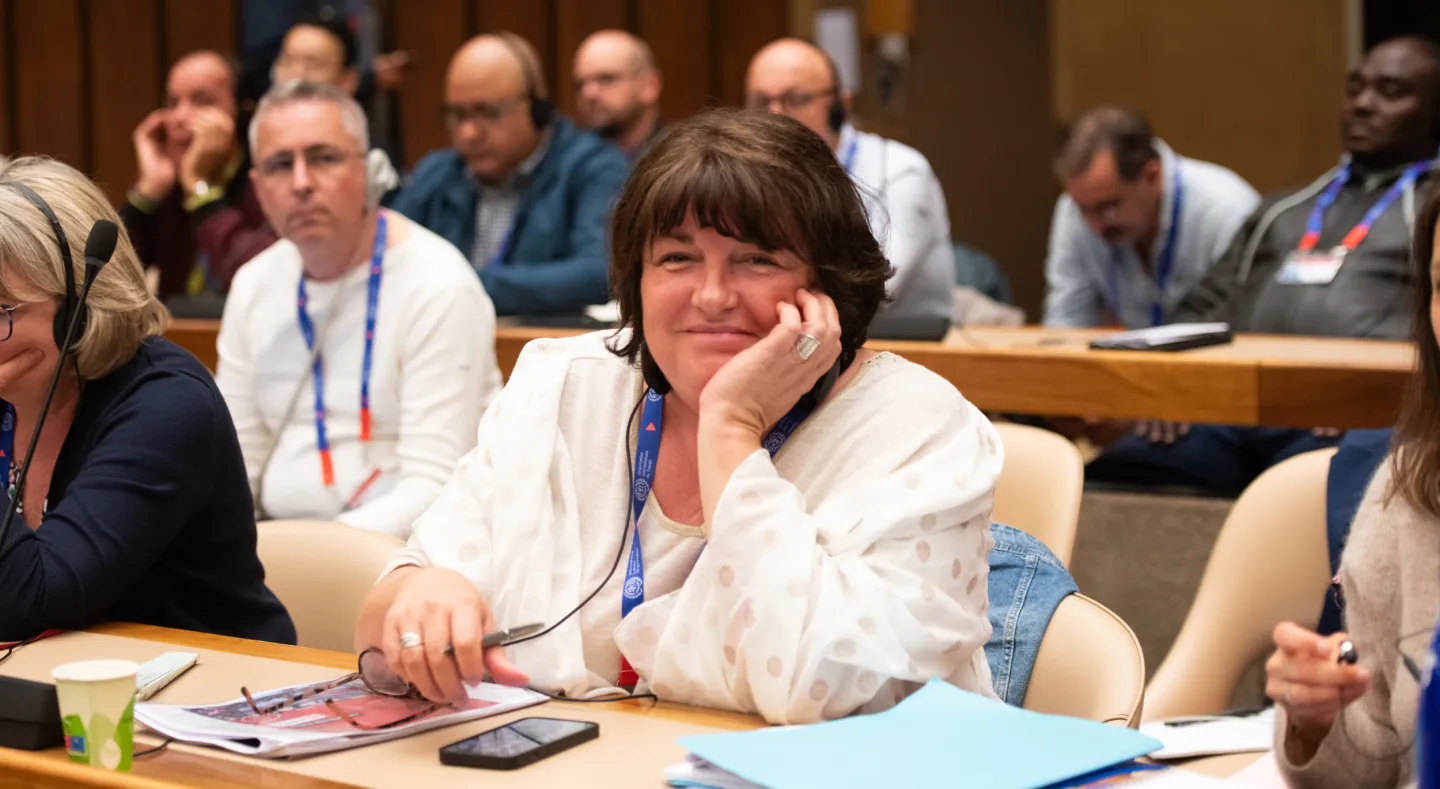
In a world marked by unprecedented economic, climate, health and social crises, Ms Béatrice Lestic, Vice-President of the Workers Group at the 112th session of the International Labour Conference (ILC), shares her vision of the "New Social Contract" presented by the ILO Director-General. In this interview, she stresses the importance of a universal and inclusive commitment to protecting workers’ rights, and the need for coherent policies to ensure a prosperous and equitable future. Ms Lestic also discusses the specific challenges posed by biological hazards and by discrimination in the care economy; and outlines her expectations for the 112th International Labour Conference.
4 June 2024
In 2024 the Director-General presented a new report entitled Towards a New Social Contract, with the aim of "making social justice the foundation of lasting peace, shared prosperity, equal opportunities and just transition". What do you think this new social contract means for workers?
Béatrice Lestic: The combined impact of the multiple crises (economic, climatic, health, democratic, war, etc.) the world has been undergoing for several years now are making it more difficult to achieve social justice and the United Nations' Sustainable Development Goals (SDGs) by 2030. We must put people and the planet back at the centre of the game. This means placing the economy at the service of people; protecting citizens and workers; and working to save the planet from the various threats that lie ahead. If this new social contract is to be truly universal and inclusive, it must benefit all the world's workers, regardless of their status, and it must be redistributive. The benefits of economic and technological progress must be equitably shared. It is, after all, workers who create wealth through their labour. The benefits of wealth creation and technological progress must also be used to make invest in public services, in particular education and social protection for all. Moreover, social dialogue at global, national and local levels is effective in providing concrete solutions to the various challenges and crises we face.
The multilateral world order is being threatened by a lack of public confidence in national and international institutions. There is an urgent need for policy coherence among the different UN agencies and international financial institutions within the multilateral system, particularly in terms of social policy. The ILO, as the only tripartite international agency, is a leader on social issues. The Director General’s new social contract must ensure that ILO's standards and declarations have a real policy impact. Tripartite social dialogue can be demanding. However, as we have seen since the foundation of the ILO, a comprehensive framework of labour standards improves the lives of workers without acting as a brake on economic prosperity.
The 80th anniversary of the Declaration of Philadelphia reminds us that "labour is not a commodity; freedom of expression and association are essential to sustained progress; poverty anywhere constitutes a danger to prosperity everywhere".
ACTRAV INFO: One of the major themes of this year’s ILC is biological hazards, as demonstrated by the recent COVID-19 pandemic. What is needed to ensure protection for workers, particularly those working in hospitals, laboratories and other occupations, most at risk of being exposed to bacteria and viruses?
In 2022, the International Labour Conference recognised two new ILO Conventions (ILO Conventions 155 and 187), both of which promote safe and healthy working environments as fundamental conventions. This means that Member States, regardless of whether they have ratified these Conventions, must ensure and promote compliance with them. The COVID-19 pandemic also highlighted the importance of protecting workers in high-risk sectors, as well as “essential workers”, namely workers deemed essential to economic and social stability. The ILC discussion of standards on biological hazards is designed to fill these gaps. It is essential that these discussions lead to a new convention based upon a general precautionary principle for dealing with biological risks to all workers.
ACTRAV INFO: Certain regions of the world are simultaneously experiencing population growth and an ageing population, meaning the care economy and personal services sector is set to boom in the years ahead. This sector of the economy is particularly affected by gender-based and class-based discrimination in both the formal and informal economies, with an over-representation of women and young girls, who are often poorly paid or unpaid. What concrete actions can be taken to protect women workers in the care economy from discrimination that is reinforcing this precarious position?
Jobs in the care economy are heavily feminised and characterised by professional inequalities between women and men; low salaries; poorly recognised professional skills; and poor working conditions. The situation has further deteriorated since the pandemic. It is crucial that care workers are valued. They contribute to people’s health and well-being and are an essential to the sustainability of society. To achieve this, public investment is needed to promote quality jobs in the care sector. In this respect, a broader discussion on the economics of care is essential. It is also vital that the principle of equal pay for work of equal value, as set out in ILO Convention 100, is respected. Pay policies and wage-setting mechanisms must be transparent, and must promote gender equality and non-discrimination, as approved last February by the ILO meeting of experts on pay policy. There ought to be a clear career path for care workers, with high-quality, accredited training and skills development. Qualifications must be recognised and transferable, so that care workers can change jobs within the sector.
Finally, we must stress the importance social protection, maternity protection, the right to parental leave, and adequately paid paternity leave, and the right to leave for carers. Policies in these areas must allow a more equitable sharing of care responsibilities between women and men, as it is usually women who take on these unpaid family responsibilities, often to the detriment of their careers. The effective application of ILO standards is essential to filling existing legal gaps in this respect.
ACTRAV INFO: What are your expectations and hopes for this 112th session of the International Labour Conference?
The are several world-of-work challenges to be dealt with at the 112th International Labour Conference.
It is important for the ILO to reaffirm its original standard-setting function. The vote to repeal four ILO conventions must be accompanied by an acceleration in the drafting of new standards and by the ratification of existing conventions. The standard-setting debate on biological hazards is essential in this respect. Constituents must confirm the principle of adopting a convention on the subject next year. Similarly, the recurrent discussion on fundamental principles and rights at work should accelerate ratification and implementation of the ILO's fundamental conventions. The Committee on the Application of Standards must provide guidance that is binding on Member States. Tripartism and the supervisory mechanisms of ILO standards play a crucial role in guaranteeing adherence to conventions and respect for workers' rights.
The conclusions adopted by the various commissions working towards social justice must be accompanied by concrete actions by constituents that benefit all workers. This 112th ILC is an essential stepping stone toward the World Social Summit organised by the United Nations in 2025.
Finally, the special session on Director General's report on the Occupied Palestinian Territories demonstrates the absolute urgency for a concrete commitment from ILO Member States to support Palestinian workers.