

Apprenticeship
Indonesia advances quality apprenticeships with new tripartite recommendations
Government, employers and workers unite behind 20 recommendations to strengthen apprenticeship governance in Indonesia and align with international labour standards.
8 May 2026
JAKARTA, Indonesia (ILO News) – Indonesia has taken a significant step towards strengthening its apprenticeship system by disseminating 20 tripartite recommendations on quality apprenticeships, developed jointly by government, employers’ organizations and trade unions through a series of consultations facilitated by the International Labour Organization (ILO).
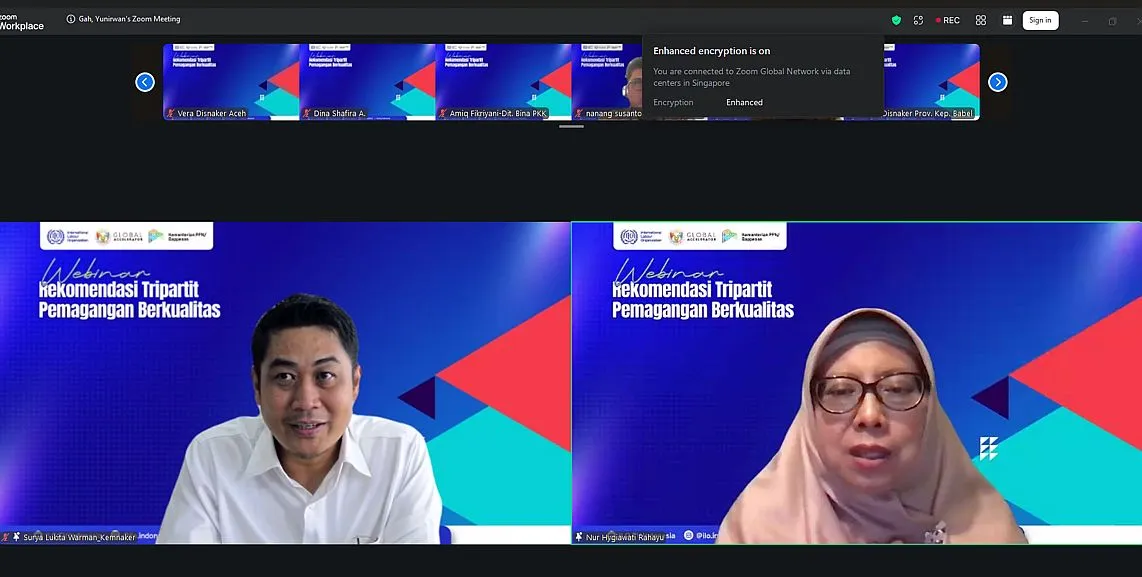
The recommendations, finalized in November 2025 and disseminated through a national webinar on 5 May, provide a roadmap for improving the quality, governance and inclusiveness of apprenticeship programmes in Indonesia. They are expected to contribute to the revision of Minister of Manpower Regulation No. 6 of 2020 on Apprenticeships and help align national policies with ILO Recommendation No. 208 on Quality Apprenticeships, adopted in 2023.
We need to establish a system where apprenticeships continue to evolve and remain relevant to labour market needs, with clearly defined roles and responsibilities shared among apprentices, companies and government institutions.
Nur Hygiawati Rahayu, Director of Employment at Bappenas
The dissemination webinar, co-organized by the Ministry of National Development Planning (Bappenas), the Ministry of Manpower and the ILO, brought together 123 participants, including representatives of provincial and district Manpower Offices, employers’ organizations, trade unions, training institutions and development partners.
The recommendations are the outcome of an extensive tripartite dialogue process conducted under the Global Accelerator on Jobs and Social Protection for Just Transitions, a joint initiative of the Government of Indonesia and United Nations agencies supported by the Joint SDG Fund. The initiative aims to support the achievement of Indonesia’s 2025–2029 National Medium-Term Development Plan (RPJMN) and the Sustainable Development Goals.
The process began with a National Tripartite Workshop on Quality Apprenticeships held in Jakarta in March 2025. Building on discussions from the workshop, the ILO facilitated a series of focused consultations with trade unions, employers’ organizations and government institutions between April and September 2025. These consultations enabled each stakeholder group to identify challenges, propose solutions and build consensus on reforms needed to strengthen Indonesia’s apprenticeship system.
The resulting recommendations are grouped into seven priority areas: regulation, promotion, governance framework, protection, institutionalization, equality and diversity as well as collaboration for quality apprenticeships.
Nur Hygiawati Rahayu, Director of Employment at Bappenas, highlighted the importance of building a sustainable apprenticeship ecosystem. “We need to establish a system where apprenticeships continue to evolve and remain relevant to labour market needs, with clearly defined roles and responsibilities shared among apprentices, companies and government institutions,” she stated.
Meanwhile, Surya Lukita Warman, Director of Vocational Training and Apprenticeship Programmes at the Ministry of Manpower, emphasized that the recommendations provide a valuable foundation for updating Indonesia’s apprenticeship regulations. “Developed through tripartite collaboration, these recommendations offer important input for revising the Minister of Manpower Regulation and strengthening apprenticeship implementation across the country,” he noted.
Representatives of both workers and employers reaffirmed their commitment to maintaining constructive social dialogue throughout the regulatory reform process.
“Trade unions are ready to remain actively involved in the revision of Minister of Manpower Regulation No. 6 of 2020,” stated Sulistri, representing the trade unions. Meanwhile, Lispiyatmini, speaking on behalf of employers, underscored the value of apprenticeship programmes in supporting workforce development and recruitment, while also stressing the importance of effective monitoring and supervision to ensure quality implementation.
Developed through tripartite collaboration, these recommendations offer important input for revising the Minister of Manpower Regulation and strengthening apprenticeship implementation across the country.
Surya Lukita Warman, Director of Vocational Training and Apprenticeship Programmes at the Ministry of Manpower
Jordi Prat Tuca, Technical Specialist on Skills and the Future of Work at the ILO, commended Indonesia’s commitment to developing tripartite recommendations by drawing on Recommendation No. 208 as a reference. “ILO Recommendation No. 208 provides the most up-to-date international guidance on apprenticeship systems. Although it is not legally binding, it offers authoritative direction for countries seeking to strengthen their apprenticeship frameworks,” he emphasized.
The recommendations mark a significant milestone in Indonesia’s efforts to establish a more inclusive, effective, and future-ready apprenticeship system. By reinforcing social dialogue and aligning national policies with international labour standards, the initiative seeks to improve young people’s transition from education to employment, while enabling employers to cultivate the skilled workforce essential for sustainable economic growth.
Related content
Programme
Global Accelerator on Jobs and Social Protection for Just Transition in Indonesia
Relevant projects
Programme
Global Accelerator on Jobs and Social Protection for Just Transition in Indonesia