

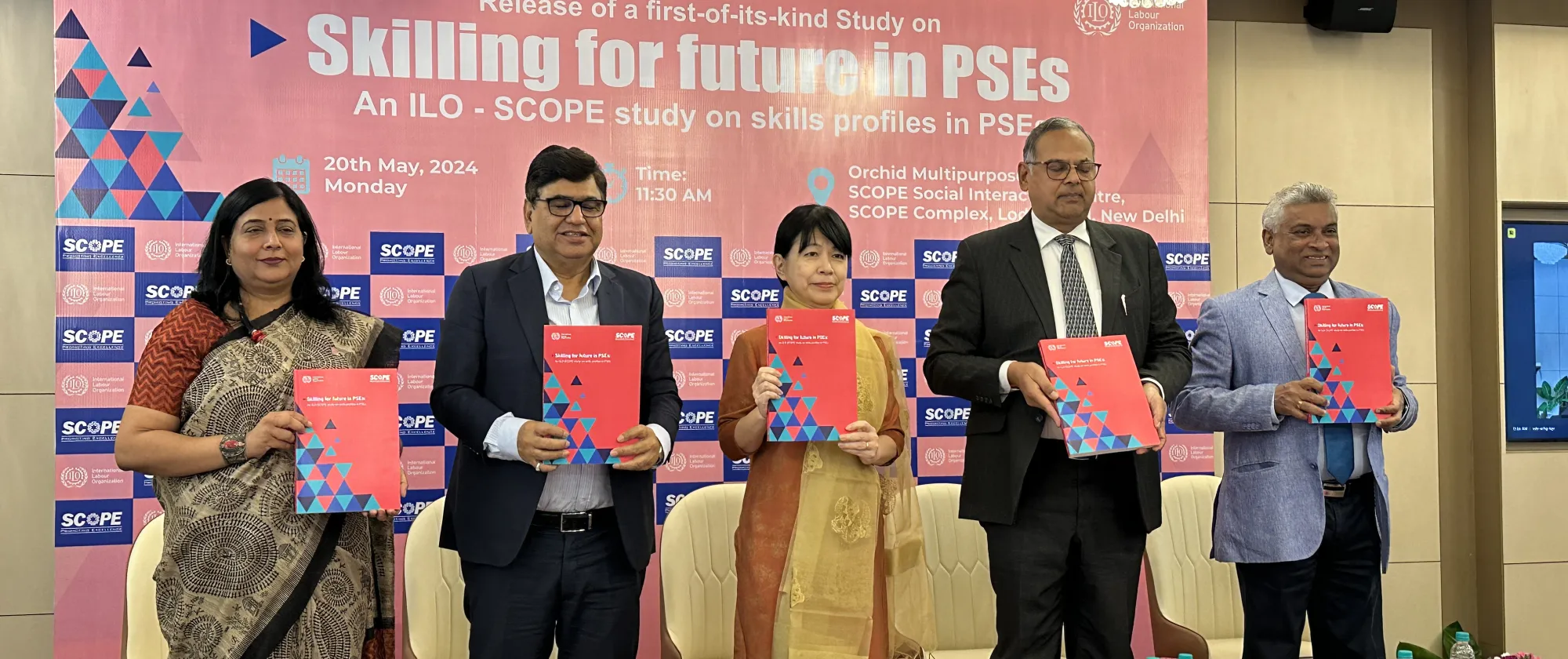
India’s public sector explores skilling and lifelong learning with new ILO-SCOPE report
20 May 2024

The world of work is dynamic and fluid, with new trends constantly making it adapt and innovate. The public sector is one such sector in India which, by contributing to 14 per cent of the country’s GDP, adapts to changing trends in the economy and has played a crucial role in the country’s socio-economic development since its inception. To understand the skills levels and assess the re-skilling and upskilling requirements of public sector professionals, the ILO and SCOPE conducted a study which was launched as the “Skilling for future in PSEs: An ILO-SCOPE study on skills profiles in PSEs” report.
The study was undertaken over one year, focussing on four sectors – Energy, Manufacturing & Construction, Metals & Minerals and Services. Each country has its own Skills Qualification Framework (SQF) for benchmarking skills across various industries and job levels. This study was undertaken to align the current and anticipated skill requirements among mid-level management positions in the four identified sectors with the National SQF. It aimed to identify any gaps in the current qualification requirements and inform the skills strategy in SCOPE’s membership, making it an instrumental tool for skill development in the public sector.
“Focussing on skilling and an orientation to lifelong learning is what a human-centred growth advocates for. There is keen interest from workers, and this study demonstrates the appetite of enterprises for investing in the human capital development of the country and achieving intergenerational equity,” said Michiko Miyamoto, Director, ILO DWT/CO-New Delhi.India is a young country with a vast demographic dividend of almost 60 per cent of the population in the working age group of 15-59 years. This presents an enormous opportunity to take advantage and meet the global workforce requirement by giving more prospects to Indian youth. However, this can only be achieved if the workforce is skilled and ready for future work as India focuses on becoming self-reliant and rapid digitalization coupled with pandemic-induced uncertainty changes the face of business. For this purpose, it is imperative to reduce the skill gap and create pathways for international mobility and prosperity for individuals and the country.
In the study, the skills demand has been trifurcated into Theoretical Professional Skills, Functional or Generic Skills, and Behavioural Skills, to help the holistic development of the lower, middle and senior management in the PSEs. Relationship building, communication, problem-solving, negotiation, leadership and team management were identified across all sectors and levels as essential skills, which are both essential and can be further refined through training and capacity building. This alludes to a positive trend that while technical skills are necessary, social and emotional skills are also becoming increasingly valuable in the ever-changing employment market.
The report explores in detail how skilling, upskilling and reskilling are to be approached in each sector, also focussing a just-transition, which ensures that current skills aren’t redundant as sectors and enterprises pivot to sustainability. A critical component is engagement with academic institutions to ensure the skills being imparted in educational institutions are aligned with the needs of the employment market, to propel the public sector and industry forward.
SCOPE is a constituent of the ILO in India.
Related content

Lifelong learning
Skilling for future in PSEs: An ILO-SCOPE study on skills profiles in PSEs