

ILO Türkiye and partners discuss international standards for the prevention of occupational diseases
The workshop addressed the importance of supporting early diagnosis, preventive approaches and cooperation among stakeholders in preventing occupational diseases, while discussing practical, field-oriented solutions.
21 January 2025
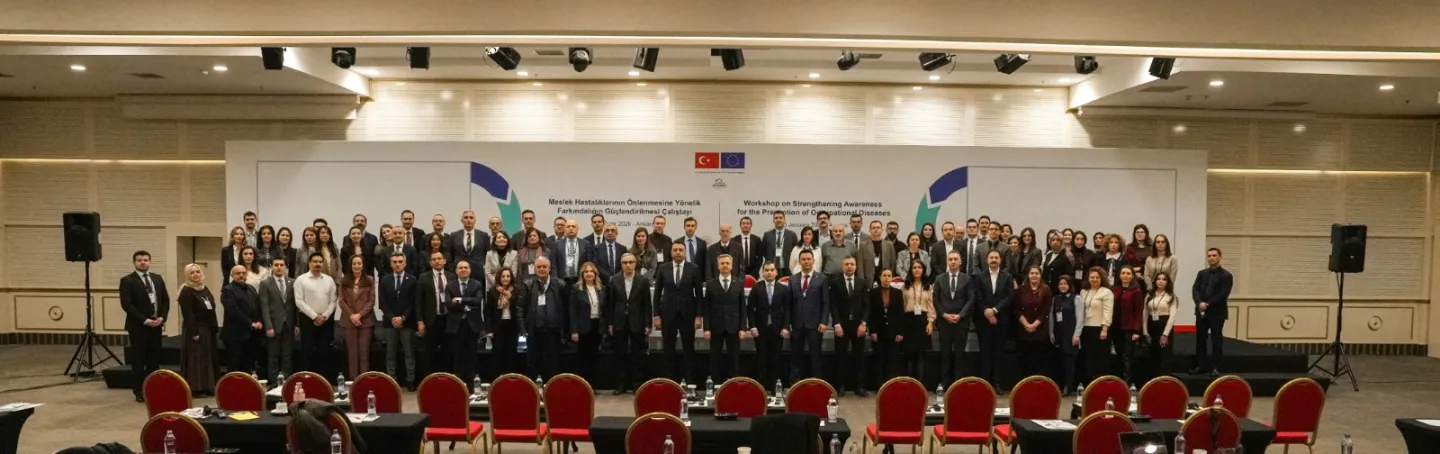
ANKARA (ILO News) – The Workshop on Strengthening Awareness for the Prevention of Occupational Diseases was held on 20 January 2026 in Ankara within the framework of the “Workplace Compliance through Labour Inspection Guidance and Social Dialogue Project” which is implemented in cooperation with the International Labour Organization (ILO) and the Directorate of Guidance and Inspection (DoGI) of the Ministry of Labour and Social Security, and is financed by the European Union under the Instrument for Pre-Accession Assistance (IPA III).
The workshop brought together representatives from public institutions, academia, workers’ and employers’ confederations, professional and civil society organizations. It aimed to increase awareness of occupational diseases in Türkiye, address national-level challenges in diagnosis, recording, and notification processes, strengthen inter-institutional cooperation, and promote preventive practices.

Opening remarks were delivered by Bekir Aktürk, Director of the Directorate of Guidance and Inspection of the Ministry of Labour and Social Security, and Yasser Hassan, Director of the ILO Türkiye Office. In his address, Bekir Aktürk emphasized that occupational diseases are largely preventable through systematic and determined efforts. He underlined that the proactive inspection and guidance approach adopted under the project seeks to strengthen compliance with occupational safety and health legislation, promote a culture of prevention, and ensure that decent working conditions become sustainable across all workplaces. Aktürk also highlighted the role of social dialogue mechanisms in bringing all parties together on common ground, contributing both to the protection of workers and to the creation of fair and sustainable working environments for employers. He expressed confidence that the cooperation established through the project would increase awareness of occupational diseases and yield tangible results in practice.

Speaking online, ILO Türkiye Office Director Yasser Hassan stressed that the prevention of occupational diseases lies at the heart of the decent work agenda, noting that the majority of work-related deaths worldwide are caused by occupational diseases. Referring to challenges in the detection and reporting of occupational diseases in Türkiye, Hassan emphasized the critical importance of early diagnosis, reliable data, strong institutional coordination, and increased awareness for effective prevention policies. He also highlighted the need for a robust national occupational safety and health framework based on international labour standards and social dialogue, stating that the workshop contributes to the development of practical solutions at the field level.

During the morning session, Assoc. Prof. Mehmet Erdem Alagüney from Ankara Bilkent City Hospital of the University of Health Sciences delivered a comprehensive presentation on challenges in the diagnosis, recording, and notification of occupational diseases in Türkiye. His presentation covered current data on the most common occupational diseases, the role of authorized hospitals in the diagnostic process, the importance of early diagnosis and medical surveillance, and the responsibilities of workplace physicians.
Dr. Canan Demir, Assistant Professor at Dokuz Eylül University Faculty of Medicine, addressed the difficulties faced by workers after receiving an occupational disease diagnosis, as well as opportunities related to rehabilitation and reintegration into working life.
Joining online from ILO Headquarters, Dr. Shengli Niu from the ILO Occupational Safety and Health and Working Environment Branch presented international labour standards related to occupational diseases, including ILO Conventions No. 121, 155, 161, and 187, and shared insights on global developments. He emphasized the importance of proactive and preventive approaches, as well as effective data collection and monitoring systems.

In the afternoon panel session, moderated by Levent Sözen, Chief Labour Inspector at the Directorate of Guidance and Inspection, representatives from academia and workers’ and employers’ confederations shared field experiences on the detection and prevention of occupational diseases. Dr. Bilginer Dinke, Workplace Physician at the TİSK Confederation; Barış İyiaydın, Social Security Advisor at the TÜRK-İŞ Confederation; Mert Demir, Chair of the Occupational Safety and Health Committee of the HAK-İŞ Confederation; Erdoğan Demir, Secretary General of Dev Sağlık-İş and Organization Specialist at the DİSK Confederation; and Assoc. Prof. Cebrail Şimşek, Training Supervisor at the Occupational Diseases Training Clinic of Ankara Atatürk Sanatorium Training and Research Hospital, University of Health Sciences, discussed early diagnosis and prevention mechanisms, social dialogue, data sharing, and gender equality in occupational diseases.
The workshop concluded with a question-and-answer session and closing remarks. The event is expected to contribute to raising awareness of occupational disease prevention in Türkiye, expanding preventive practices, and strengthening cooperation among stakeholders.