

News
The ILO research provides evidence-based data and policy recommendations for the prevention of workplace violence and harassment
The results of the “Perceptions and Experiences of Workplace Violence and Harassment Research,” first study of its kind in terms of scope, conducted with 3,007 respondents as a collaborative effort between the International Labour Organization (ILO) and Özyeğin University, reveal that more than 75% of employees in Türkiye have experienced workplace violence at least once during their careers
15 October 2024
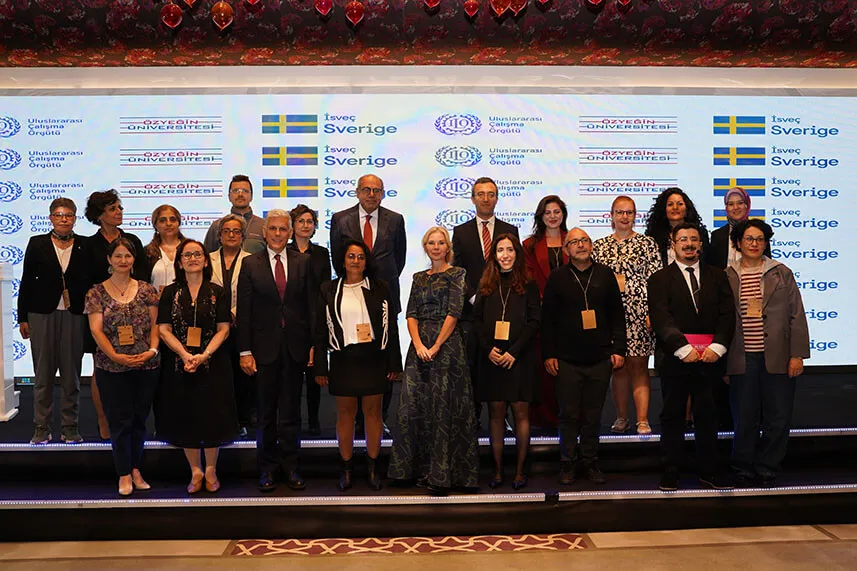
The results of the first study of its kind on workplace violence and harassment in Türkiye, conducted in collaboration with Özyeğin University as part of the "More and Better Jobs for Women" program led by the ILO Türkiye Office with funding from Sweden, were shared with the public at a meeting held in Istanbul on October 16, 2024.
The event, attended by Yasser HASSAN, Director of the ILO Türkiye Office; Malena MARD, Swedish Ambassador to Ankara; Prof. Dr. Barış TAN, Rector of Özyeğin University; and Suat DEDE, Deputy Director General of Labour at the Ministry of Labour and Social Security, highlighted the striking findings of the research.
Study focuses on different types of violence and sectors, offering policy recommendations
The study is the first large-scale research to focus on physical, psychological, sexual, and economic violence, as well as discrimination and sectoral differences. It provides important data on perceptions and experiences of workplace violence and the information and experiences of employees regarding referral and support mechanisms available to them. The research report offers concrete policy recommendations for policymakers, public institutions, and worker and employer organizations concerning the world of work. The research design and the resulting policy recommendations were developed taking into account the views of relevant public institutions and worker and employer organizations.
Convention No. 190: A Guiding Framework for the Research
In 2019, the ILO adopted the Violence and Harassment Convention to prevent violence and harassment in the world of work. With this convention, the ILO aimed to fill the data gap on workplace violence and harassment. In 2021, the ILO's headquarters conducted a global study to analyze the frequency of physical, psychological, and sexual violence and harassment in the workplace, as well as the challenges of disclosing such incidents, publishing the report titled "Violence and Harassment in the World of Work: The First Global Study." In line with these global initiatives, the ILO Türkiye Office, in collaboration with Özyeğin University, conducted a comprehensive household survey to shed light on perceptions and experiences of workplace violence and contribute to closing the data gap on this issue.
The study aims to identify, in general, the prevalence of different types of violence among various demographic groups, the level of employees' awareness of violence, and the coping strategies they use in response to violence.
Key Findings: Violence and Harassment: A Widespread Issue
Key findings from the research show that workplace violence and harassment is a widespread problem affecting both women and men in various industries. Some of the key findings are listed below.
- More than 75% of respondents reported experiencing at least one form of workplace violence at least once during their careers.
- There is a significant gap between perceived and experienced violence across all types. This finding indicates a general lack of awareness regarding workplace violence.
- Around 60% of respondents reported experiencing economic violence during their careers. Respondents in the private sector reported significantly higher levels of economic violence (almost double) compared to those in the public sector.
- Psychological violence is widespread, with almost half of all employees, regardless of gender, experiencing it. Women in managerial positions experience psychological violence more often than their male counterparts in managerial positions and women in non-managerial roles.
- Sexual violence disproportionately affects women, with one in four women experiencing it at least once in their working lives. The prevalence of sexual violence among women is more than twice that of men.
- One-third of respondents reported experiencing physical violence at work. Men experience physical violence more frequently.
- One in five respondents has been the target of discrimination. Discrimination based on gender and attire and/or appearance was more commonly reported by women, while men reported higher rates of discrimination based on ethnicity and religion.
- Violence is not an isolated incident. Those who experience one form of violence are likely to encounter others. The fact that more than half of the respondents experienced two or more forms of violence highlights how severe and widespread violence is.
- While employees with low education levels experience psychological, economic, and physical violence more frequently, those with high education levels are more likely to experience sexual violence.
- Workplace violence has a negative impact on employees' job satisfaction, job engagement, and general well-being.
- One-third of the respondents who quit their jobs cited economic violence as a major reason for leaving.
- Almost 90% of respondents reported that their organizations do not provide sufficient information about workplace violence, indicating a lack of efforts to increase knowledge and awareness.
- Those who witness violence prefer to remain silent and passive to a great extent. This finding shows that those who have been subjected to violence may be deprived of the support that is critical for them.
- Union membership provides employees with protection against workplace violence, particularly sexual violence and discrimination.
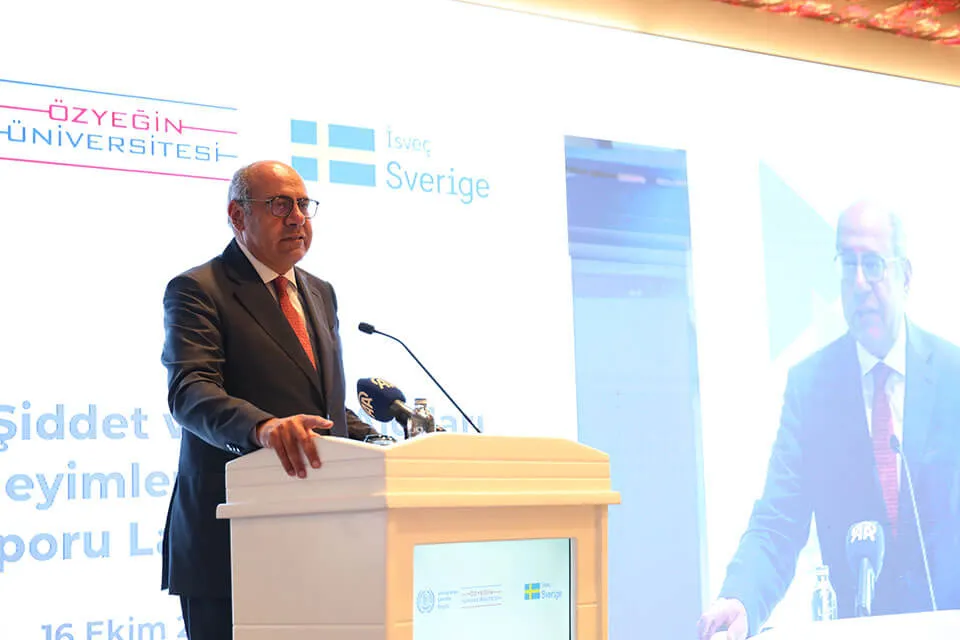
ILO Türkiye Director: "I Hope the Research Will Lay the Groundwork for National Policies and Cultural Transformations"
Highlighting the importance of evidence-based data and social dialogue in combating workplace violence and harassment, ILO Turkey Office Director Yasser Hassan stated, "Violence and harassment in the workplace are a threat to the right to work. The Violence and Harassment Convention No. 190, adopted in 2019, is one of the key tools of the ILO that provides guidance for preventing violence and harassment in the world of work."
"To combat violence and harassment in the workplace, it is crucial to develop policies through a social dialogue approach involving governments, workers' and employers' organizations. The most critical need in this process is evidence-based data to develop effective policies. In this regard, the data presented in Turkey's first research report, which brings together the experiences of both women and men across various sectors, is highly valuable and important for shaping these policies. I hope that the policy recommendations in this research will guide policymakers, workers' and employers' organizations, and the private sector in the fight against violence and harassment in the workplace; ultimately laying the foundation for national policies and cultural transformations towards equality," he said.
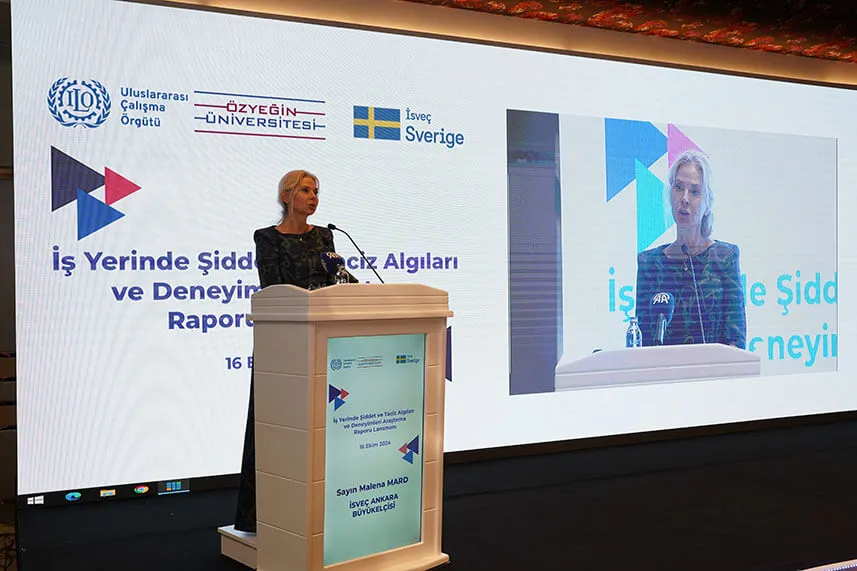
Swedish Ambassador to Ankara: "The Research Will Undoubtedly Play a Key Role in Shaping Effective Policies."
Swedish Ambassador to Ankara, Malena Mård, stated, "ILO continues to promote zero tolerance for violence and harassment in the workplace. This research, conducted in collaboration with Özyeğin University, is the first of its kind in Turkey on workplace violence and harassment, and it is a crucial step in understanding the prevalence and impact of this phenomenon."
Ambassador Malena Mård added, "As Sweden, we are proud to support the 'More and Better Jobs for Women Program,' which has made this important research on violence and harassment, a critical issue in Sweden as well, possible within the framework of our ongoing bilateral cooperation with Turkey. I believe that this research, by shedding light on these critical issues, will play an important role not only in creating safer working environments for everyone but also in shaping effective policies on workplace violence and harassment."

Suat DEDE, Deputy Director General of the Ministry of Labour and Social Security, stated, "Violence and harassment encountered in the world of work, regardless of the type, is a human rights issue that can happen to any worker, irrespective of age, gender, educational level, or hierarchical position."
"The Ministry of Labor and Social Security places great importance on combating all forms of harassment and violence to ensure safe, healthy, and decent working conditions for all employees, in line with our vision of establishing labour markets where such conditions are met," he emphasized.
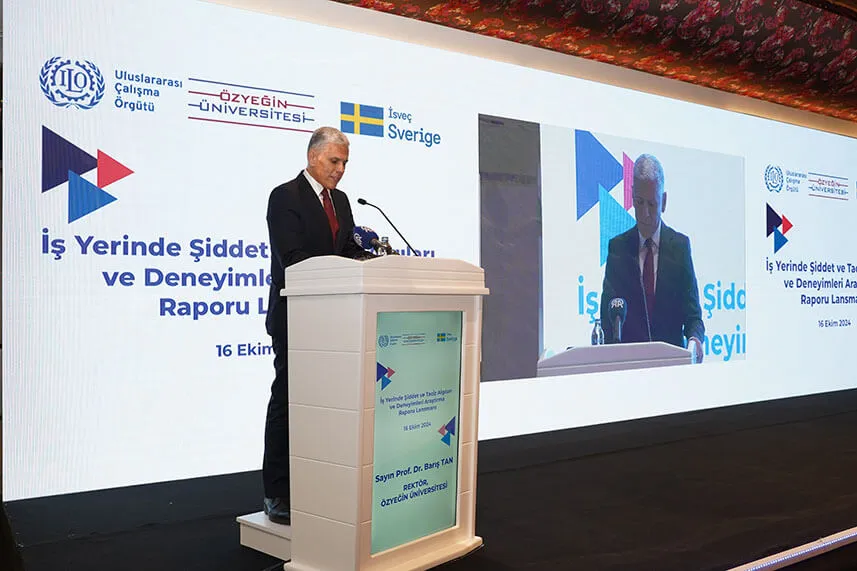
Prof. Dr. Barış TAN, Rector of Özyeğin University, stated, "With this study, we have acted in alignment with our mission as a research university and reached results that will shed light on the business world. Through this collaboration with our valuable partner ILO, we aim to create a global impact, scientifically, socially, and economically, as an institution, against all forms of violence."
The research involved face-to-face interviews with over 3,000 individuals
In the study conducted in collaboration between the ILO and Özyeğin University, the prevalence of five types of workplace violence and harassment was surveyed in the context of Istanbul. The types of violence focused on included psychological violence, discrimination, economic violence, physical violence, and sexual violence. The research was carried out through face-to-face interviews with 3,007 households living in Istanbul between May and July 2024.