

ILO – Kampung Halaman Foundation to launch a series of videos and photos on domestic workers by Indonesian youth in Makasssar
To promote the rights of domestic workers, the ILO in collaboration with Kampung Halaman Foundation (YKH), will launch a series of video diaries and photo stories titled “Fom Youth to Youth: Nine Stories of Our Friendship with Domestic Workers” on Tuesday, 16 June 2015, at Panakukkang XXI, Panakukkang Mall, Makassar. These video diaries and photo stories are part the campaign to promote decent work for domestic workers and elimination of child domestic labour.
16 June 2015
To promote the rights of domestic workers, the ILO in collaboration with Kampung Halaman Foundation (YKH), will launch a series of video diaries and photo stories titled “Fom Youth to Youth: Nine Stories of Our Friendship with Domestic Workers” on Tuesday, 16 June 2015, at Panakukkang XXI, Panakukkang Mall, Makassar. These video diaries and photo stories are part the campaign to promote decent work for domestic workers and elimination of child domestic labor, launched in conjuntion with the commemoration of the World Day Against Child Labour and the Internatitonal Domestic Worker Day which fall on 12 June and 16 June, respectively.
The campaign is conducted by the ILO through its Promoting Decent Work for Domestic Workers to End Child Domestic Work (PROMOTE) Project. Funded by the United States Department of Labour (USDOL), PROMOTE Project aims at reducing child domestic workers significantly by building institutional capacities of partners to promote Decent Work for Domestic Workers (DWDW) effectively. The Project works to increase the knowledge, skills and expertise on reducing child domestic workers and promote DWDW.A video diary method is a method that can help participants recognizing their life experiences so that they can freely respond to them and turn these experiences into personal or group advocacy tools. We wish these videos will help the public at large to listen and understand voices and perspectives of youth regarding their interaction with domestic workers and domestic workers."
Rachma Safitri, Executive Director of YKH
The first of its kind, these videos are produced by 25 youth aged 12-17 years old, selected from hundreds of youth, in Jakarta dan Makassar, showing the roles of domestic workers in their lives, their daily interaction with their domestic workers and the lives of domestic workers from the eyes of their teenager children. Using their own words and selection of scenes, these videos document daily lives, plights, journeys and hopes of the domestic workers. These videos consist of four video diaries and five photo stories with a total duration of 90 minutes.
“The ILO trusts that these participatory videos will raise awareness and a sense of importance in the public of the domestic workers’ contribution to our society. Domestic workers needs to be recognized as workers just like any other workers like you and me. Awareness of existence of child domestic labour is also important. The elimination of child labour is strongly supported by the national roadmap of elimination of child labour so we should continue our campaign as a nation towards elimination of all child labour”, stated Michiko Miyamoto, the ILO’s Officer-in-Charge in Indonesia, commenting the launch of these participatory videos.
The production of these participatory videos and photo stories started with a two-day workshop on video and photo making participated by more than 200 youth from various schools in Jakarta and Makassar. During the workshops, participating youth worked in group of two to five people independently in identifying their own experiences with domestic workers and in exploring angles on the contribution of domestic workers to their families using a so-called video diary method.
“A video diary method is a method that can help participants recognizing their life experiences so that they can freely respond to them and turn these experiences into personal or group advocacy tools. We wish these videos will help the public at large to listen and understand voices and perspectives of youth regarding their interaction with domestic workers and domestic workers’ contribution to their families,” said Rachma Safitri, Executive Director of YKH.
The workshops began with efforts to identify problems and challenges that could be developed into stories. Together with the mentors, various methods to identify problems were used, such as role plays, group discussions and visual as well as non-visual research. The workshop was concluded with the selection of the winning four video diaries and five photo stories by practitioner jurors, with the youngest group from an elementary school.
Dian Herdiany, one of the mentors admitted that it was not easy for the participants to explore the stories on their domestic workers. “Although domestic workers are part of their daily lives, most of them do not know their domestic workers. Some of them are even not aware of the existence of their domestic workers, particularly for the not-live ones. Thus, they learnt more about their domestic workers and their contribution to their lives during the workshop.”
The workshop continued with the story development and production process (shooting, pictures taking and script writing) for the selected group of 25 youth. The workshops also involved their families and schools. After the finalization, each video and photo story has been screened at schools, followed by an interactive discussion with participating students on the roles of domestic workers.
All the works and production processes, including participants and mentors, for all the video diaries and photo stories are documented through social media channels to enhance the awareness of the public at large about issues related to domestic workers, particulary for young people. The behind the scene information can be accessed through Facebook “temansetara” and twitter @temansetara with hashtag #temansetara.
In collaboration with Cinema XXI, the largest cinema chain in the country, a similar launch was conducted in Jakarta on 12 June at Epicentrum XXI. Conducted in conjunction with the commemoration of the World Day against Child Labour and the International Domestic Worker Day, the launch also presented school students who produced these videos.
For further information please contact:
Arum RatnawatiILO’s Chief Technical Adviser for Domestic Workers
Tel.: +6221 3913112 ext. 130
M. Rasyidi Bakri
ILO’s Project Officer for Domestic Workers in Makassar
Gita Lingga
ILO’s Communications Officer
Tel.: +6221 3913112 ext. 115
Rachma Safitri
Executive Director of Kampung Halaman Foundation
Tel.: +62274 7478602, +62274 8356556
Related content
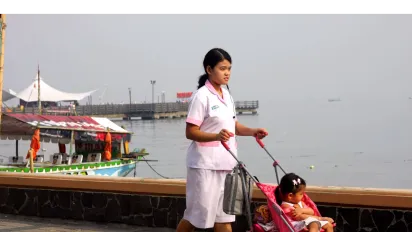
PROMOTE: Decent Work for Domestic Workers to End Child Domestic Work

Synopsis of Nine Stories of Our Friendship with Domestic Workers: From Youth to Youth Programme (Teman Remaja Teman Setara)