

Cooperatives
ILO highlights global lessons as Trinidad and Tobago drives co-operative transformation
The National Co-operative Conference in Trinidad and Tobago brought together leaders, experts, and practitioners to redefine the role of co-operatives and credit unions in national development, with the ILO providing critical global insights to guide the movement’s modernization.
14 November 2025
Port of Spain, Trinidad and Tobago (ILO News)- From 12 to 14 November, 2025, Trinidad and Tobago's Co-operative Movement reached a defining moment at the National Co-operative Conference organised and hosted by the Elma Francois Institute, Cipriani College of Labour and Co-operative Studies (CCLCS) in collaboration with the Cooperative Credit Union League of Trinidad and Tobago (CCUM TC). Under the theme “Repositioning the Co-operative Movement as a Strategic Driver in National Development,” the three-day summit united sector leaders, scholars, youth advocates, and international partners to reimagine co-operatives as pivotal engines for a more equitable and resilient economy.
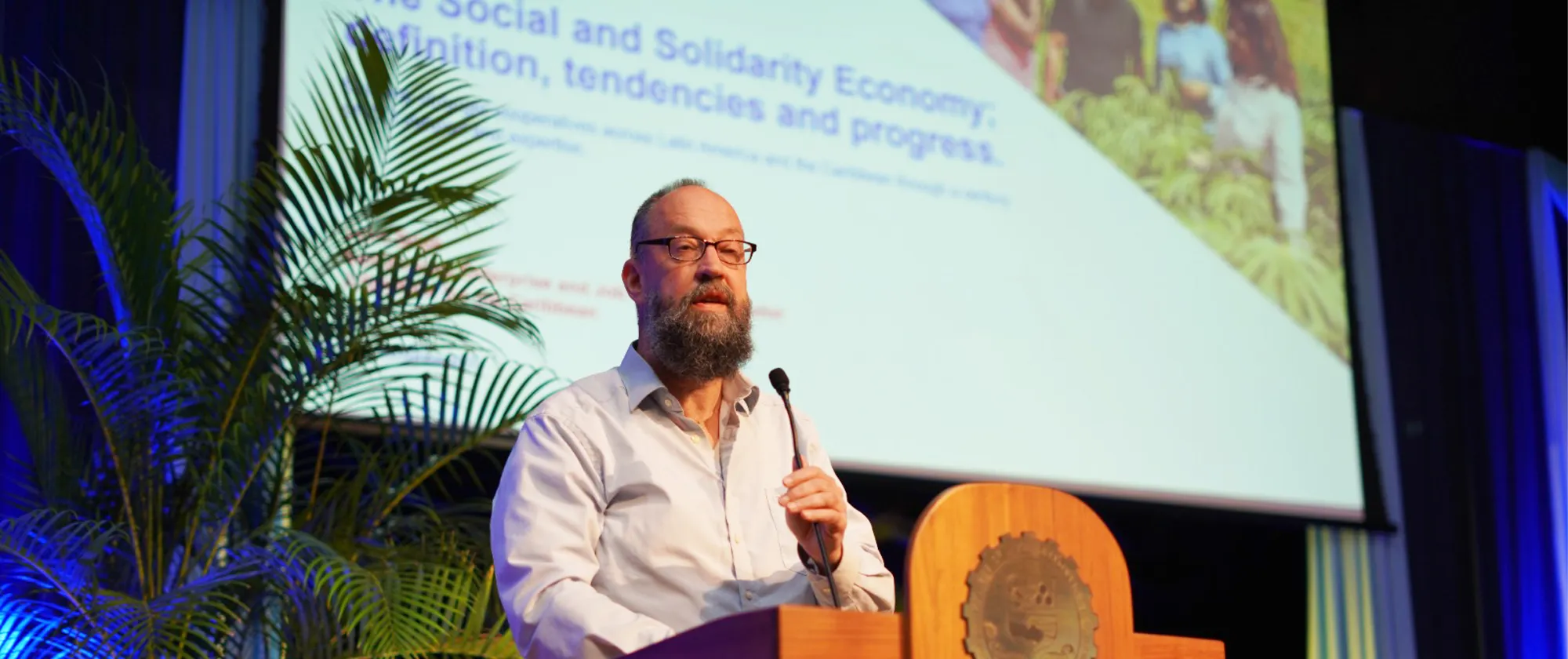
The International Labour Organization (ILO), a long-standing partner in co-operative development across the Caribbean, played a central role in shaping the discussions. On November 13, John Bliek, ILO Specialist, Sustainable Enterprise Development and Job Creation, delivered a well-received presentation on the Social and Solidarity Economy (SSE), which underscored the growing importance of cooperatives and other SSE entities in driving inclusive, sustainable development across the Caribbean. He highlighted that cooperatives, built on democratic participation, mutual aid, and social purpose, remain vital engines of decent work, rural livelihoods, and economic resilience. With global evidence showing that cooperatives provide jobs or work opportunities to 10% of the world’s employed population, Bliek stressed that strengthening the cooperative sector is not only relevant but essential for addressing informality, supporting agriculture, and expanding financial inclusion in the region.
Bliek also pointed to the ILO’s long-standing leadership in cooperative development, emphasizing the Organisation’s expanding tools, training systems, and policy support. He presented examples from Latin America and the Caribbean where ILO technical assistance has strengthened agricultural value chains, improved farmer incomes, and expanded market access. He shared the impact of targeted capacity-building tools such as the ILO’s My.COOP and Our.COOP training packages.
The ILO Specialist noted that Caribbean countries stand to benefit significantly from more enabling legal frameworks, better cooperative statistics, and stronger institutional ecosystems, especially as the region faces climate impacts, market volatility, and outmigration of young workers. He stressed the necessity of measurement at all levels to be able to adjust and track progress, starting with self-assessment at the level of the cooperative. The measurement and follow up to the cooperatives and credit unions will require a holistic all government approach.
Bliek also highlighted the Caribbean’s potential, noting that “the region has the talent, tradition, and community strength to lead a new generation of co-operative innovation, what is needed now is alignment and action and stronger integration of youth and women." He concluded that with the right support, cooperatives can play a transformative role in building greener, more competitive, and more resilient economies across Latin America and the Caribbean. Cooperatives and MSMEs are key drivers of the just transition needed for a sustainable future.
Diverse national perspectives shape the future
In his presentation to the conference, Mr. Colin Bartholomew, Programme Dean for Co-operative Studies and lead on Innovation and Enterprise Development at CCLCS issued a compelling call to action for participants and organisations to, “Move from survival to sustainability, from isolation to integration, for tradition to transformation. Re-imagine the movement's future, invest in co-operative leadership, unite to build a resilient, inclusive Caribbean economy.”
The commitments needed to respond to this call were crystallized in a final National Conference Declaration issued by the CCUM TC. The Declaration outlines a clear set of priority actions to strengthen the co-operative sector as a driver of national development, beginning with accelerating legislative reform, modernising governance systems, and embracing digital transformation. Delegates agreed on “supporting legislative reform, strengthening regulatory frameworks, and aligning national co-operative policies with the revised ICA Statement and the Sustainable Development Goals,” while committing to build institutional capacity for risk-based supervision, transparent governance, data-driven decision-making, and shared services. The Conference also underscored the movement’s responsibility to deepen financial inclusion, particularly for youth, women, migrants, rural communities, and informal-economy workers, through expanded microfinance, accessible digital financial products, and targeted social protection mechanisms.
Looking ahead to 2030, participants endorsed a forward-leaning action agenda that places digital innovation, climate resilience, and youth leadership at its centre. The Declaration calls for the creation of a “Co-operative Digital Readiness Roadmap (2025–2030)” to guide mobile-first services, secure payments, fintech partnerships, and cyber-resilience across the movement. It also commits co-operatives to invest in green initiatives, disaster-preparedness, and community-based resilience, while advancing leadership succession through youth accelerators, innovation labs, and expanded education programmes.
Collectively, these commitments signal a sector prepared to evolve, adapt, and lead - transforming co-operatives into a dynamic engine of inclusive and sustainable development for Trinidad and Tobago.
With the ILO’s technical support and global perspective, alongside national dedication, Trinidad and Tobago’s Co-operative Movement is poised to make a transformative contribution to sustainable development, economic recovery, and better livelihoods.