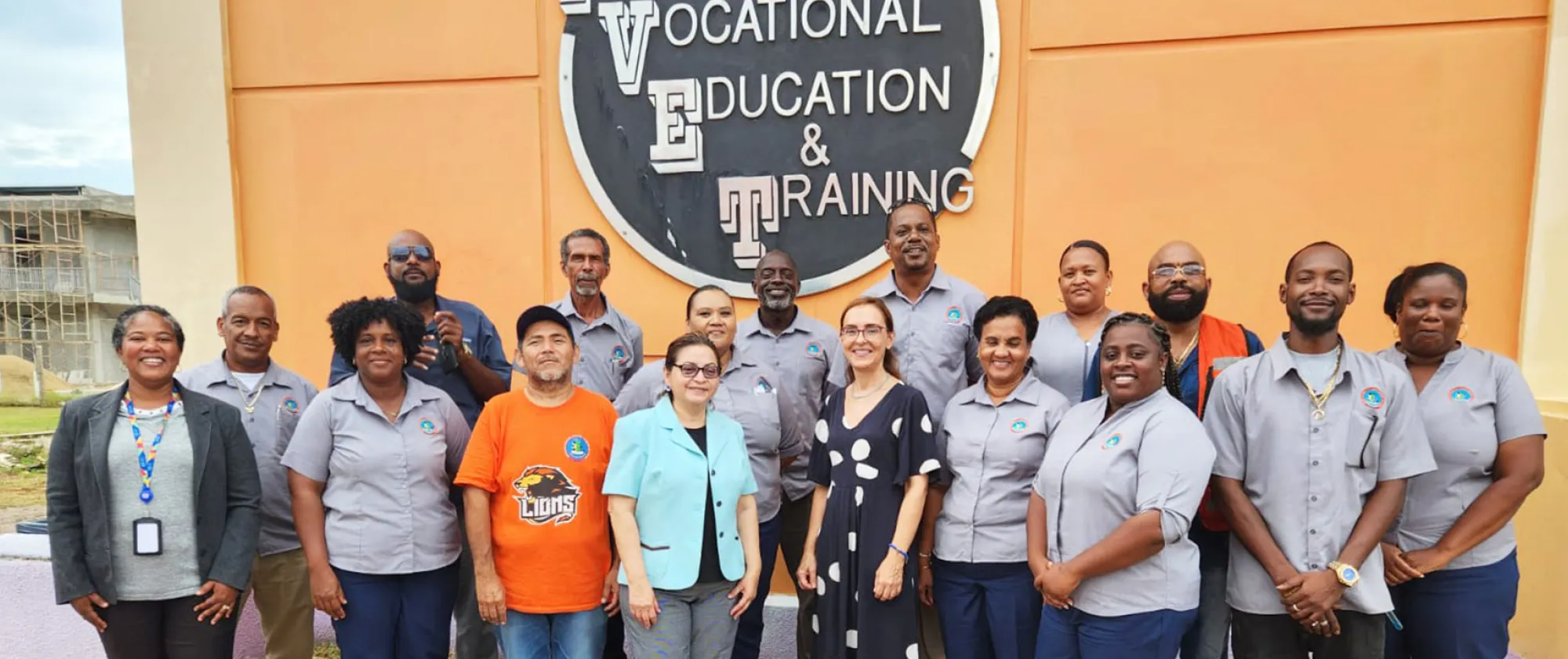
The Government of Belize and the International Labour Organization (ILO) Decent Work Team and Office for the Caribbean are working together to improve the quality of Technical and Vocational Education and Training (TVET) and skills development across the country.
The partnership will support training institutions, policymakers, employers’ and workers’ organizations, and academia so they can all contribute to strengthening the national TVET landscape to effectively meet labour market needs. The collaboration draws upon ILO's skills-focused activities under the Joint Sustainable Development Goal (SDG) Fund Programme: “Building a resilient Belize through universal, adaptive and sustainable social protection”.
Key beneficiaries include the Ministry of Education, Culture, Science and Technology (MOECST), Institutions for TVET (ITVET), the Centre for Employment Training (CET), the National Trade Union Congress of Belize (NTUCB), the Belize Chamber of Commerce and Industry (BCCI), and the University of Belize.
Programme support will boost current efforts by the MOECST to grow TVET and upgrade its status through accredited programmes that will ensure quality education and pathways to employment for all.
Transforming TVET in Belize will also require governance and a renewed commitment to social dialogue. The ILO Caribbean team is working with national partners to discuss the representation of employers’ and workers’ organizations and other relevant entities in the design, implementation, monitoring and evaluation of skills development systems and TVET programmes.
While on mission to Belize from 26 to 30 June 2023, ILO Caribbean Skills and Lifelong Learning Specialist, Ms. Ilca Webster, led meetings with national partners and beneficiaries including officials of four vocational institutions: ITVET in Hope Creek, ITVET in Orange Walk, TVET in Belize City, and the CET in San Ignacio. During her meetings, she conducted a rapid assessment of the institutions to understand the way forward with TVET in Belize and alignment with the ILO's Standard on Quality Apprenticeships adopted at the 111th ILC in June 2023.
The visit was co-led by the Government of Belize Team: Ms. Yolanda Gongora, Chief Education Officer, with support from Ms. Laura J. Flores, Deputy Chief Inspector of Schools, and Mr. Elvis Franklyn, Education Officer, with support from the National Project Coordinator, Pamela Ann Bradley.
“The ILO is proud to partner with the Government of Belize to ensure that the country’s TVET system will gain a more enabling environment that provides greater access, established targets, and resources including people, skills and funding. These expected outcomes will help to ensure that TVET and skills development programmes are effectively designed and equip learners with skills that respond to the current and future labour market needs and safeguard the inclusion of young females, migrant communities, and persons with disabilities,” said Ms. Webster.
“TVET towards sustainability using competency-based education will meet SDG 4 - Quality Education - and SDG 17 – Partnerships for the Goals. Step by step we will prosper,” said Chief Education Officer, Ms. Gongora of the Programme’s aim to enhance the TVET system in Belize.
“Reform for TVET is key in Belize and should be marketed more as TVET is a part of the foundation of every developing nation. It is important to sensitize the business sector to know that their investment is a win-win and they will spend less money to train. The National Training Agency will need to be autonomous with its proper resources to address all the needs of TVET of our developing nation for TVET to be formed by people with passion and a good track record. Economic prosperity can easily come by starting with investing in TVET,” said Mr. Armando Gomez, Manager of the ITVET in Orange Walk.
“TVETs should be inclusive to serve national needs,” said Dr. Vincent Palacio, President of the University of Belize, during his discussion with Ms. Webster and other officials on labour market realities including an increase in the participation of women and youth in job markets.
Repositioning the TVET system will help the people and businesses of Belize become more competitive and productive, support economic growth, reduce inequalities and lead to a higher standard of living that will empower lives. These outcomes directly fulfil priority areas of the Joint SDG Fund Programme: “Building a resilient Belize through universal, adaptive and sustainable social protection”, particularly Shared Prosperity and Economic Resilience as well as Equality, Well-being and Leaving No One Behind.
For more information, please visit the ILO's website.