

The ILO enhances trade unions' knowledge and compliance with labour laws in Indonesia
The ILO's Strengthening Industrial Relations in Indonesia (SIRI) initiative has enhanced trade unions' capacity for policy engagement by providing a labour law guideline and conducting an impact study.
16 April 2025
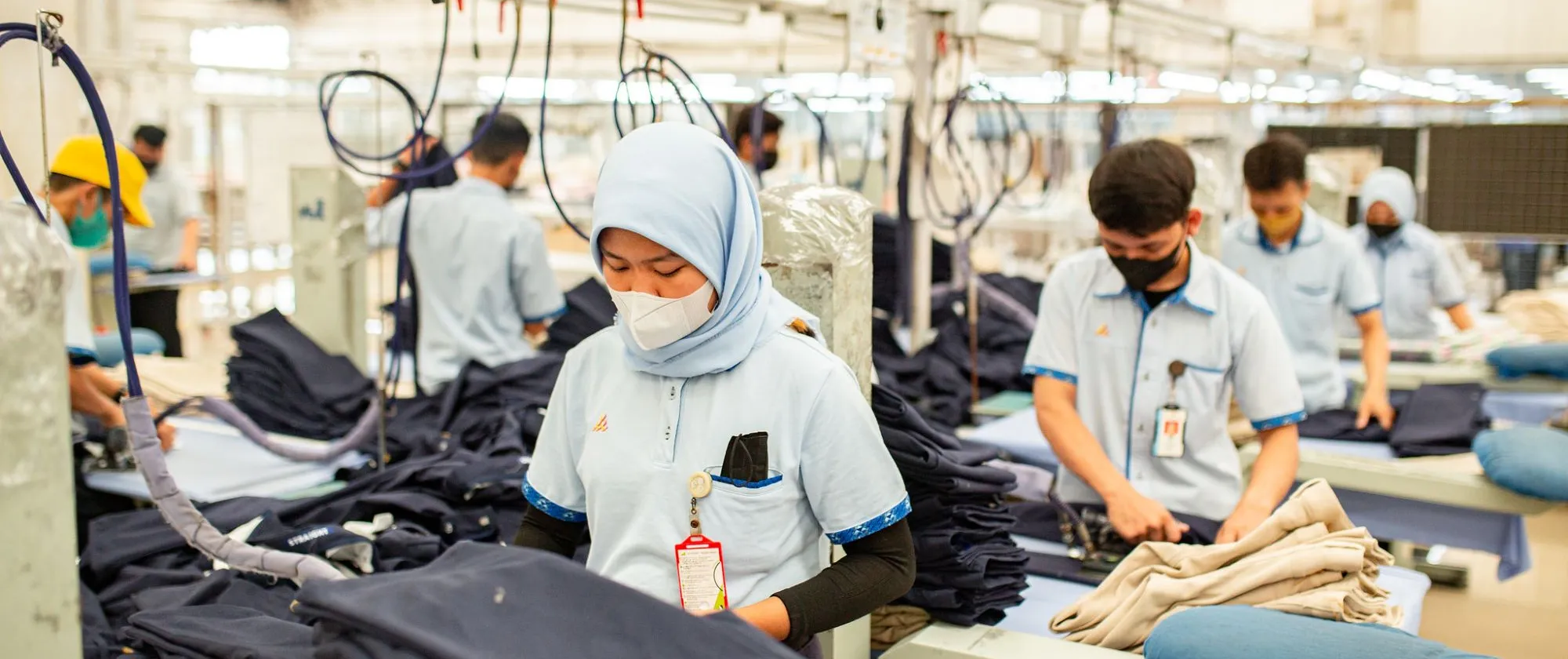
JAKARTA, Indonesia (ILO News) - Recent labour law reforms have significant implications for work conditions and the evolving nature of labour, presenting new challenges for trade unions such as increased economic hardship, declining trade union influence and emerging obstacles in the future of work. Thus, to support and revitalize the Indonesian trade unions as its main mandate, the ILO’s Strengthening Industrial Relations in Indonesia (SIRI) has supported the strengthening of trade unions’ policy engagement capacities through the development of a labour law website and a study on the impact of the Employment Cluster Regulation under the Job Creation Law to the fixed-term employment contracts in the garment sector.
The Labour Law Guideline

One of the key achievements of the ILO’s SIRI project was its contribution to the development of a labour law website, in collaboration with Better Work Indonesia (BWI), a partnership programme between the ILO and the International Finance Corporation (IFC). This Labour Law Guideline covers all the necessary day-to-day provisions required by parties in the workplace, including trade unions, as well as for officials, particularly in the field of employment.
The Guideline presents a detailed compilation of national labour regulations at all levels, encompassing the National Constitution, labour-related laws and acts, government and presidential regulations/decrees, as well as ministerial, director general, provincial, governor, and district-level regulations/decrees. These regulations serve as references for addressing nine key labour issues: Child Labor; Discrimination; Forced Labor; Freedom of Association and Collective Bargaining; Compensation; Work Agreements and Human Resources; Occupational Safety and Health; Working Hours; and Industrial Relations and Dispute Resolution.
In addition, the Guideline provide a series of instructional videos on dispute settlement, prevention of sexual harassment at work and other employment issues as well as a simulator that can be used by viewers to calculate payment for overtime, severance pay and the Religious Holiday Allowance (THR); The simulator is free and easy-to-use tool for performing basic calculations that can be done by the management and workers.
To date, the website has been visited by more than 31,000 viewers.
The impact study of the Job Creation Law to the fixed-term employment contracts in the garment sector
As a response to the Job Creation Law or so-called “Omnibus Law” which has introduced significant reforms to labour legislation, particularly impacting industries that rely heavily on contract-based workers, the ILO’s SIRI conducted a study focusing on the Employment Cluster Regulation within the Law and assessed the most prominent changes on fixed-term employment contracts (PKWT) that have sparked debate across various groups, including policymakers, trade unions, employers and workers on critical themes such as job security, wages, and working conditions.
While acknowledging the law’s goals of boosting investment and economic growth, the study critically examines its impact on worker welfare. The study also contributes to broader conversations about fostering equitable and sustainable employment policies in Indonesia by aligning with global labour standards.
Nurus Mufidah, Project Coordinator of the ILO’s SIRI
This study focuses on the Employment Cluster Regulation within the Job Creation Law, analysing its effects on workers in the garment industry—a key pillar of Indonesia's labor-driven economy. By exploring the legal context, recent court decisions, and real-world scenarios, the study provides a comprehensive look at the law’s implementation, highlighting its benefits alongside unexpected challenges.
“While acknowledging the law’s goals of boosting investment and economic growth, the study critically examines its impact on worker welfare. The study also contributes to broader conversations about fostering equitable and sustainable employment policies in Indonesia by aligning with global labour standards,” stated Nurus Mufidah, Project Coordinator of the ILO’s SIRI.
Based on thorough analysis, extensive stakeholder engagement, and comprehensive data collection, the study presents a balanced viewpoint along with key recommendations:
- Striking a balance between flexibility and protection: Flexibility enables businesses to adapt to changing economic conditions, but it must not undermine workers’ rights or job security.
- Promoting effective communication and outreach: Ensuring that both workers and employers are well-informed about new regulations is critical for smooth and successful implementation.
- Implementing robust enforcement mechanisms: Strong systems are necessary to ensure compliance with labour laws and safeguard workers’ rights.
- Ensuring protections for non-regular workers: Providing adequate benefits and protections for non-permanent employees is essential to prevent economic disparities and maintain social stability.
- Securing financial sustainability of social security programmes: Maintaining the long-term viability of these programmes is crucial for continued support to workers.
- Encouraging collaboration among stakeholders: A cooperative approach involving the government, employers, and labor unions can lead to fairer and more effective labour policies.
- Adapting labour regulations to industry-specific needs: Tailoring rules to address the unique challenges and requirements of different industries can improve their overall impact and practicality.
Related content

Strengthening Industrial Relations in Indonesia Project
Relevant projects
Strengthening Industrial Relations in Indonesia Project