

ILO and partners highlight pathways to post-crisis recovery in Syria through social dialogue
An ILO-led meeting in Damascus focused on the crucial role of decent work, social protection and labour rights towards realising social justice and sustainable peace in Syria.
5 May 2025
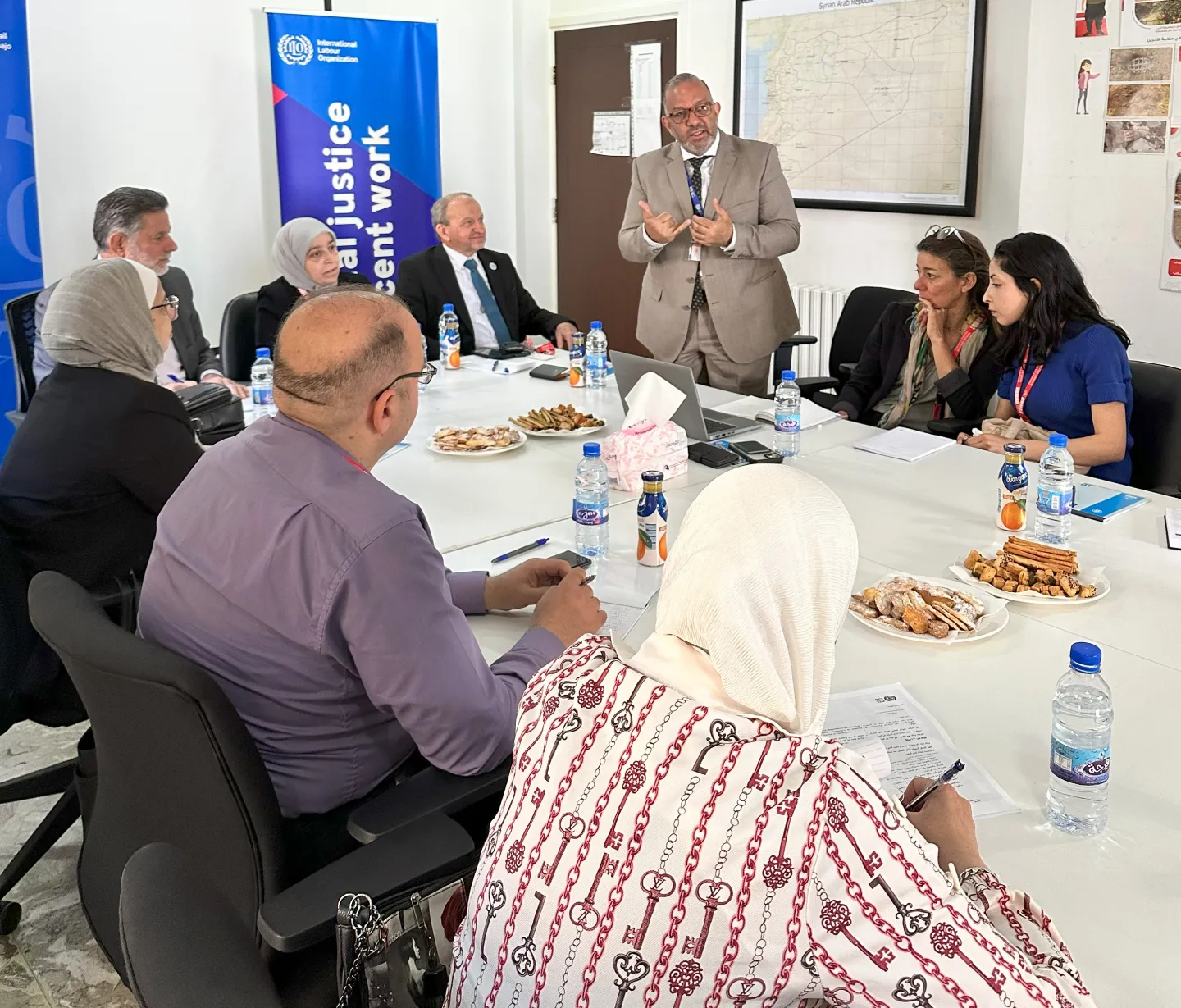
DAMASCUS (ILO News) - In a significant step toward strengthening cooperation between the International Labour Organization (ILO) and government, employer and worker representatives in Syria, an ILO-led meeting brough together representatives from the Ministry of Social Affairs and Labour (MoSAL), the Damascus Chamber of Industry (DCI) and the General Federation of Trader Union (GFTU). The event was hosted with the participation of ILO Syria Country Coordinator Anas Sabee, ILO Iraq Country Coordinator and Senior Resilience and Crisis Response Specialist for Arab States Maha Kattaa, and ILO Chief Technical Adviser and post-crisis recovery specialist Nieves Thomet.
The meeting served as an initial platform to build social dialogue around inclusive recovery and reconstruction efforts in Syria, focusing on decent jobs, social protection and labour rights towards realizing social justice and sustainable peace.
Opening the dialogue: A shared commitment
Highlighting the ILO’s commitment to creating decent work opportunities as a foundation for social cohesion and peace, Anas Sabee emphasized the importance of international labour standards, including those relating to the elimination of child labour, social protection and workplace safety. “This meeting marks a starting point for long-term collaboration,” he said, reiterating the ILO’s readiness to support Syria’s economic and labour market recovery in a manner that is inclusive and rights-based.
Chairman of the Damascus and Damascus Countryside Chambers of Industry, Ayman Mawlawi, expressed hope that the ILO would support efforts to reintegrate displaced Syrians and rebuild the industrial sector. “We are committed to working with the ILO. Our chamber is ready,” he noted.
Lessons from Iraq: A blueprint for transition
Maha Kattaa shared Iraq’s experience of transitioning from humanitarian response to development following years of conflict. She outlined how the ILO played a key role in shaping national employment policies, implementing employment intensive investment programs during crises, and gradually transferring ownership of initiatives to national institutions. “The path from crisis to stability involves empowering governments and social partners,” she said. “We must move from humanitarian aid to long-term development.”
Global perspective on recovery and labour rights
Nieves Thomet offered a broader perspective on the ILO’s post-crisis work globally. She highlighted the organization’s Nobel Peace Prize-winning role in promoting peace through social justice, labour standards, and tripartite dialogue. “The ILO is unique in representing governments, employers, and workers. This tripartism is essential for sustainable recovery,” she said. She stressed the value of Recommendation 205 on employment and decent work for peace and resilience, adopted at the International Labour Conference in 2017, which sets the framework for protecting labour rights during and after crises.
She underscored the importance of integrating decent work principles into humanitarian and recovery strategies, calling for close coordination between development actors and humanitarian agencies. “We must ensure that short-term responses are linked to long-term systems while addressing conflict drivers related to decent work deficits,” she stressed. This means that governments, employers and workers—the ILO’s constituents—must be actively involved from the very beginning of humanitarian efforts. Their early participation helps ensure that emergency responses are aligned with national priorities and can smoothly transition into long-term development that benefits the whole society.
National strategy: Challenges and path forward
Adviser to the Minister of Social Affairs and Labour Raghda Zedan outlined the strategic vision for transitioning from relief to development. She emphasized that the Ministry is working to create job opportunities, revise outdated labour laws, and address challenges posed by sanctions and economic instability.
“There is an urgent need to modernize our labour legislation and strengthen institutional capacities,” she noted. “We have developed a preliminary strategy outlining short, medium, and long-term goals based on current economic conditions.”
Director of the Planning and international cooperation Administration at MoSAL Ahmad al-Qasem also highlighted cooperation with the ILO on initiatives such as a planned labour force survey, and a pilot project creating 170 jobs in infrastructure rehabilitation despite the constraints imposed by sanctions.
Employers and workers voice their challenges
Industrialists and trade union representatives voiced their concerns about the economic hardships faced by businesses and workers alike. Director General of the Damascus Chamber of Industry Khaldoun Dadou described the launch of a new Human Resource Development and Training Center in Adra Industrial City in Damascus Countryside in cooperation with the ILO. The centre offers training courses to employees in the enterprises located in the Adra Industrial City, including on occupational safety and health and on first aid.
“Rising costs, outdated machinery, and foreign imports have severely impacted local industries,” he said. “We need continued support to revitalize production, increase exports, and bring back investors who are outside the country and need encouragement to come back and invest in their homeland.”
Voicing the position of workers, GFTU Secretary of Labour Affairs Bashar Khresteen emphasized the psychological and social toll of unemployment and poor working conditions. “Lack of decent work leads to increased crime, instability and social fragmentation,” he warned. He proposed the creation of a national training authority and a labour market observatory to better align skills with demand. GFTU Director of the regional Office in the Middle East Adnan Azouz said: “We aspire to decent work, but the reality is that there are not sufficient job opportunities. We would encourage having vocational training programmes for youth that can be linked to reconstruction efforts and aligned with international standards.”
Social dialogue as a cornerstone for peace
All participants agreed on the critical importance of social dialogue. Nieves Thomet cited the Tunisian example of the “Quartet,” through which social partners collaboratively designed a national platform for civic dialogue that earned them the Nobel Peace Prize. “This is the power of inclusive dialogue,” she said. “for sustainable Peace, recovery must involve everyone—government, employers, and workers.”
The meeting concluded with a shared commitment to building on this initial dialogue. Participants emphasized the need for sustained cooperation, technical support, and alignment with international labour standards. They stressed that as Syria moves toward recovery, the role of the government, workers, employers and the ILO will be vital in ensuring that the transition is inclusive, rights-based, and geared toward lasting peace and development.
Related content

Country Portal
Syrian Arab Republic