

ILO and Jurnal Perempuan examine the role of women in work and care economy
As part of the ILO’s campaign on care economy, a joint special edition was launched, in collaboration with Jurnal Perempuan to promote a greater investment in care economy for more gender equal world of work.
2 August 2024
JAKARTA, Indonesia (ILO News) - The ILO and Jurnal Perempuan, the Indonesian feminist journal, launched the second joint edition titled “Work and Care Economy”, examining the double burden faced by women in dealing with care work that has resulted in the stagnancy of women’s participation in the labour market. Still recognized as unproductive work, the launch, held last January, also marked the ILO’s continuous campaign in promoting a greater investment in care economy for building a better and more gender equal world of work.

Key issues highlighted by this joint edition included the qualitative research on the importance of redistribution of care work, policy gap on paid and unpaid care work, the promotion of maternity rights, the lack of support from the state and industry to women factory and home-based women workers, the urgency of domestic workers protection and social reproduction at the palm oil sector.
We urge the need for further education and training to support the involvement of men in care work through role models and champions who can voice gender understanding particularly at rural area or at enterprise level.
Abby Gina, Executive Director of Jurnal Perempuan
During interactive discussion, Early Dewi Nuriana, ILO’s Programme Coordinator for Care Economy, explained about the ILO support to the Ministry of Women’s Empowerment and Child Protection in developing a Road Map on Care Economy. The Road Map has identified the inter-ministerial coordination to ensure the implementation of care work policies and services under the authority of each relevant ministry.
“The Road Map focuses on prioritized programme activities for the next 20 years, contributing to the Indonesian Golden Goals on Adaptive Social Protection, Science, Innovation, Economic Productivity Quality Family and Gender Equality as part of the Long-Term National Development Planning. This road map is expected to contribute the increase of women workforce participation on 70 percent by 2045. This will involve inter-ministerial and inter-institution not only at the national level, but also at the regional level to build better and more gender equal in all aspects of life, including the world of work,” she stated.
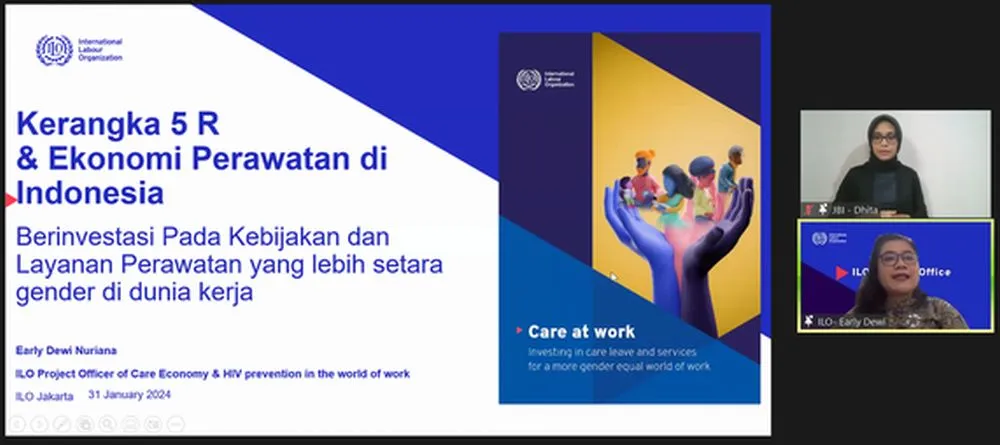
Meanwhile, Abby Gina, Executive Director of Jurnal Perempuan, presented the key findings of the qualitative research on redistribution of care work focusing on the involvement of men based on the perspective of feminism. Despite the draft Bill on Mother and Child Welfare still emphasize traditional values of women are still in charge for caring responsibility, the findings revealed a new progress in the proposed extension of paternity leave from to 40 days.
The research also found that good practices shown some companies in promoting and applying paternity leave. A start-up company with a male CEO, for example, has implemented a one-month paternity leave since 2017; while a multinational company with 22 thousand employees has implemented genderless leave policy by using the term of primary caregiver.
“From this research, we learnt an important progress that has been implemented at the workplace. However, we urge the need for further education and training to support the involvement of men in care work and the need for a new way to identify the meaning of masculinity and fatherhood through role models and champions who can voice gender understanding particularly at rural area or at enterprise level,” remarked Abby.
This road map is expected to contribute the increase of women workforce participation on 70 percent by 2045. This will involve inter-ministerial and inter-institution not only at the national level, but also at the regional level.
Early Dewi Nuriana, ILO’s Programme Coordinator for Care Economy
The interactive discussion also presented Resmi Setia Milawati, the staff of National Team for the Acceleration of Poverty Reduction, who co-authored the journal article on maternity protection. She pointed out that the national social protection programme only applies for women working in the formal economy and not yet applied for informal women workers and contract workers. She also examined the burden shouldered by the private sector to fund their women employee’s maternity protection.
“Thus, we recommend the urgency of joint funding among employers, workers and government that is incorporated through the national social protection programme. We recommend a collective responsibility in ensuring maternity protection can be enjoyed by all women workers, including informal workers and self-employees,” she stated.
The launch and interactive discussion were viewed by 370 viewers online. Some comments included hopes that the Road Map on Care Economy could bring gender equity and equality, the need for social construction that can shift the responsibility for care work not only for women, but also men and the need for affirmative policy to balance work-life responsibility for both men and women.
As part of the launch, a joint social media campaign was also conducted to raise the public awareness. A series of social media messages were published, raising messages on the recognition of rights of domestic workers, the vulnerability of informal workers to benefit from maternity leave, the need for daycare for working women and men with family responsibilities. The campaign has reached and engaged 44,715 viewers.
Related content

Public Education 116: Work and Care Work

Indonesia
Women still struggle to juggle paid work and unpaid care work
Project
The Care Economy in Indonesia
Relevant projects
Project
The Care Economy in Indonesia