

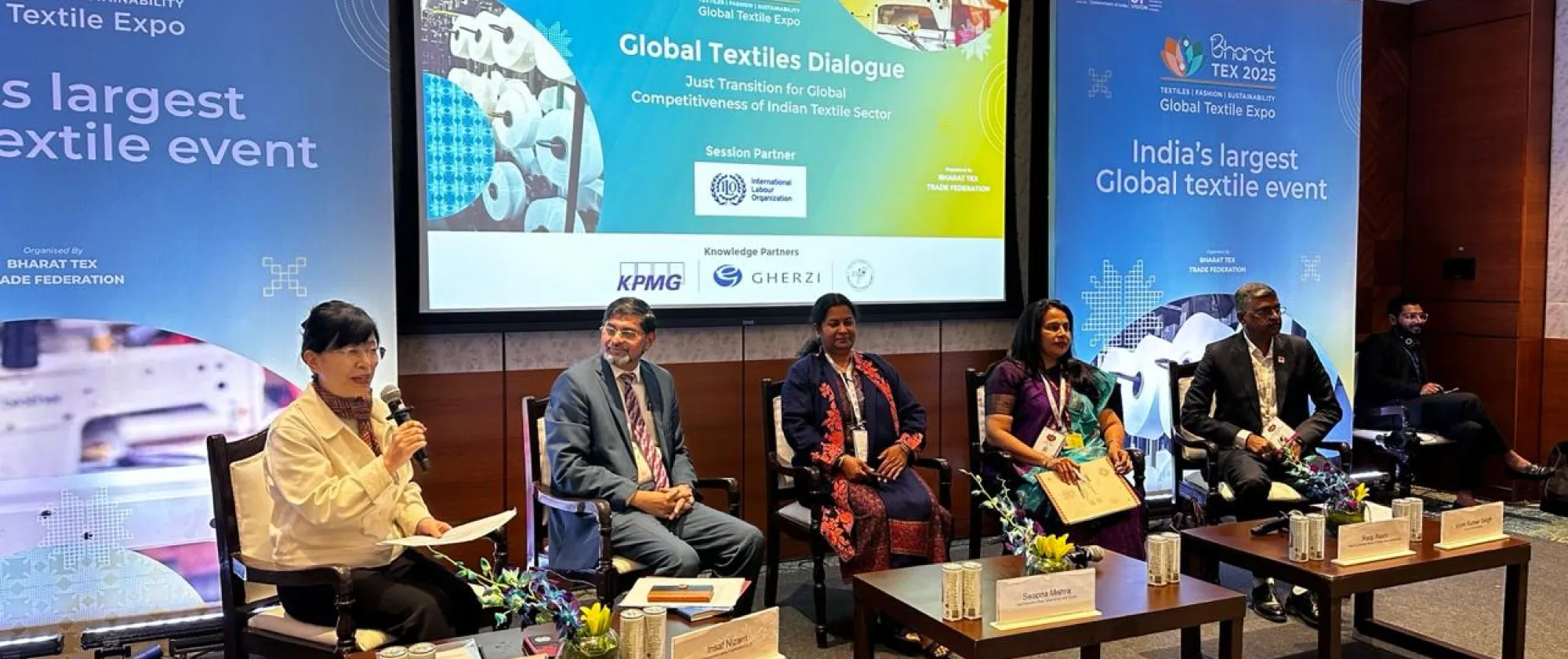
ILO advocates for a just transition in the Indian textile sector at Bharat Tex
The sector faces rapid and multiple changes due to automation and digitalization, climate change, demography and trade patterns and requires tripartite constituents to apply the just transition approach across the supply chain and foster social dialogue.
12 February 2025
NEW DELHI (ILO News): India is the sixth-largest exporter of textiles globally and provides direct and indirect employment to millions of people, being a significant employer for women and rural workers. The country hosted its flagship global textiles event ‘Bharat Tex’ from 14-17 February. To highlight the competitiveness of India’s textile sector and position the country as a responsible investment destination and trade partner, the International Labour Organization (ILO) hosted the “Just Transition for Global Competitiveness of Indian Textile Sector” session.
India enjoys global comparative advantage in the textiles sector due to its comprehensive supply chain and extensive network. It encompasses both downstream and upstream players, from raw materials producers to retail brands of players, that is, farm to processing to mill to garment or market. Larger retail companies source from small and medium enterprises, who in turn source from textiles mills and raw material producers.
The sector faces rapid and multiple changes due to automation and digitalization, climate change, demography and trade patterns. To sustain competitiveness of the sector, governments, employers and workers need to adopt a just transition approach across the supply chain and foster social dialogue.
“Government policies must extend beyond the Ministry of Textiles, engaging financial sectors and state-level actors. Circular economy principles should be embraced—textile waste is a resource, not solid waste, and should be collected, upcycled, and recycled to create economic value,” highlighted Ms Roop Rashi, Textile Commissioner, Government of India, in her remarks.
Ensuring quality and fairness in processes is essential for achieving a just transition. The decent work agenda espouses creating opportunities for men and women in safe, fair, and sustainable conditions. The ILO’s policy framework, including the MNE Declaration and Just Transition guidelines, provide a roadmap for sustainability for the private sector.
Mr Vivek Kumar Singh, Head of Sustainability – Grasim Textiles Business and EFI member underscored the short- and medium-term priorities of the sector, including policy advocacy, strengthening labour rights, investing in capacity building and bridging the government’s and industry’s needs in the sector.
Ms Swapna Mishra, Chief Executive Officer, Textile Sector Skill Council emphasized that skill development is crucial for ensuring employment opportunities. "The integration of AI and technology in textiles is reshaping required skill sets, and greener production—while inherently sustainable in Indian handloom—comes with additional costs, necessitating targeted upskilling, occupational mapping, MSME support, and alignment with international qualifications to facilitate a just transition," she further added.
The textile and garment industry is a key pillar of India’s economy, however, the sector faces pressing environmental and social challenges, ranging from resource-intensive production to skills gaps, informal sector inclusion to compliance and global market pressures. Strengthening multi-stakeholder collaboration, especially with financial institutions, enhancing skills development, and promoting inclusive sustainability policies that integrate MSMEs and informal sector workers into the transition are some of the ways to pivot the industry towards longevity, sustainability, and a just transition.