

#Jobs4dev
ILO advocates inclusive growth at Global Labour Conference
ILO actively participated in the 2024 Jobs and Development Conference, a global event aimed at improving job outcomes and promoting inclusive economic growth.
10 October 2024
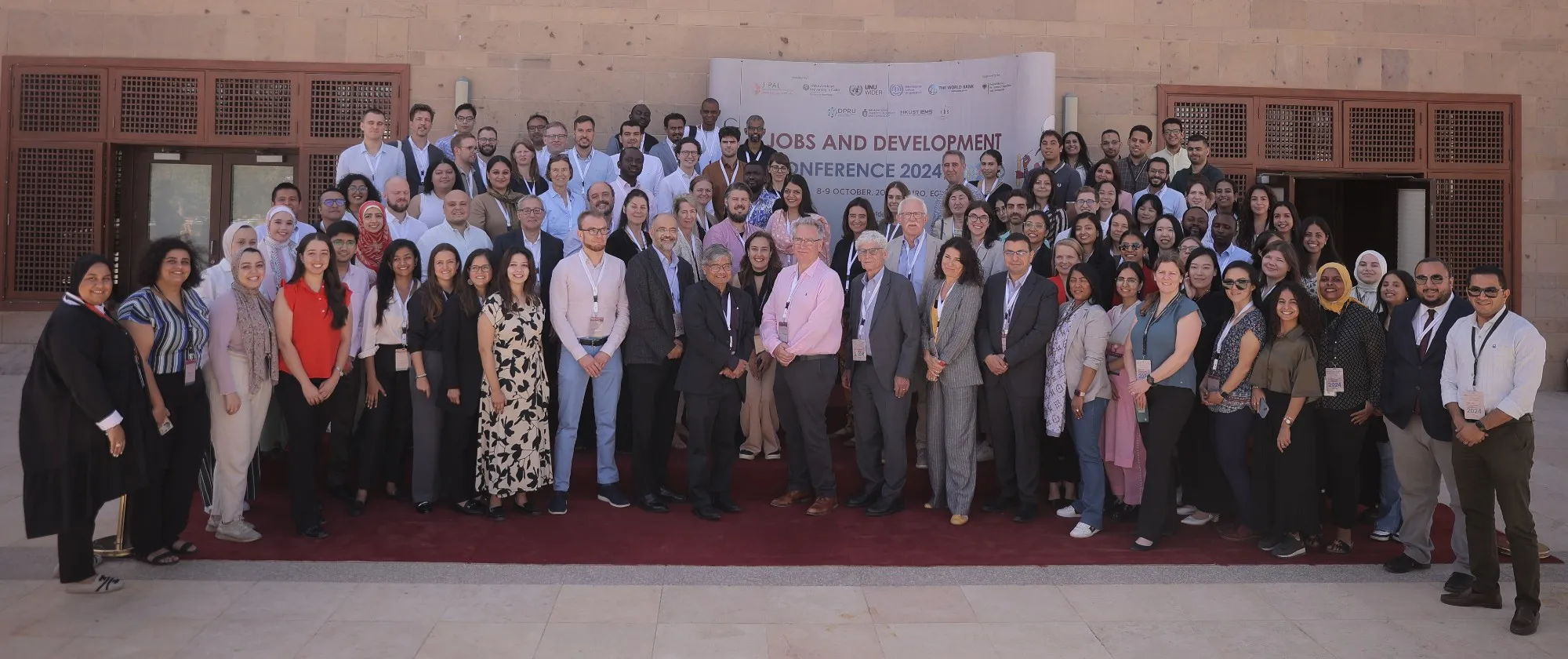
Cairo, Egypt (ILO News)- Representatives from the International Labour Organization (ILO) showcased their expertise on the world of work by co-organizing and participating in various panels and discussions at the 2024 Jobs and Development Conference.
This global event, co-organized by the ILO, World Bank, United Nations University World Institute for Development Economics Research (UNU-WIDER), and The Network on Jobs and Development (NJD), brought together academics, policymakers, and industry experts to explore ways to improve job outcomes and promote inclusive economic growth.
This year’s conference was hosted by Abdul Latif Jameel Poverty Action Lab (J-PAL) Middle East and North Africa (MENA) at the American University in Cairo. This marked the second time the ILO joined the conference as an organizer. The event, held on October 8-9 in Cairo, featured a comprehensive agenda covering topics such as gender, labour markets, inclusion, skills, lifelong learning, youth employment, socioeconomic activities, and the environment.
The conference commenced with an introductory session where Jeff Johnson, Deputy Director of the Research and Publications Department at the ILO, delivered a keynote address. He emphasized the ILO’s commitment to treating labour as more than just a commodity, advocating for an inclusive growth model that considers economic, social, and environmental dimensions.
“With our Director General, Gilbert F. Houngbo, we are advancing social justice by ensuring economic growth serves society while protecting the environment and including everyone,” Johnson stated.
Day one highlights
Throughout the first day, Jeff Johnson chaired a session on trade and labour issues, featuring contributions from representatives of the World Bank, Geneva School of Business Administration, Türk-Alman Üniversitesi, and Lancaster University. The session delved into topics such as labour demand and supply, gender equality, trade shocks, and social mobility.
Later in the day, Verónica Escudero, Senior Economist at the ILO’s Research and Publications Department, chaired a panel that examined the evolving dynamics of the labour sector, the rise of online training, and health and safety in the informal sector. Experts from Yale- National University of Singapore (NUS) College, the University of Cape Town, and O. P. Jindal Global University presented case studies from India, Costa Rica, and Bangladesh, offering a global perspective.
Day two highlights
On the second day, the ILO continued its active participation, focusing on sessions about the Human-Centered Economy, structural transformation, and technological change. These discussions further addressed critical issues related to job creation, economic development, and the challenges facing labour markets, particularly in low- and middle-income countries
The day started with a special session by Rick Samans, Director of the Research and Publications Department, examining “ Human-Centred Economics: The Living Standards of Nations,” a recently published book in association with the ILO. In pursuit of decent work and social justice for all, Samans argued for evolving from 20th century trickle-down “neoliberalism” to a more human-centred model of economic progress that better respects inclusion, sustainability and resilience.
As part of a panel on structural transformations and technological change, Samans shared the recently published research paper on Employment Exposure to Generative AI and the Digital Divide in Latin America. The discussion looked at the transformative impact of Generative AI on jobs.
In further contributions from the ILO’s Research Department, Verónica Escudero, chaired a dynamic panel on the evolving nature of labour markets. It examined topics like online training, health and safety in the informal sector, and featured global case studies from India, Costa Rica, and Bangladesh.
In a later session, Verónica Escudero presented her latest research results from, "Directed Search, Wages, and Non-wage Amenities: Evidence from an Online Job Board". Data on search patterns from a Uruguayan online job board was compiled. Analysis then examined the correlation between job applications and posted wages versus advertised non-wage amenities. Her findings indicated that low-skill job seekers focus on wages while high-skill job seekers are more likely to focus on non-wage amenities.
Maria Sabrina De Gobbi, Senior Economist with the ILO, then discussed how to promote employment creation through industrial symbiosis, specifically in developing countries. Her research precedes a soon-to-be published book on the same topic, which will include six emerging economies: Argentina, Benin, Columbia, Costa Rica, South Africa and Tanzania. De Gobbi gave the example of how greenhouses can sell or “recycle” plastic boards to plastic companies rather than disposing of them, and through this circular economy, jobs are created and maintained towards a more symbiotic industry.
Since its inception in 2016, the Jobs and Development Conference, also known as the Jobs4Dev Conference, has served as a platform to address pressing issues related to job creation, economic development, and the challenges facing labour markets. The 2024 edition continued this tradition, featuring keynote speeches, policy panels, and research presentations on topics such as labour market programmes, gender and labour issues, youth employment, trade and labour, and structural transformation.
Related content
#Jobs4Dev
2024 Jobs and Development Conference