

ILC2025
CCLCS hosts webinar on the outcomes of the 113th Session of the International Labour Conference
The December 4, 2025, CCLCS webinar explored outcomes of the ILO’s 113th International Labour Conference, highlighting implications for biological hazards, platform work, and formalization in Trinidad and Tobago.
5 December 2025
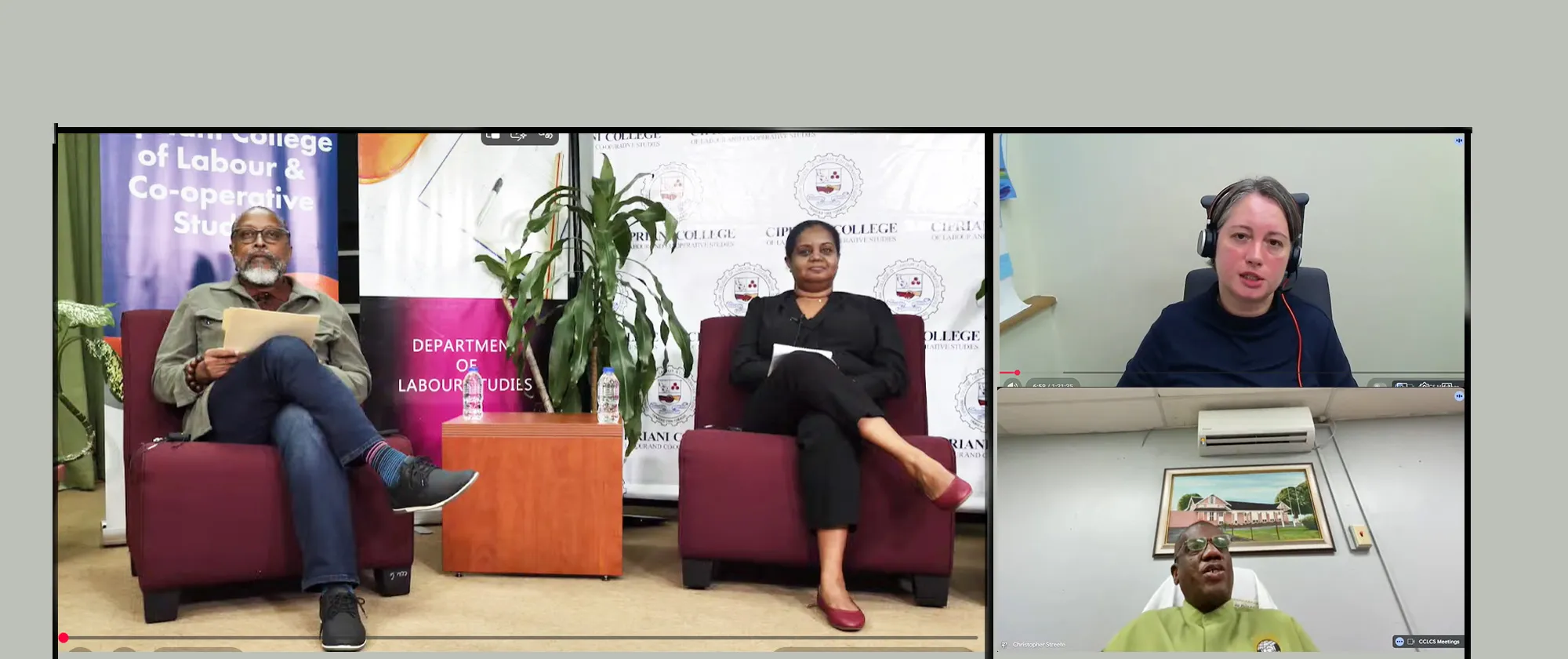
Valsayn, Trinidad and Tobago (ILO News) - The Cipriani College of Labour and Co-operative Studies (CCLCS) brought together leading labour practitioners, policymakers, and specialists on 4 December 2025 for an engaging webinar exploring the outcomes of the 113th Session of the International Labour Conference (ILC) and what they mean for Trinidad and Tobago’s world of work. The session, hosted by the Labour Studies Department, featured a distinguished panel:
- Christopher Streete, President General, NUGFW / NATUC Representative
- Rosa Mae Whittier, Head, International Affairs Unit, Ministry of Labour and Small and Micro Enterprise Development
- Vera Guseva, Workers’ Activities Specialist, ILO Caribbean Office
Moderated by Ian Daniel, Senior Lecturer and Head of Labour Studies at CCLCS, the discussion offered timely insights into the ILC’s major agenda items: protection against biological hazards, decent work in the platform economy, and transitioning from the informal to the formal economy.
ILO Workers’ Activities Specialist Vera Guseva reminded participants that the ILO, founded in 1919, rests on the principle that lasting peace requires social justice. She explained that its tripartite structure: governments, employers, and workers negotiating together produces international labour standards that set minimum protections, create a level playing field for business, and give all parties a common reference for laws, policies, and collective agreements. Guseva emphasized that biological hazards, platform work, and formalization are not abstract topics but pressing issues for Caribbean workers and employers.
NUGFW President General and NATUC representative Christopher Streete shared his impressions as a first time ILC delegate, noting the genuine spirit of cooperation he observed among governments, employers, and workers. He highlighted the ILO Director General’s focus on the “state of social justice,” acknowledging global gains in social protection but also insisting that inequality and instability demand renewed effort. Streete also urged Caribbean unions that often only send one workers’ delegate to coordinate regionally so that different countries cover different sessions and share information.
Rosa Mae Whittier, Head of the International Affairs Unit at the Ministry of Labour and Small and Micro Enterprise Development, outlined how ILC outcomes move into the national arena. She explained that adopted conventions must be submitted to Parliament and reviewed through the national tripartite ILO 144 Committee, which advises on ratification, while relevant ministries examine legislative and policy implications. Citing World Bank data, she noted that Trinidad and Tobago has the highest number of platform workers per capita in the Latin America and Caribbean region, underscoring the urgency of updating laws and social security systems for this fast growing sector.
The panellists mapped out a pathway from standards to action: immediate submission of conventions to Parliament, tripartite consultations, targeted awareness raising, systematic review of existing laws, and incorporation of international standards into collective agreements and workplace policies. They called for ratification of key conventions such as C192 and C190, and over the longer term, regular reporting on implementation, with sustained social dialogue to keep standards aligned with changing realities. As Ian Daniel summarized, the pursuit of social justice requires social responsibility and the real test of ILC 2025 will be how its decisions transform everyday working lives in Trinidad and Tobago.
The webinar demonstrated that adopting conventions in Geneva is merely the starting point. The real work lies in translating these standards into national laws, policies, workplace practices, and collective agreements that improve workers' daily lives.
Key takeaways and the call to action for Trinidad and Tobago's labour community include:
- Stay informed: Follow developments in platform economy standards ahead of the 2026 International Labour Conference
- Engage actively: Participate in tripartite consultations on instrument ratification
- Organize strategically: Reach informal and platform workers to extend union protection
- Bargain collectively: Incorporate international standards into collective agreements
- Advocate persistently: Keep pressing for ratification of critical conventions like C190
- Collaborate regionally: Work with other Caribbean nations to maximize impact at future ILCs
The Cipriani College of Labour and Cooperative Studies is committed to facilitating these crucial conversations, ensuring that what happens in Geneva finds meaningful expression in Trinidad and Tobago's workplaces. As the panellists made clear, this is not the end but the beginning of a journey toward greater social justice for all workers.