


Haiti and ILO sign two-year country programme to advance decent work and social dialogue
New agreement sets four national priorities for technical support on employment, social protection and labour reform
14 May 2026
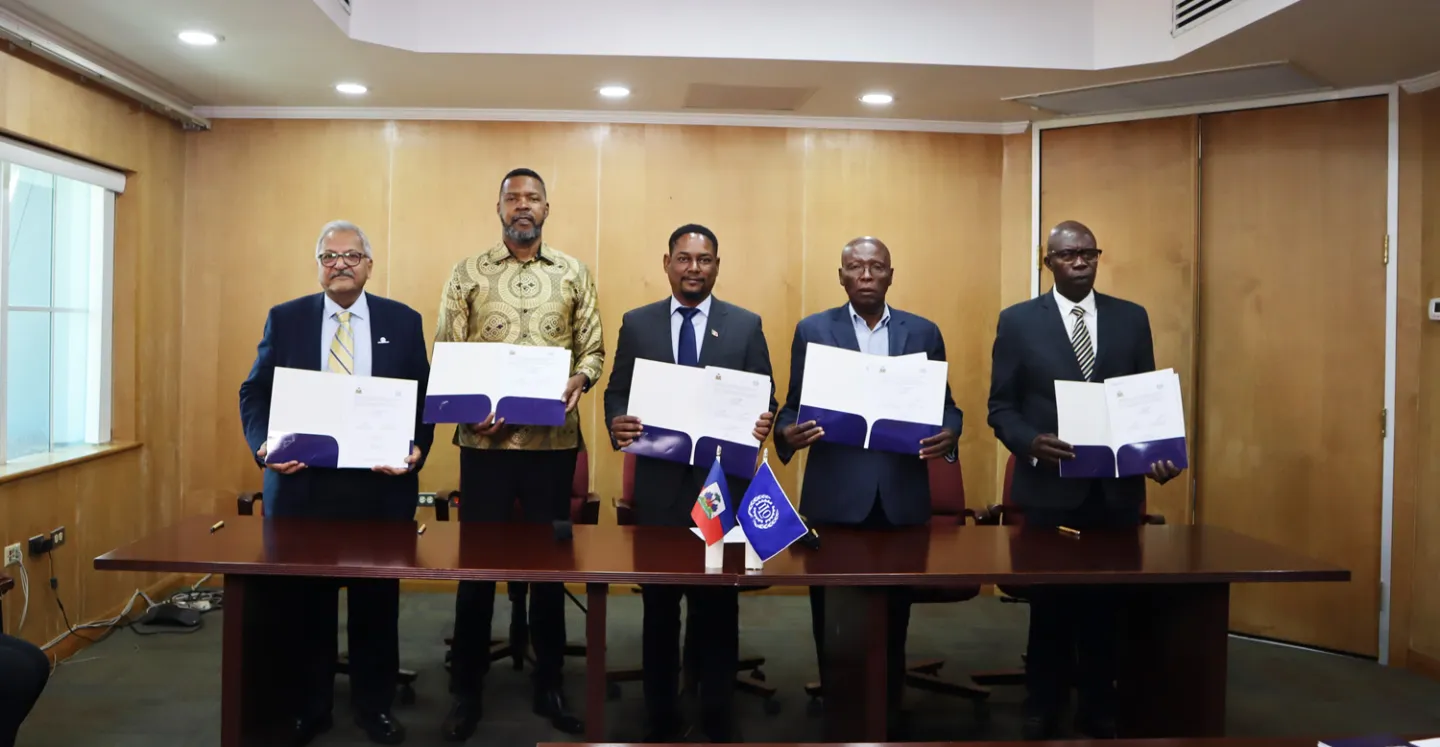
PORT OF SPAIN, Trinidad and Tobago (ILO News) – On 14 May 2026, the Government of Haiti, together with employers' and workers' representatives, signed a two-year country programme with the International Labour Organization to advance decent work through strengthened social dialogue, labour governance, employment creation and social protection.
The agreement was signed at ILO Caribbean Office in Port of Spain by the Honourable Marc Elie Nelson, Minister of Social Affairs and Labour on behalf of the Government of Haiti; Maulik Radia, President of the Association of Industries of Haiti (ADIH), for the employers; Yvel Admettre, Secretary General of the Confederation of Public and Private Sector Workers, and Louis Fignole St Cyr, General Secretary of the Autonomous Central of Haitian Workers, for the workers; and Joni Musabayana, Director of the ILO Decent Work Team and Office for the Caribbean, for the ILO.
The tripartite Haitian delegation, along with colleagues who joined online from Haiti, spent much of Thursday in working sessions with the ILO team reviewing the programme, discussing final refinements, and reaching consensus on how existing and new project interventions can best advance the priorities they had collectively defined.
The final agreement has received Prime Minister-level approval and defines a shared roadmap for ILO technical cooperation in Haiti for 2026–2027. It is the first country programme developed under the ILO Caribbean Office's expanded mandate covering Haiti.
Four priorities, one shared agenda
- The ILO country programme for Haiti is organized around four priorities identified through tripartite consultation: Revitalizing social dialogue, including reactivation of national tripartite mechanisms and strengthening fundamental principles and rights at work.
- Improving labour governance, including labour administration and inspection systems, dispute resolution, and Labour Code reform through tripartite consultation.
- Expanding employment and livelihoods, with support for MSMEs, skills development, and targeted inclusion of youth, women, displaced persons and informal economy workers.
- Strengthening social protection, including reforms of key social security institutions and progressive expansion of coverage to informal workers.
Gender equality, youth inclusion and conflict sensitivity are mainstreamed across all four pillars, alongside climate and environmental considerations in employment and enterprise development.
Statements at the signing ceremony
Minister Nelson confirmed political endorsement of the programme and its immediate implementation.
"I would like to announce that the Government, through the Prime Minister, has approved the proposal submitted, thereby marking an important milestone in this preparatory process," Nelson said. He acknowledged the collaborative spirit that had characterized the week's discussions, thanking Director Musabayana and all participants for their commitment and the quality of their contributions. "My technical team will immediately continue the work on drafting the first report… in order to ensure the diligent completion of the next stages and to guarantee effective preparation for the International Labour Conference," he added.
Director Musabayana welcomed the agreement, highlighting its tripartite foundation. "Haiti's tripartite constituents have shown real leadership in defining what support they need and on what terms. This programme of work is built on that ownership. Our role as the Caribbean Office is to turn these commitments into results that Haitian workers and enterprises can feel – more productive dialogue, stronger institutions, and more decent jobs," he said.
Maulik Radia said the agreement reflects unity during crisis conditions and the need for structured cooperation. "Haiti, as everybody knows, is going through a major crisis," Radia said. "And in a crisis, when we come together as a unity, it is very positive. This brings all sectors of the country together and will allow us to work in a very formal but cooperative way."
Workers' representatives underscored the historic nature of the agreement.
"It is extraordinary and it is historic," said Louis Fignole St Cyr. "The social dialogue championed by the ILO has become a backbone for us, a foundation for the labour movement in Haiti and for trade union organizations to function within tripartism."
Yvel Admettre called for the momentum to be sustained. "We must build a culture of dialogue," he said. "Without that culture, you will not always feel the need to come together to talk. With dialogue, we know we can find solutions even in the most difficult situations. I hope this will be a beginning, not an end."
A new chapter in Caribbean cooperation
This agreement opens a new phase in Haiti's relationship with the ILO. It follows the reassignment of Haiti to the portfolio of the ILO Decent Work Team and Office for the Caribbean, based in Port of Spain. The transfer, made in January 2026, is intended to strengthen regional alignment, responsiveness and collaboration with Haiti as part of the ILO’s work across the Caribbean region.
Haiti is a founding member of the ILO, having joined in 1919. It has ratified 25 ILO Conventions, including 8 of the 10 Fundamental Conventions. The ILO country programme for Haiti builds on those normative commitments and sets out how the ILO will work with the tripartite constituents to translate them into concrete results during 2026 and 2027.
The signing also followed a series of peer exchanges during the week-long mission. The Haitian delegation met with labour market counterparts in Trinidad and Tobago, including the Ministry of Labour, Small and Micro Enterprise Development, the National Trade Union Centre and the Employers Consultative Association, drawing on good practices and lessons learned from their experiences in social dialogue and labour governance.
Looking ahead
Implementation begins immediately. The ILO Caribbean Office will provide technical support through its Decent Work Team and existing projects in Haiti, in coordination with UN partners, bilateral donors and national institutions. A tripartite steering committee will oversee progress, and an annual strategic review will track results.
The Programme of Work is aligned with the Punta Cana Declaration for democracy, peace, decent work and social dialogue (2025), ILO Recommendation No. 205 on Employment and Decent Work for Peace and Resilience, and the United Nations Sustainable Development Cooperation Framework for Haiti (2023–2028).
For more information, please contact
Resel Melville [email protected]
Information Unit
ILO Decent Work Team and Office for the Caribbean
6 Stanmore Avenue, Port of Spain
Trinidad and Tobago
Phone: (868) 625-0524 Ext: 412
http://www.ilo.org/caribbean