

Decent work
Grenada signs its first Decent Work Country Programme
Government, employers and trade unions commit to a five-year tripartite roadmap built around three Strategic Priorities and eleven Outcomes, backed by full Cabinet endorsement.
22 May 2026
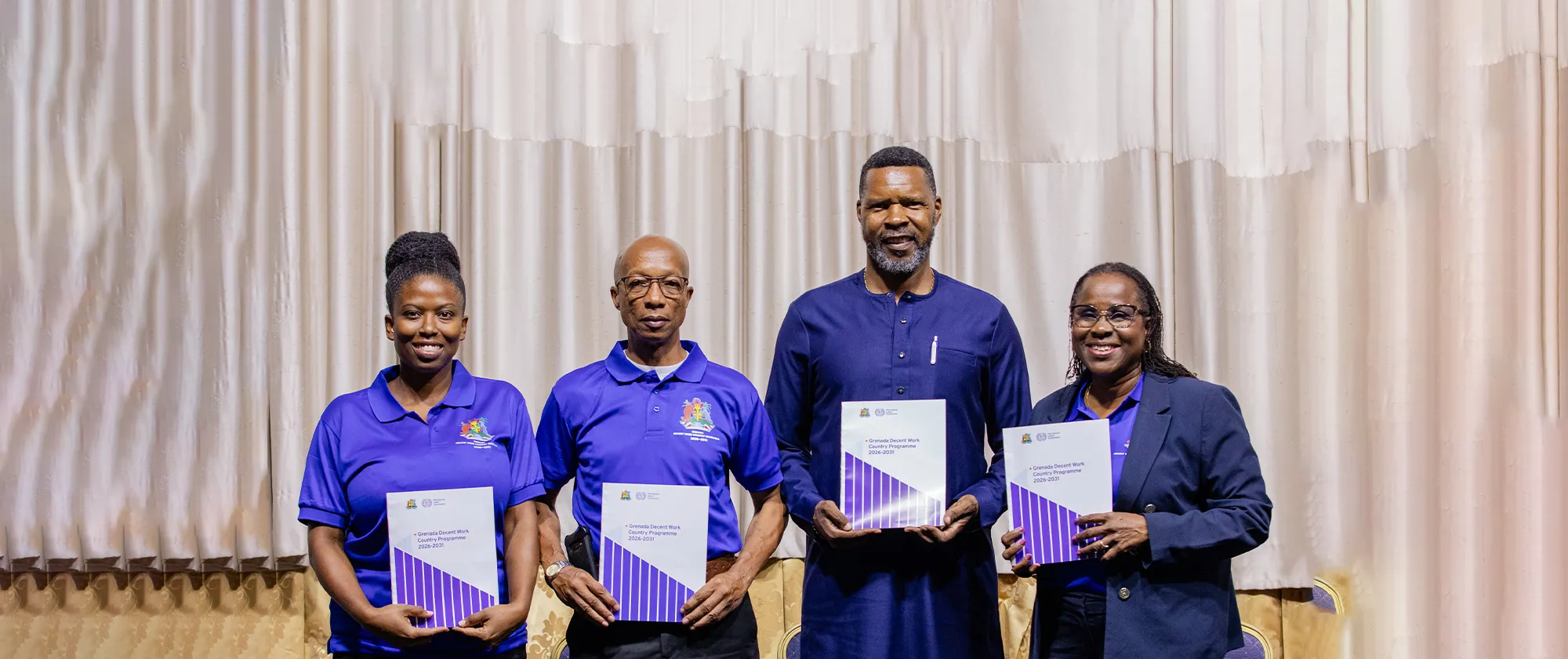
ST. GEORGE'S, Grenada (ILO News) - Grenada has signed its first ever Decent Work Country Programme. The signing and launch of the DWCP 2026–2031 took place on Tuesday, 19 May 2026, at the Grenada Trade Centre, Morne Rouge, placing Grenada ahead of its Eastern Caribbean neighbours in adopting a tripartite, ILO-supported framework for national labour and employment policy.
The DWCP is structured around three Strategic Priorities agreed by the tripartite constituents:
Priority 1: Enhanced governance, inclusion, and efficiency of Grenada's labour market.
Priority 2: Expanded offer of decent work opportunities through increased formalization, productivity, and tripartite cooperation.
Priority 3: Inclusive, rights-based social and labour protections through strengthened social partners and tripartism.
The DWCP was developed through an extensive tripartite process facilitated by the ILO Decent Work Team and Office for the Caribbean, under the leadership of the Ministry of Legal Affairs, Labour and Consumer Affairs and the Tripartite Labour Advisory Board.
The launch drew Acting Prime Minister, the Hon. Andy Williams, and a substantial Cabinet delegation, signaling whole-of-government backing for delivery. Cabinet has endorsed the Programme at the highest level and has further approved both the Programme's results framework as the official mechanism for monitoring, evaluation and reporting, and the establishment of a dedicated subcommittee of the Labour Advisory Board to provide oversight, coordination and systematic monitoring of implementation. The Labour Advisory Board has been authorized to finalize the subcommittee's terms of reference.
"This is the first Decent Work Country Programme ever undertaken by Grenada," said Senator the Honourable Claudette Joseph, Attorney General of Grenada and Minister for Legal Affairs, Labour and Consumer Affairs. "We are not simply launching a programme. We are formalizing a national compact on work and development rooted in shared responsibility, vision, and collective action."
Senator Joseph emphasized that implementation, not signing, will determine the Programme's success. "Cabinet has approved a robust governance and oversight mechanism to ensure that the Decent Work Country Programme does not remain a policy on paper or, as Senator Lewis admonished us, a document to collect dust on a shelf, but that it becomes a framework for action. The success of this Programme will depend not on its ambition, but on our discipline in implementation."
For the ILO, the signing positions Grenada within a global community of practice. "By signing this Programme today, Grenada joins the community of nations of the ILO's 187 member States. Sixty currently have working Decent Work Country Programmes," said Joni Musabayana, Director of the ILO Decent Work Team and Office for the Caribbean.
He also recognized Grenada's growing regional role within the ILO system. Caribbean partners have entrusted Grenada with leading regional negotiations at the 114th International Labour Conference, opening in Geneva in early June 2026, on a new international convention and recommendation to govern platform work, currently the fastest-growing form of employment globally. "We, the ILO, stand with you in that leadership role," Dr Musabayana said.
Senator the Hon. Andre Lewis, President of the Grenada Trades Union Council (GTUC), welcomed the launch but kept the emphasis on delivery. "We have identified what we need to do, and now we have to put ourselves to the work," he said. "Social dialogue must not just take place, but it must be meaningful. Consultation must result in meaningful implementation." Senator Lewis underlined that Priority 1 of the Programme rests on the Fundamental Principles and Rights at Work, the five core ILO principles encompassing freedom of association and collective bargaining, the elimination of forced labour, the abolition of child labour, the elimination of discrimination, and a safe and healthy working environment.
For the employers, Ms Abena Peters, Research Officer at the Grenada Employers' Federation (GEF), described the Programme as a balanced and forward-looking framework. "This program speaks directly to the realities we face. It reinforces a simple but powerful truth. Strong businesses and decent jobs go hand in hand. When enterprises grow, jobs are created. When workers are protected and empowered, productivity and innovation flourish," Ms Peters said.
Closing the ceremony, Acting Prime Minister Williams framed decent work as a national development priority. "Decent work is not just a labour issue. It is a national development issue," he said. "Today cannot simply be another launch ceremony. The true success of this Programme will depend on implementation and results."
The Grenada DWCP 2026–2031 aligns the country's national labour priorities with international labour standards and the 2030 Agenda for Sustainable Development, in particular Sustainable Development Goal 8 on decent work and economic growth. Implementation will proceed under the oversight of the new Labour Advisory Board subcommittee, with continued technical cooperation, policy advice and capacity-building support from the ILO Decent Work Team and Office for the Caribbean over the period 2026 to 2031.