

Labour relations
Grenada puts decent work commitments into action
Implementation of Grenada’s new Decent Work Country Programme rapidly advances as ILO carries out in-country training to strengthen dispute resolution and collective bargaining capacity.
26 June 2026
ST. GEORGE’S, Grenada (ILO News) – Grenada’s Decent Work Country Programme 2026–2031 (DWCP) has moved quickly from agreement to implementation, with the International Labour Organization (ILO) delivering its first technical assistance mission under the newly signed framework.
Led by Pablo Arellano, ILO Senior Specialist in Social Dialogue and Labour Relations, and Vera Guseva, ILO Workers’ Activities Specialist, the mission which took place from 22 to 25 June, focused on two practical areas at the heart of effective labour institutions: how labour disputes are handled, and how workers’ organizations prepare, negotiate and represent their members through collective bargaining. Both are central to building trust, improving services and making decent work a reality in everyday working life.
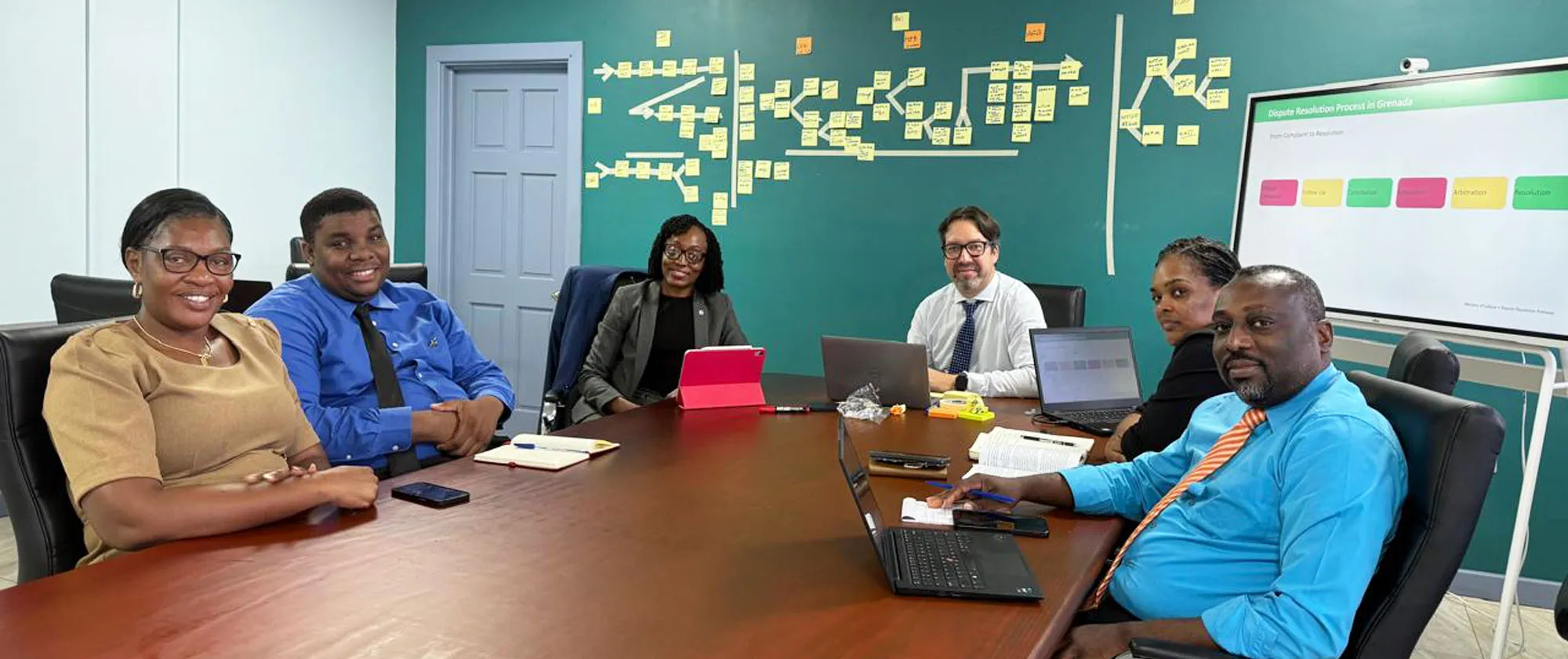
With the Ministry of Legal Affairs, Labour and Consumer Affairs, the ILO supported a mapping exercise of dispute resolution procedures, building on a self-diagnostic tool introduced by ILO Caribbean. The exercise helped identify bottlenecks and opportunities to improve the timeliness and quality of services. Staff of the Division of Labour and the Office of Consumer Affairs also took part in training on conciliation techniques, including theory, coaching and role-play exercises.
“The mapping exercise has helped us look closely at how disputes move through the system, where delays can occur and where services can be improved. The conciliation training also strengthened the practical skills our officers need to support faster, fairer and more constructive resolution of labour disputes.”
From 24- 25 June at the Public Workers’ Union premises, 25 to 30 representatives of affiliates of the Grenada Trades’ Union Council (GTUC) took part in a two-day workshop that honed their collective bargaining skills. The workshop covered freedom of association, collective bargaining, conflict management, negotiation theory, preparation of bargaining objectives, communication, use of information and practical role-play scenarios.
During a separate consultation on 23 June, GTUC affiliates reviewed the DWCP’s priorities and identified areas for follow-up noting that DWCP is designed not only as a planning document, but as a tool for tripartite action. Areas prioritized by the union representatives included occupational safety and health, labour law reform, minimum wage setting, formalization, business support and protections for vulnerable groups of workers. The forum also provided an opportunity for unions to agree on a focused list of priorities to take forward through the Labour Advisory Board and other social dialogue spaces.
André Lewis, President of the GTUC: “For workers’ organizations, the DWCP gives us a practical framework to identify priorities, organize our engagement and bring workers’ concerns into national dialogue. The collective bargaining training strengthens our ability to prepare, negotiate and represent workers more effectively.”
By strengthening the capacity of Grenada’s labour administration to diagnose and improve dispute-handling processes, and by equipping union representatives with practical bargaining tools, the ILO’s support is contributing to faster, fairer and more accessible labour services, as well as stronger representation for workers.
Next steps include using the mapping findings to inform recommendations for process reform, exploring further capacity-building support for GTUC affiliates and assessing how participants apply the tools in real negotiation processes. As Grenada’s Decent Work Country Programme enters full implementation, the focus is now on turning agreed priorities into better services, stronger representation and social dialogue that delivers concrete results for social justice and decent work.