

Building peace from the ground up
Green skills and new economic opportunities for youth in Haiti
In Jérémie, Haiti, with the support of the ILO and the UN Peacebuilding Fund, youth are transforming bamboo into sustainable livelihoods through skills and entrepreneurship training.
12 January 2026
JEREMIE, Haiti (ILO News) — In Jérémie, a Commune in Haiti’s Grand ’Anse Department, a quiet transformation is taking place. Inside workshops and training spaces, young women and men are shaping bamboo into household items, furniture, and works of art. In addition to the tangible items, what they are really building goes far beyond crafts: they are building skills, confidence, and pathways to sustainable livelihoods- an essential foundation for peace and stability.
This initiative is part of the jointly implemented United Nations Environmental Programme (UNEP) and International Labour Organization (ILO) project “Youth, Agroecology and Green Jobs,” funded by the United Nations Peacebuilding Fund and executed in collaboration with community partners, including the Fondation Communautaire Haïtienne–Espwa (FCH-Espwa) and the Chambre de Métiers et de l’Artisanat d’Haïti (CMAH).
In a context marked by economic fragility and limited opportunities for young people, investing in skills development and entrepreneurship is more than an employment strategy- it is a peacebuilding intervention. When young people can generate decent income, contribute to their communities, and envision a positive and prosperous future for themselves, the risk of instability decreases and social cohesion grows.
Building skills rooted in sustainability
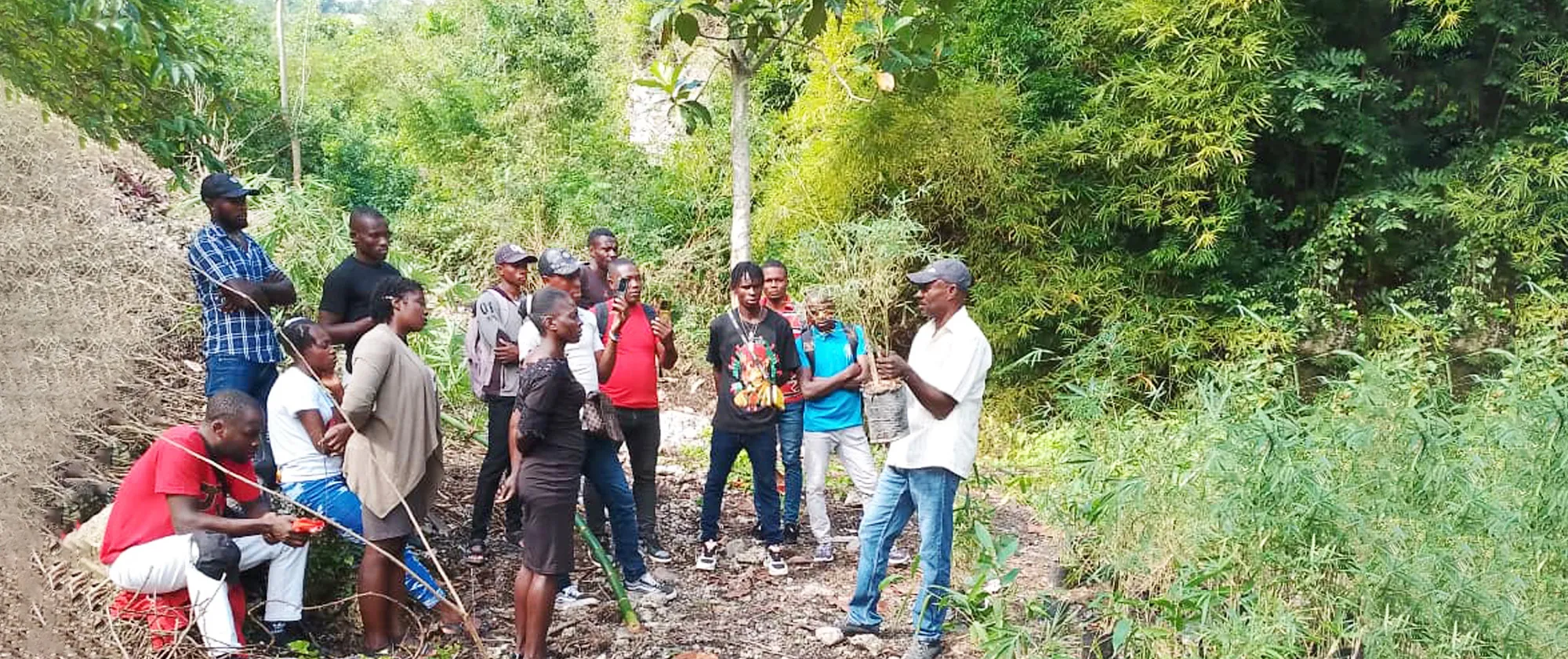
Thirty-one young women and men aged 18 to 30 from the commune of Jérémie are participating in an intensive training programme focused on bamboo, a renewable, environmentally friendly resource with strong economic potential. Guided by local experts from CMAH, FCH-Espwa, and specialized consultants, participants are learning practical techniques ranging from bamboo planting and propagation to basketry, design, and manufacturing.
They are transforming raw bamboo into innovative, marketable products: everyday household items, furniture, and decorative artisanal pieces. The work connects environmental restoration with income generation, demonstrating how green jobs can support both livelihoods and ecosystems.
“This programme on bamboo processing that I received is, for me, a sign of opportunity; in the future, it will enable me to generate income, use these bamboo products in my own home, and share this knowledge with others in my community.” - Mirtho JN JACQUES, 30-year-old youth programme participant.
Beyond technical training: entrepreneurship and markets
The programme goes beyond craftsmanship. Participants also receive training in entrepreneurship, business management, and marketing, including how to use mobile technologies to access modern markets. These skills are critical in helping young people move from production to profitability.
At the end of the programme, participants who complete at least 80 per cent of the training sessions will receive official certification. Each young person will also benefit from a start-up grant- either in kind, in cash, or both- to help launch or strengthen their own micro-enterprise.
“The Artisanat component of this project represents an opportunity for the entire Grand’Anse department. On the one hand, it enables young people to acquire the knowledge and means necessary to meet their economic needs and to create their own small businesses. On the other hand, it allows the department to enhance and make better use of its resources and potential. All of this is carried out within an approach that protects and promotes the environment.” - L'Hérisson HILAIRE, Executive Director, FCH-Espwa.
Community-level impact and peacebuilding
The ILO’s approach places communities at the centre of change. By working closely with trusted local organizations such as FCH-Espwa and CMAH, the project strengthens local capacity while ensuring that training responds to real economic opportunities. Plans are also underway to build and equip a modern bamboo workshop in the Grand’Anse Department, expanding access to training and production facilities for young people.
This community-based model reflects the broader objective of the UN Peacebuilding Fund: addressing the root causes of instability by expanding economic inclusion, especially for youth.
“Youth employment acts as a pillar of peace and social stability by transforming potential vulnerability into an engine for development. This project does not only offer sustainable income opportunities with access to a sustainable resource, it strengthens social cohesion among these young people.”- Fabrice Leclercq, ILO Chief Technical Adviser.
In Jérémie, bamboo is more than a material. It is a symbol of resilience, innovation, and hope. By investing in young people, green skills, and entrepreneurship, the ILO and its partners are helping lay the groundwork for sustainable livelihoods- and for a more peaceful and stable Haiti.