

Green impact: Environmentally focused value chain Project in Suriname concludes
The Project addressed the critical areas of promoting a just transition and tackling informality in Suriname's economy.
13 March 2025
PARAMARIBO (ILO News) - The ILO has successfully concluded its Project, Environmentally focused value chain development in the economy of Suriname, fostering enterprise creation and formalization through just transition, which ran from April 2024 to March 2025. This initiative aimed to support Suriname’s transition to a diversified and environmentally sustainable economy while fostering enterprise creation and formalization through a just transition framework. The Project aligned with Suriname’s Multi-Year Development Plan (2022-2026) and the United Nations Sustainable Development Goals (SDGs).
The Project addressed the critical areas of promoting a just transition and tackling informality in Suriname's economy. Its core objectives centered on building the capacity of ILO constituents to create supportive policies, assisting MSMEs in green value chains to formalize and generate decent work, and empowering local leaders to drive formal and just transitions. With a specific focus on rural and interior regions, the Project prioritized closing socio-economic gaps and including marginalized Indigenous and Maroon communities, while ensuring gender-responsive and inclusive activities.
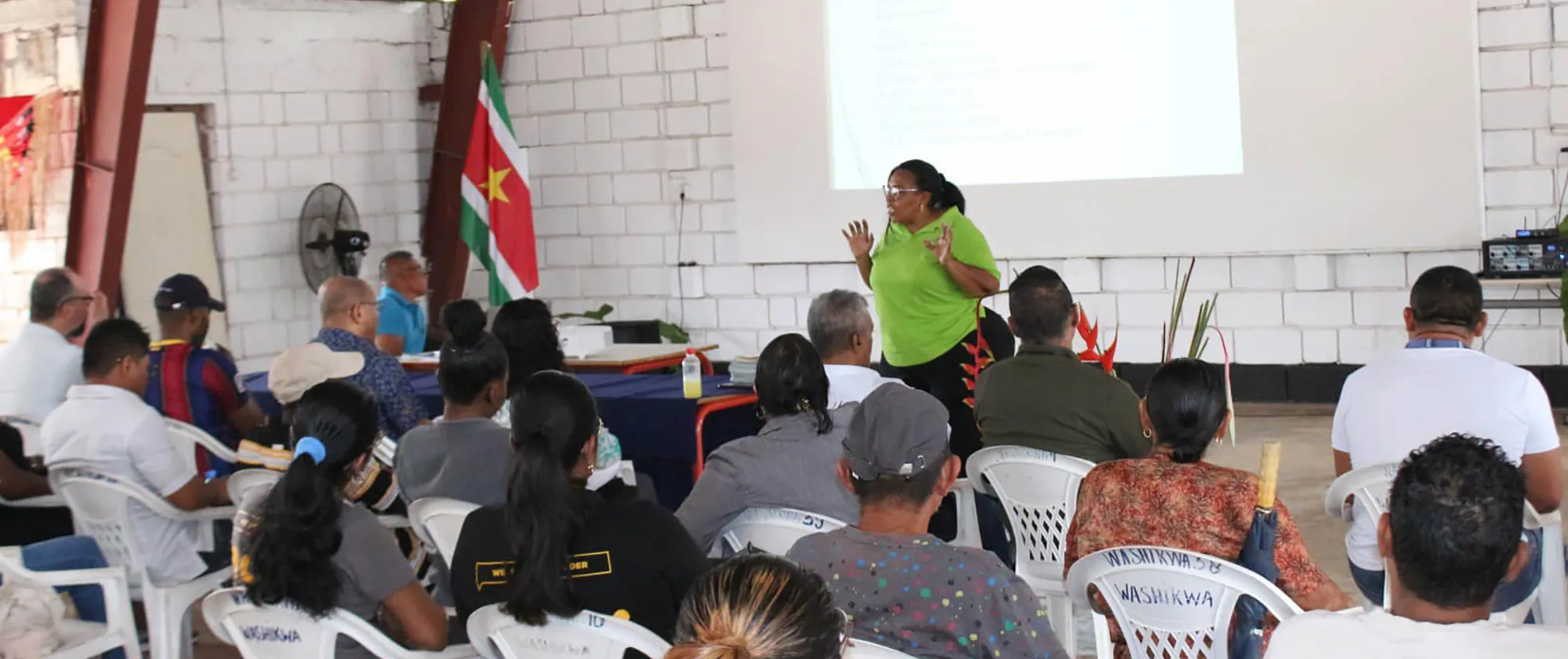
A pivotal moment was the Tripartite Social Dialogue Workshop in October 2024, which brought together Government, and employers’ and workers’ organizations to tackle barriers to formalization and just transition. The discussions highlighted key challenges, including the lack of trust, weak institutions, financial constraints, and fragmented decision-making. Proposed solutions focused on capacity building, better coordination, and increased technical and financial support for social dialogue institutions. Moving forward, priorities included mapping the informal sector, reducing barriers to formalization, and strengthening labour market policies to support a more inclusive and sustainable economy.
The Project also produced valuable knowledge resources, including publications on Skills for Green Jobs in Suriname, an assessment of Barriers and Opportunities for Enterprise Formalization in Suriname focusing on the wood and tourism sectors, and a Value Chain Analysis of Suriname’s Wood-Processing Sector.
Key achievements included engaging national stakeholders and simplifying complex concepts like formalization and just transition for local and district-level actors to ensure their active participation. Businesses were trained to adopt greener practices, while lobbying efforts to successfully integrate decent work principles into Suriname’s new national Green Development Strategy.
Looking ahead
This initiative has laid a strong foundation for advancing sustainable economic diversification in Suriname. By fostering environmentally sustainable inclusive development, the effort has set the stage for sparking green value chains, creating better formal jobs and opening opportunities for all.
"What we're witnessing in Suriname is more than policy implementation - it's the birth of a new economic paradigm where environmental sustainability and decent work reinforce each other at all levels, from a national policy level to local community level," said John Bliek, Specialist for Sustainable Enterprise Development and Job Creation for the International Labour Organization (ILO). "The ILO celebrates how Surinamese stakeholders have embraced this opportunity to build not just greener businesses, but fairer communities and more resilient livelihoods for generations to come."
In line with this vision, Suriname has established two dedicated committees, each equipped with an ILO-supported roadmap to advance formalization and just transition at both national and local levels.
As Suriname continues its journey toward a green economy, collaboration among stakeholders remains crucial. The lessons learned will serve as valuable guidance for future efforts to ensure no one is left behind in this transformative process.