

International Year of Cooperatives
Global research conference deep-dives into the role of the social and solidarity economy in socio-ecological transitions
The ILO highlighted how the social and solidarity economy (SSE) can play a critical role in advancing decent work and inclusive development, and shared progress on SSE statistics and country-level innovations at the 10th CIRIEC International Research Conference on the Social Economy.
3 November 2025
Bordeaux (ILO News) - Officials from the International Labour Organization (ILO) shared research and policy insights on how the social and solidarity economy (SSE) can advance decent work and social justice, at the 10th CIRIEC International Research Conference on the Social Economy in Bordeaux, France from 27 to 29 October 2025. The conference brought together over 400 researchers, policymakers and practitioners from around the world to explore how the SSE can drive socio-ecological transitions towards sustainable development, building on growing international recognition following the ILO resolution on decent work and the SSE and the United Nations resolutions acknowledging its importance.
The SSE as a driver of inclusive change
The focus of the examination was on three interrelated processes through which the SSE contributes to socio-ecological transitions: transforming local economies by generating decent jobs and sustainable enterprises; strengthening territorial cooperation and governance through partnerships and collective resource management; and shaping broader policy frameworks by informing multi-level policymaking with grassroots solutions. Discussions highlighted that improving SSE data, expanding tailored financing mechanisms and strengthening collaborative governance are essential to scaling up the SSE’s contribution to just transitions worldwide.
Global leadership in SSE statistics
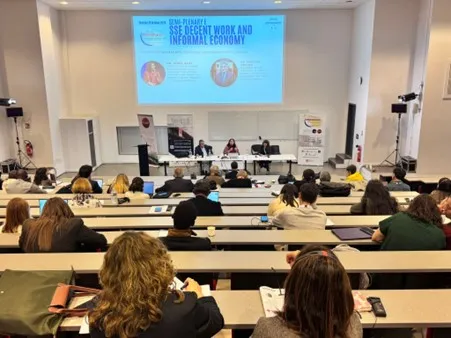
A major ILO contribution is its global leadership in developing standards on SSE statistics in a consultative manner. In a special session co-organized with CIRIEC International, ILO experts outlined ongoing efforts to establish an international statistical framework for the SSE. Through a multi-year initiative (2024–2026) funded by the Republic of Korea, the ILO is spearheading the development of a coherent international statistical framework for the SSE, including developing Statistical Guidelines on the SSE and a comprehensive Manual on Cooperative Statistics that incorporates methodologies for assessing the economic contribution of cooperatives, as well as related training modules. The outcomes will be presented at the 22nd International Conference of Labour Statisticians in 2028, positioning the SSE more prominently in official statistics and policymaking.
Country-level innovations
ILO representatives shared concrete country experiences demonstrating the SSE's value in different contexts.
- In Tunisia, the ILO's Jeun'ESS project has created a supportive ecosystem for youth-led collective entrepreneurship and formalization of informal SSE entities, leading to decent job creation. A Social Innovation Fund established under this initiative provides financing and capacity-building to emerging SSE ventures.
- In fragile and conflict-affected settings, like Jordan cooperatives and other SSE organizations support refugees and host communities, proving essential services for inclusive recovery.
- In the Republic of Korea, SSE initiatives are fostering inclusive and resilient local economies through social innovation, with communities collectively addressing inequities and environmental challenges.
Advancing formalization and decent work
One of key conference themes was the SSE's role in facilitating transitions from informal to formal employment. The SSE enables workers in the informal economy to organize collectively, improve working conditions, and gain access to social protection through self-organization into cooperatives, extension of social protection coverage, and prevention of further informalization. SSE organizations can act as intermediaries connecting informal workers to national social protection systems and as providers of essential services in underserved communities.
Strengthening partnerships
The ILO's engagement at CIRIEC 2025 reinforced key partnerships and policy commitments. The UN Inter-Agency Task Force on SSE – which the ILO chairs – was recognized as an "institutional player of change." Looking ahead, the ILO will continue to collaborate with the CIRIEC and contribute to the next CIRIEC Research Conference in 2027 in Bogotá, Colombia, reaffirming its commitment to positioning the SSE as a pillar of decent work, inclusion and sustainability worldwide.