

News
A global call to action to make trade inclusive for persons with disabilities
International trade's impact on persons with disabilities has often been overlooked in discussions on inclusivity. In 2024, UNCTAD, ITC, ILO, and WTO formed a Technical Working Group on Trade and Disability Inclusion. Marking the international day of persons with disabilities, a high-level meeting was held by this group, alongside Finland, South Africa, and UN Women, to spotlight inclusive trade initiatives.
3 December 2024
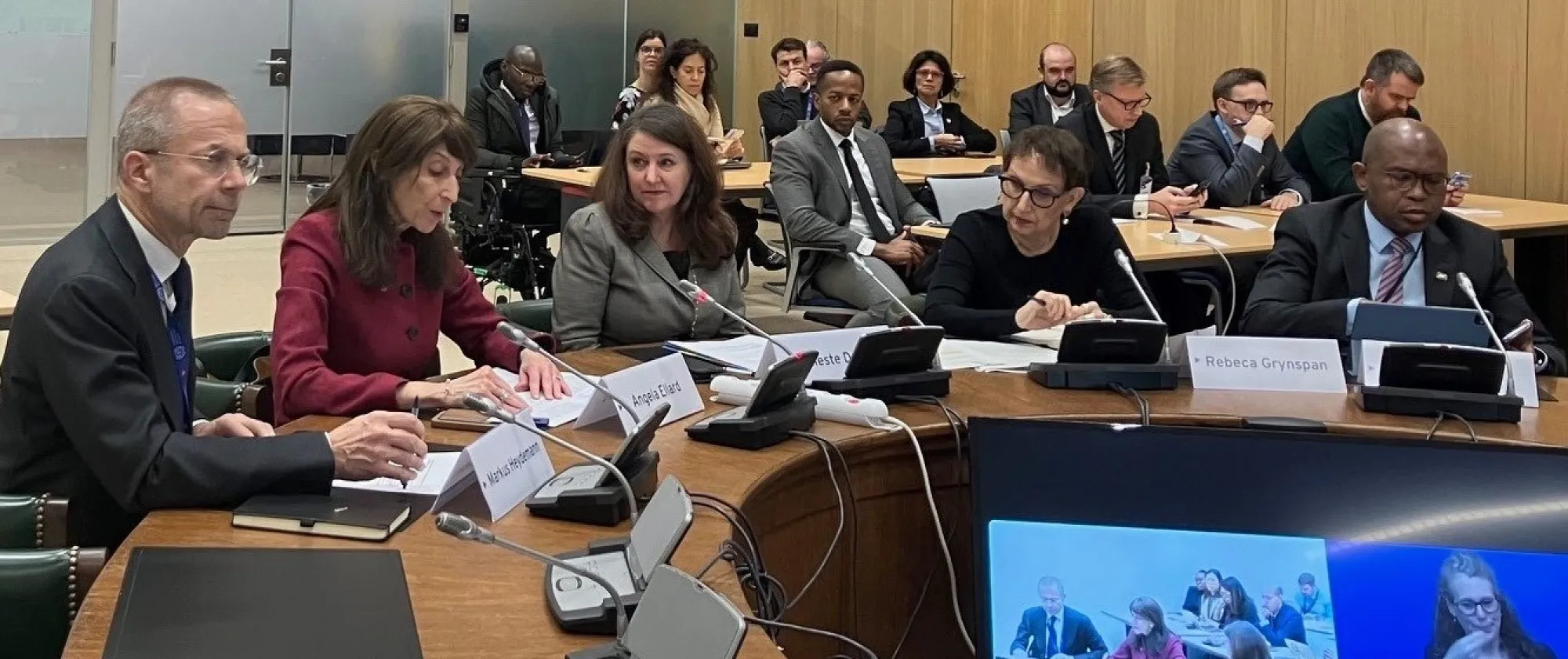
Geneva (ILO News) – On the International Day of Persons with Disabilities the Inter-Agency Working Group on Trade and Disability Inclusion and the Permanent Missions of Finland and South Africa, with the support of UN WOMEN, co-organized a high-level meeting calling for global action to make trade more inclusive for persons with disabilities.
The meeting brought together trade experts from Geneva-based missions, trade specialists, civil society organizations focused on trade, and representatives of disability organizations.
“Disability inclusive trade is a relatively new topic that has often been overlooked in broader discussions of inclusive trade", said Celeste Drake ILO Deputy Director-General. "With this event, we hope to inspire Member States to prioritize the inclusion of persons with disabilities in trade-related discussions", she added.
The event served as a strategic call to action, urging countries to integrate disability inclusion into trade discussions to create concrete impacts.
WTO Deputy Director-General Angela Ellard emphasized that "with the necessary leadership, dedication, and a strong and consistent focus on inclusion, trade can be a powerful tool for driving equality". Noting that the WTO is a member-driven organization, she highlighted that "there are many actions that our members can take - such as eliminating duties on products designed to assist persons with disabilities - which can open doors to employment”.
Greater access to assistive technologies is key
A panel discussion offered key insights from the representatives of Finland and South Africa, and the Secretary-General of UNCTAD, Rebeca Grynspan. The discussion centred on the significance of disability-inclusive trade and upcoming opportunities, such as South Africa's presidency of the G20 in 2025.
The South African ambassador to Geneva HE Mr Mxolisi Nkosi emphasized that G20 countries have the opportunity to address disability inclusion by adopting international accessibility and product standards and enforcing universal design principles in infrastructure.
The ambassador also highlighted the importance of recommendations from trade and disability experts, such as Marzia Fontana and Sophie Mitra, whose research “Inclusive Trade and Persons with Disabilities: initial plans” outlines how improving access to assistive technologies could have a transformative impact.
“By embracing the report’s recommendations, we can open doors to greater access to food, medicines, and assistive technologies for people in developing nations, with a special focus on Africa", he added.
Highlighting international interest to removing barriers, Zimbabwe’s recent policy change to eliminate tariffs on 55 essential assistive products, including sunscreen for people with albinism, was also celebrated by participants as a significant step in advancing disability-inclusive trade.
Rasak Adekoya from the NGO Sightsavers discussed how the African Continental Free Trade Area (AfCFTA) could provide an opportunity to support local production of assistive devices, reducing the continent’s reliance on imports.
“Only 5 per cent to 15 per cent of people with disabilities in Africa currently have access to assistive technologies due to high costs,” Adekoya said. He urged governments to invest in local production, which would help lower costs and improve access.
Leaving no one behind
“We need to understand that persons with disabilities are an incredibly diverse group of people. They have the right to participate and contribute to society in the same way as anyone else”, argued Rebeca Grynspan,the Secretary-General of UNCTAD.
To ensure no one is left behind, all participants agreed on the need for more research, analysis, and data alongside collective efforts by the inter-agency technical working group. “We need a group of enthusiastic Member States to champion the agenda,” declared Markus Heydemann, Deputy Permanent Representative of Finland to the United Nations in Geneva.
In her closing remarks, Dorothy Tembo, Deputy Executive Director of the International Trade Centre, called for a mindset shift when addressing disability inclusion. Disability inclusion should not be viewed purely through a medical lens. “We must instead consider disability-inclusive trade as an economic imperative and approach it from a rights-based perspective,” she concluded.
About the Inter-Agency Working Group on Trade and Disability Inclusion
The informal Inter-Agency Technical Working Group on Trade and Disability Inclusion is an informal network of staff from UN Trade and Development (UNCTAD), the International Trade Centre (ITC), the International Labour Organization (ILO), and the World Trade Organization (WTO), encouraging participation from staff of Geneva-based international organizations involved in trade and development.
The group’s mission is to promote disability inclusion in trade policies and to support governments in integrating this issue into their trade and development agendas.
You may also be interested in
Disability Inclusive Trade
Disability Inclusive Trade: Leveraging Digital Technologies to Make Trade Work for All

Topic portal
Disability and work

Topic portal
Supply chains