

EU conference highlights cooperative contributions to industrial transformation
On March 18, 2025, the ILO participated in the European Commission conference on “Fostering Europe’s Prosperity and Industrial Transformation: Cooperatives as Drivers of Change”.
26 March 2025
GENEVA (ILO News) - Marking the second United Nations International Year of Cooperatives 2025 the conference underscored the European Commission's ongoing commitment to the cooperative model as a foundation for a more prosperous and sustainable economy in the European Union.
The event included a series of plenary sessions and parallel workshops aimed at fostering dialogue among cooperative representatives, academics, international organizations and policymakers. The plenary sessions centred on the resilience of the cooperative model in times of economic uncertainty, and environmental and social challenges; the role of public authorities in supporting the development of cooperatives and a dialogue with stakeholders one the future of cooperatives in the EU.
In parallel workshops, the participants explored: getting the right skills for tomorrow; boosting investment and finance opportunities for scaling-up and growth; clusters and hubs uniting for strategic empowerment; boosting youth cooperative entrepreneurship; exploring opportunities with the European cooperative society; and how cooperatives can lead the way for innovation and digitalization.
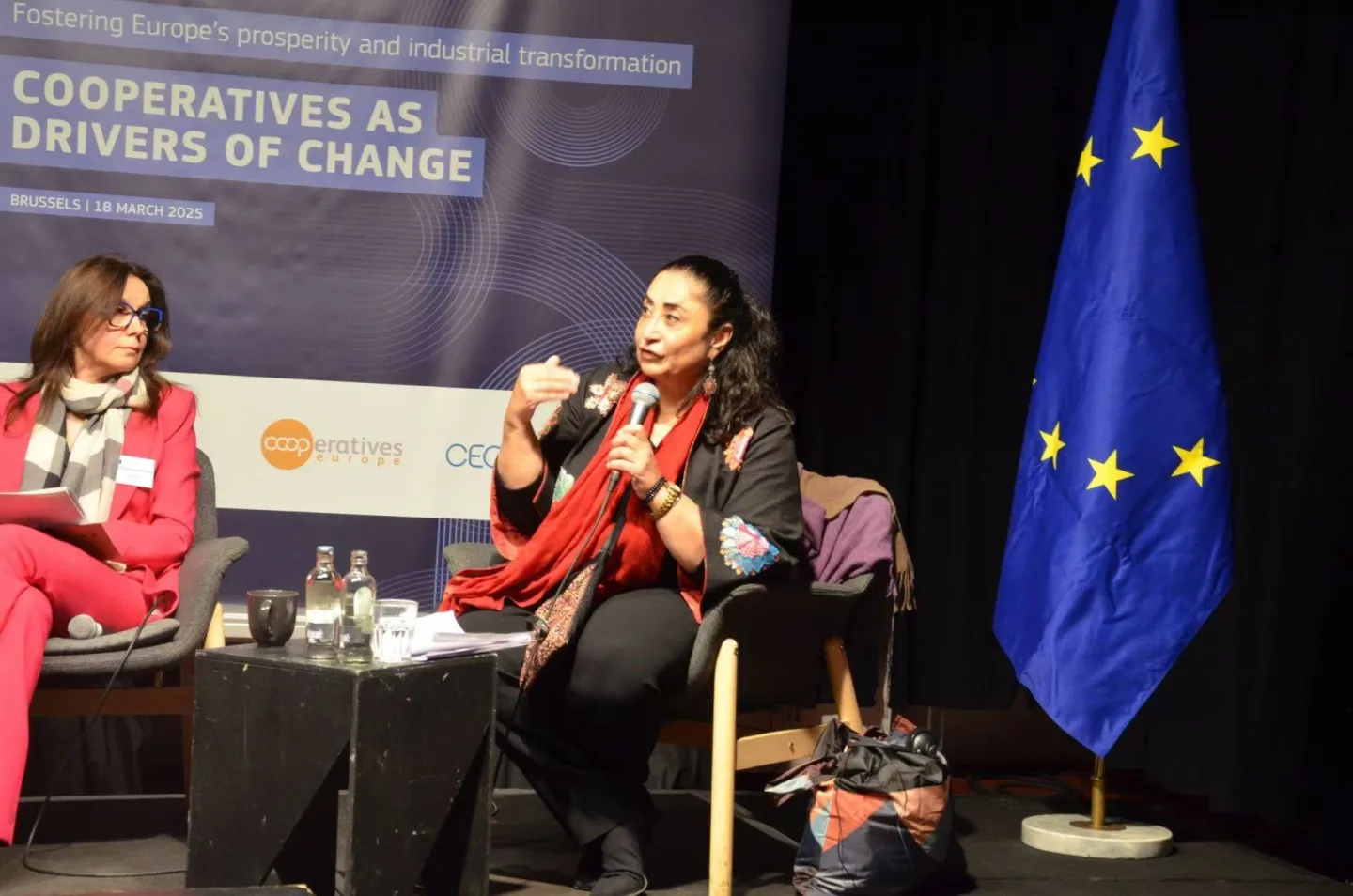
Simel Esim, Head of the ILO Cooperative, Social and Solidarity Economy (COOP/SSE) Unit and Chair of UN Inter-Agency Task Force on Social and Solidarity Economy (UNTFSSE), participated as a panellist in the Plenary Session “Decarbonisation, Innovation, and Competitiveness: Shaping the Future of Cooperatives in Our Industrial Policy – A Dialogue with Stakeholders.” During the session, panellists explored the critical role of cooperatives in Europe’s economic and social transition, especially in growing global economic competition. Simel Esim emphasized how cooperative values, principles and practices are well aligned with the UN SDGs, and European cohesion policy priorities of social cohesion, inclusion, and sustainability.
She also highlighted how, driven by democratic governance, long-term resilience, and reinvestment in local communities, cooperatives present a unique comparative advantage in relation to competitiveness. European cooperatives, she noted, span a wide range of sectors from agriculture, forestry and banking to retail, pharmaceuticals and health care, demonstrate how market competitiveness can be harmonized with social and environmental objectives.
Drawing on global examples, Simel Esim highlighted some good practices that can be further scaled up in relation to social innovation. These include cooperative to cooperative trade, financing of cooperatives by financial cooperatives, and elimination of child labour in agriculture in the operations of cooperatives and their members in rural areas. She pointed to platform cooperatives as a key model, combining technological innovation with democratic decision-making to secure fairer wages and better working conditions in the digital economy. She noted that cooperatives are involved in climate change adaptation through mutual insurance for crops and supporting diversification of crops or improved watershed management. She also provided examples of cooperatives mitigating climate change in renewable energy, forestry and agroforestry and recycling.
To maximize cooperatives’ contributions to industrial policy, Simel Esim emphasized the importance of creating a level playing field. This includes ensuring cooperatives have equal access to credit, investment, public procurement, and a supportive regulatory environment. By implementing these measures, cooperatives will be better positioned to play a significant role in shaping industrial policy while staying true to their core values and principles.