Advancing social justice, promoting decent work
ILO is a specialized agency of the United Nations
English
Domestic workers in Jamaica receive entrepreneurship grants from the ILO-Ministry partnership
The specific aim of the collaboration is to foster the participation of female domestic workers in formal entrepreneurial activities that generate additional income to supplement their livelihoods and ultimately, reduce their economic vulnerability.
Approximately 50 female domestic workers are to benefit from small entrepreneurship grants under a partnership between the ILO and Ministry of Labour and Social Security (MLSS), Jamaica.
The ILO’s financial contribution seeks to give direct support to the MLSS to strengthen its entrepreneurship training and grant programme, with resources specifically targeting female domestic workers.
The specific aim of the collaboration is to foster the participation of female domestic workers in formal entrepreneurial activities that generate additional income to supplement their livelihoods and ultimately, reduce their economic vulnerability. In particular, the intervention aims to see an increase in the number of female domestic workers who initiate (and/or expand) formal entrepreneurial activities through the creation of a temporary “special window” for these target beneficiaries who were nominated by the Jamaica Household Workers’ Union.
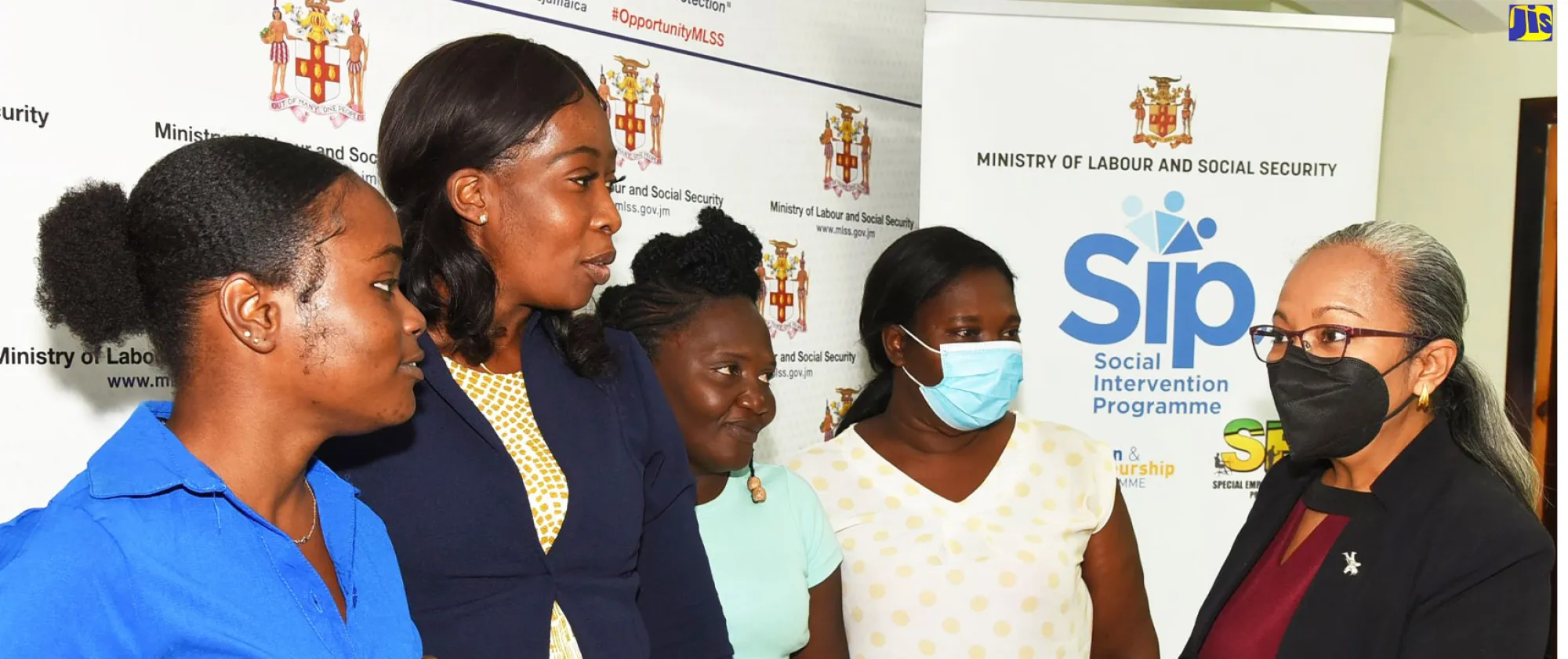
During the presentation of cheques ceremony held on 4 May 2022 at the Ministry’s North Street Office in Kingston, Permanent Secretary, Colette Roberts Risden (in photo, right) noted “It is indeed an achievement for us to see this initiative finally get off the ground.”
This initiative was developed in the framework of the Jamaica Formalization Project developed in 2020 with the expressed aim of expediting implementation of key interventions agreed in the National Transition to Formality Action Plan 2020-2022 (TFAP) and other urgent actions to mitigate the increased vulnerability of targeted workers induced by COVID-19.
Activities within the framework of the project have been designed to provide vulnerable female domestic workers with financial and non-financial support for entrepreneurial initiatives to improve income security and as incentives towards formalization under the Ministry’s Social Intervention Programme (SIP). The grant recipients will also benefit from basic training through the existing Education and Entrepreneurships Grants Programme (E&EGP).