

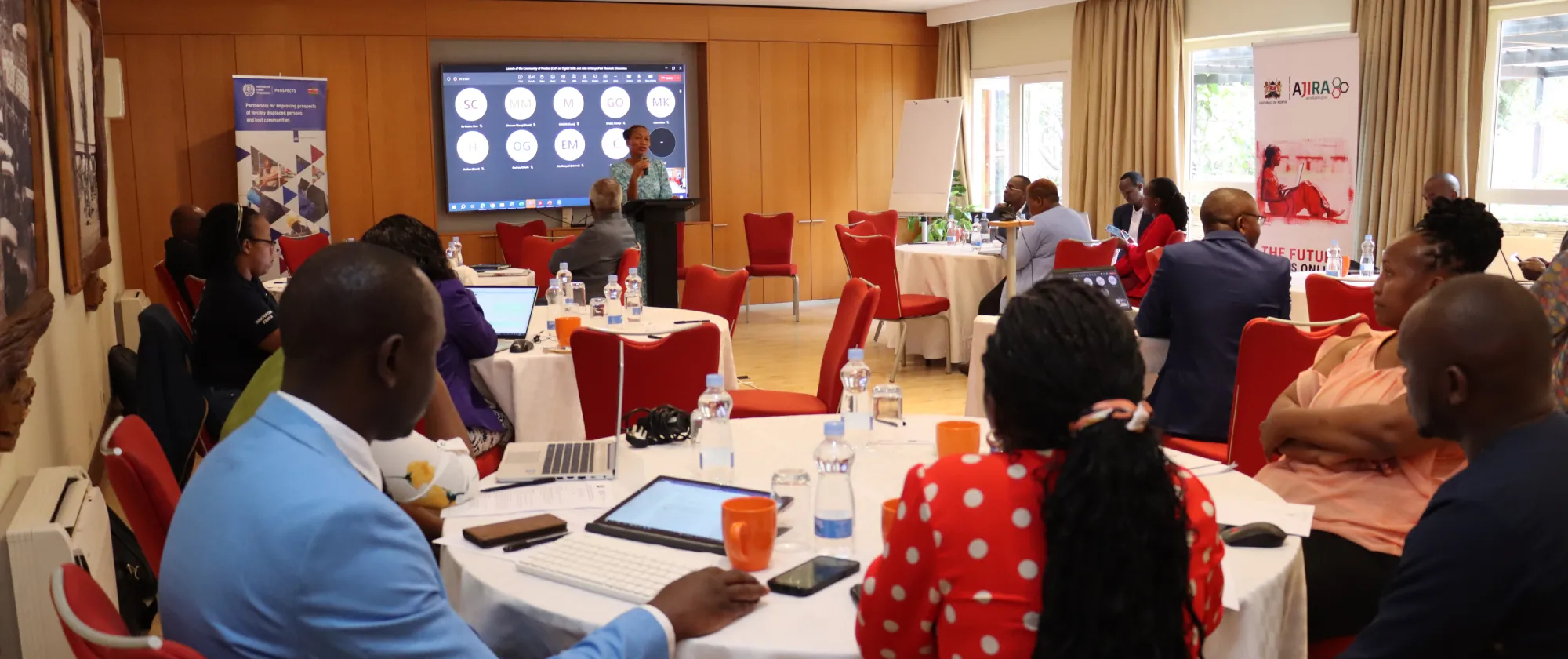
Community of Practice on Digital Skills and Jobs kicks-off with a discussion on digital entrepreneurial activity in Kenya
On the heels of a rapidly growing digital economy, the ILO, Government of Kenya and social partners came together to discuss coordinated responses to drive forward innovation and decent work.
28 August 2023
Nairobi KENYA (ILO News) – At a blended webinar event co-hosted by the International Labour Organization (ILO), Ministries of Labour and Social Protection and of Information, Communications and the Digital Economy in Kenya, the Community of Practice (CoP) to support the country’s rapidly evolving digital economy was officially launched.
Convening close to 70 participants, including government representatives, policymakers, educators, digital skills trainers, unions, industry leaders, workers’ organizations of freelancers and local associations interested in discussing, engaging and co-creating around an inclusive transformation of Kenya's digital economy.
“The CoP, now formally operational, looks to foster collaboration, exchange industry and sector insights, and address key challenges to drive forward sustainable and inclusive growth in Kenya’s digital economy,” said Caroline Njuki, Chief Technical Advisor at the ILO.
In her address, she encouraged participants to reflect on the preparation of Kenya’s digital economy to ensure safety and support for all actors. “While digital jobs provide opportunities for many, these come with inherent risks that need to be addressed. We need to be aware of the challenges of work in the digital sphere,” Njuki added.
“With the CoP’s inauguration comes a collaborative platform for collective action”, said, Bro. Benson Okwaro, Deputy Secretary General of the Central Organization of Trade Unions (COTU-K). Coordination is an essential step in harnessing the full potential of the digital economy, he stressed, adding that the “CoP will help to build a conducive environment where innovation fosters digital jobs aligned with internationally recognized decent work principles”.

Need for an ecosystem conducive to digital entrepreneurial activity
Established in July 2023, the CoP, through its Core Working Group identified five thematic priorities of collaboration, the first one being innovation, job creation and entrepreneurship.
Experts joining the event highlighted how digital platforms have democratized entrepreneurship, enabling some individuals to transform their ideas into business ventures without the need for extensive resources or physical infrastructure. This has led to the emergence of innovative start-ups that leverage technology and e-commerce as a sustainable source of livelihood. Still, the success of local tech businesses depends on policy coherence to provide a conducive business environment for digital entrepreneurial activity.
Localization and understanding the unique context emerged as key factors in ensuring that global platforms can respond to the opportunities and capacities of local tech ecosystems. Panellists also emphasized the importance of sustaining businesses and fostering an environment conducive to innovation. Collaborative efforts between government, businesses, and the tech community were identified as the driving force behind long-term inclusive growth.
Mercy Mugure, CEO at Adept Technologies, highlighted the need for a public procurement system that provides opportunities to local tech businesses. This would ensure that contracts are accessible to start-ups and SMEs, ultimately fostering local economic growth and investment. Participants further underlined the significance of education, collaboration, and cultural understanding in achieving sustainable innovation and growth in the tech sector.
The power of tripartite partnerships was evident in the day’s discussions. The participants agreed that creating platforms for knowledge sharing, mentorship, and resource access can empower freelancers and entrepreneurs to overcome challenges and tap into new opportunities.
Kenya as a digital talent hub
Discussions also centred on the opportunities for employment and inclusion afforded by having Kenya positioned as a global technology talent hub. With the rise of remote work and the increasing prevalence of digital collaboration across sectors and disciplines, Kenya's highly skilled workforce can tap into job opportunities facilitated by transnational labour markets. To this end, possibility of expanding 'borderless work' was discussed, emphasizing that technology professionals can now work from anywhere in the world, transcending geographical constraints, and not being subject to work opportunities available in national labour markets.
Bridging divides and advocating for decent online work
The two panel discussions also highlighted the importance to improve access to decent jobs opportunities for workers considering the digital economy as a viable source of income. Participants pointed at occupational hazards, navigating cyber safety risks, pursuing upskilling support, and coping with a lack of formal protections as some of the challenges in working online.
These and other challenges, if left unaddressed, may contribute to widening existing inequalities and divides in terms of income, digital skills, and social inclusion. “This is especially true for persons with disability,” highlighted Esther Mkamori, Program Director at United Disabled Persons of Kenya. “Specific skilling may be necessary together with special tools, which represents the dual nature of technological advancements,” she added.
Lynette Kinyua, an online freelance worker, provided a first-hand account of some of the inherent risks that workers like herself face in the digital economy. She spoke of sleep deprivation due to long hours and working for clients in different time zones, as well as the irregular flow of income due to the nature of ad hoc work assignments made available through digital labour platforms. She further touched on how working directly with clients without platform intermediaries improved her work-life balance, pointing to the areas where digital labour platforms can better support workers.
Taking it one step further, Teresios Bundi, Gig and Data Economy Advisor at GIZ, stressed that with online workers not recognized as formal employees by platforms, the challenges related to platform work are brought to light, in particular those related working without benefits and social protection.
The absence of clear dispute resolution mechanisms for online workers was also highlighted by Frida Mwangi, Board Secretary at Online Professional Workers Association of Kenya, pointing to opportunities for digital labour platforms to encourage collaboration and offer mentorship opportunities, especially around navigating digital risks such as online harassment, scams and fraud.
Participants also acknowledged the need for effective policies and regulations that more closely align with the evolving digital landscape. As the gig economy continues to reshape traditional work models, policymakers face the challenge of creating a conducive environment that encourages digital entrepreneurship while ensuring fair treatment, benefits, and protection for freelancers. The discussion highlighted the importance of crafting regulations that are adaptable, inclusive, and informed by the unique characteristics of digital work.
A life-cycle approach to digital upskilling
Another prevailing theme was the need for digital upskilling, with a life-cycle approach, to ensure continuous learning in response to changing digital labour market needs. To this end, the importance of staying relevant in a competitive landscape was underscored by Josephine Ndambuki, Chief Manager of the Business Development and Innovation at the Konza Technopolis Development Authority (KoTDA). In response to a question from the audience, she added that “freelancers must remain agile, learning new skills and adapting to emerging trends to remain viable contributors to the industry.” The panel discussion further underscored that the transformational power of upskilling has a positive effect, enabling individuals to diversify their skill sets and remain competitive in a rapidly changing environment.
A salient concern also raised in the conversations was the discrepancy in earnings between local and international freelancers. This disparity drew attention to the larger issue of global wage inequalities in the tech industry, underscoring the need for initiatives that address wage disparities and promote fair compensation for freelancers across the globe.
- Moving forward, participants agreed on the need to continue discussing the growing trend of outsourcing and the labour policy and protection measures needed to adapt to this changing world of digitally enabled work.
- Calling for policy coherence, there was consensus around the need for alignment between conversations, actions, and outcomes in boosting innovation, entrepreneurship and job creation for all in the digital economy.
The PROSPECTS programme in Kenya and the Opportunity Fund project on the Promotion, inclusion and protection of refugees and host communities in the gig economy, funded by the Kingdom of the Netherlands are supporting the CoP for driving the expansion of a digital economy that ensures growth while generating equity in access to skills and decent work opportunities for all.
Relevant projects

Promotion, inclusion and protection of refugees and host communities in the digital and gig economy

PROSPECTS Opportunity Fund project
Advancing Young People’s Engagement and Meaningful Participation in the PROSPECTS Partnership