

EU-funded ILO PROSPER Project
Community-led economic planning takes shape in Southern Belize
The pilot of a Participatory Appraisal of Competitive Advantage (PACA) in Hopkins and Seine Bight demonstrated how community-led planning can generate practical, locally owned priorities for inclusive and sustainable economic development in Southern Belize.
2 January 2026
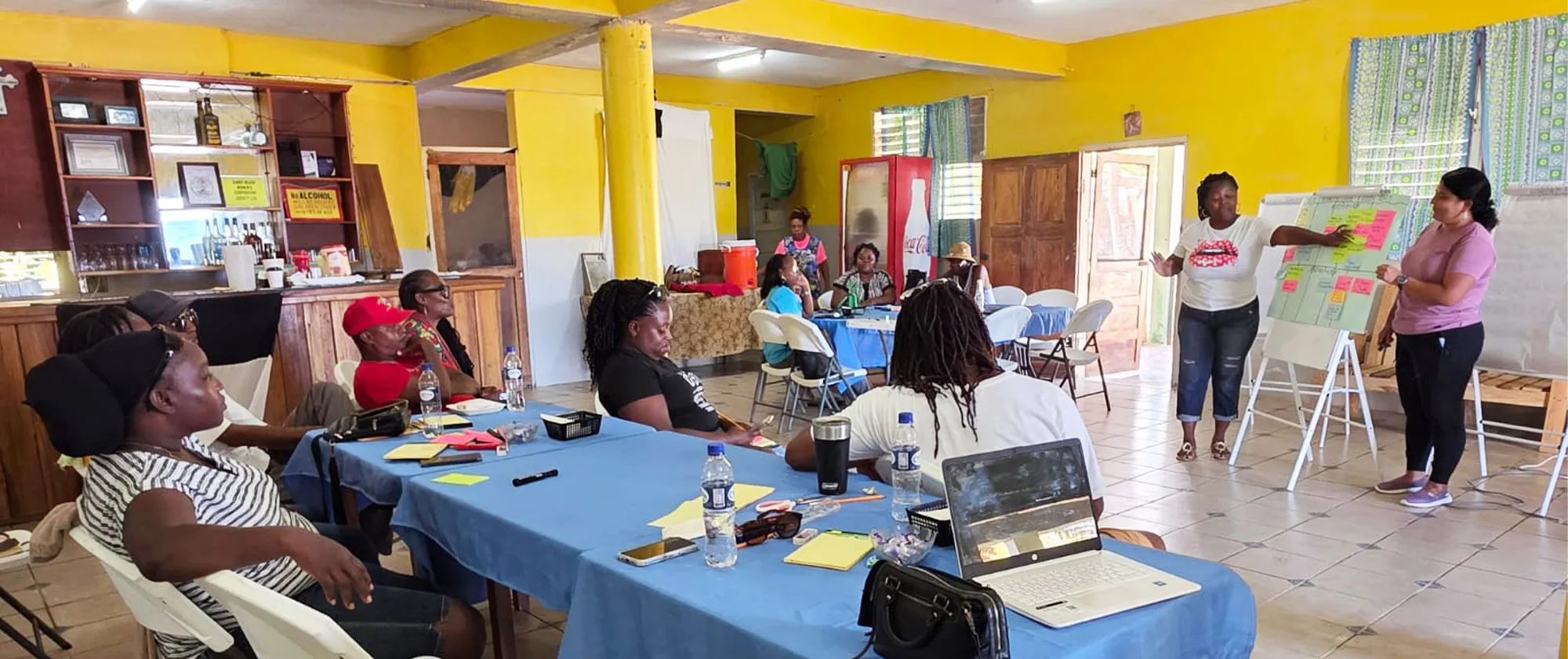
Seine Bight, Belize (ILO News) - From December 7 to 17, 2025, the Garifuna communities of Hopkins and Seine Bight piloted the Participatory Appraisal of Competitive Advantage (PACA) methodology, placing community members at the centre of local economic development (LED) planning.
Humana People to People Belize (HPPBZ) facilitated the PACA sessions under the EU-funded ILO PROSPER Project, engaging 118 participants from diverse groups including business owners, service providers, women, youth, and marginalized communities. Trained PACA implementers Wilder Gonzales (HPPBZ), Francelia Bolon (Julian Cho Society), and Dr. Enita Barette (National Garifuna Council) led facilitation, delivering a participatory, inclusive, and rigorous process. The process helped participants define and agree on shared priorities and concrete next steps to advance local economic development (LED), grounded in local conditions.
A process built for inclusion
The PACA process entailed a structured ten-day sequence. Key activities over the period included:
- December 7: Hypothesis Workshop to set initial priorities.
- December 8: Diagnostic session used analytical matrices to synthesize community inputs.
- December 15: PACA champions crafted tailored LED action frameworks for each village.
- December 17: Public presentations shared findings, top initiatives, and next steps.
Local PACA champions (facilitators) drawn from the communities also conducted key informant interviews, mystery shopper exercises, and group discussions. This multi-method approach created a holistic picture of each community’s economic strengths, gaps, and constraints. Community mini-workshops enabled participants to validate and rank initiatives using agreed criteria such as economic impact, feasibility, and sustainability, ensuring priorities reflected local realities rather than external perceptions.
Although Hopkins and Seine Bight share Garifuna heritage and a coastal setting, the pilot underscored the need for context-specific approaches. Seine Bight’s younger population, compared to Hopkins’ stronger reliance on fishing and self-employment, required tailored facilitation methods. Prioritising youth engagement through youth-friendly techniques and flexible scheduling, ensured young people were meaningfully involved in shaping future local economic development pathways.
"I could share my ideas about jobs and opportunities without worrying that adults would ignore us. It feels good to be part of shaping our future," added a youth participant from Seine Bight.
Barriers affecting women, informal workers, and marginalized groups were also addressed through targeted outreach, inclusive facilitation techniques, and the creation of safe discussion spaces. Gender balance and representation were treated as core design principles rather than assumed outcomes.
"The workshops gave us a safe space to speak up. We were able to discuss our challenges, and now we have clear steps we can actually work on," said a local woman engaged in informal work.
The role of the local PACA hosts proved critical. Their involvement strengthened trust, improved turnout, and helped navigate community dynamics demonstrating that meaningful participation depends on locally anchored facilitation.
Charting paths forward
The pilot was designed to connect with broader local economic development efforts. Its results were aligned with skills development and TVET programmes, access to microfinance or seed funding, business development services, and partnerships with NGOs, government agencies, and development partners.
"What made this process meaningful was seeing fellow citizens realise that their voices matter. Being able to guide a process where communities shape their own development is something I’m truly proud of.” said PACA champion facilitator, Wilder Gonzalez of Humana People to People, Belize.
By strengthening local capacity, fostering ownership, and linking priorities to implementation pathways, PACA provides a strong foundation for inclusive and resilient economic development. The Hopkins and Seine Bight pilot offers a practical model for scaling how PACA is deployed within Belize’s national LED framework. As these communities move forward with their prioritized initiatives the real measure of success will be tangible improvements in livelihoods and community resilience. The foundation has been laid; the next steps are building economic futures together.
Related content

An ILO-EU Project
Participation, Ownership and Sustainable Progress for Economic Resilience (PROSPER)
Relevant projects
An ILO-EU Project
Participation, Ownership and Sustainable Progress for Economic Resilience (PROSPER)