


Employment strategy
Collaborative action drives Timor-Leste's National Employment Strategy forward
The ILO supports Timor-Leste’s key labour actors in reviewing and refining national proposed priority interventions to achieve a sustainable labour market and inclusive growth in the country.
27 May 2025
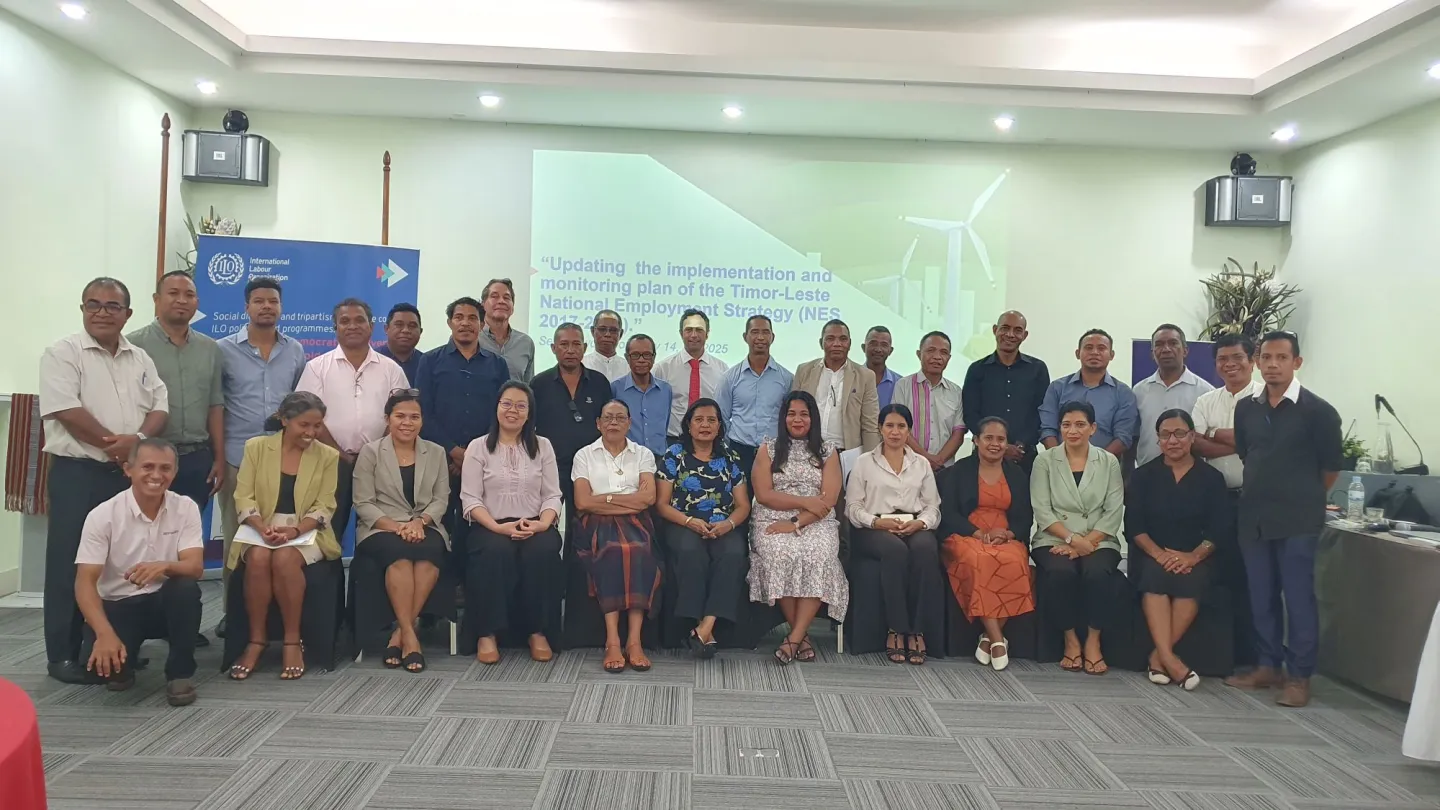
DILI, Timor-Leste (ILO News) - The Government of Timor-Leste, through the National Employment Strategy (NES) Secretariat, in collaboration with the ILO, convened the second national workshop in Dili, from 14-15 May. Bringing more than 40 participants, including representatives from 15 government ministries, training centres, trade union and private sector institutions, the workshop aimed to update the Implementation and Monitoring Plan of the Timor-Leste National Employment Strategy (NES 2017-2030). It also served as a critical step toward finalizing the NES Implementation Plan for the period of 2025-2028 and refining its Monitoring Framework.
We are committed to ensuring that every Timorese, especially our youth and returning migrant workers, has a fair shot at decent employment.
Paulo Alves, Executive Director of the NES Secretariat
Paulo Alves, Executive Director of the NES Secretariat, reiterated the government’s commitment to employment creation and the alignment of national policy implementation with current priorities such as climate resilience, skills development and economic diversification. “Updating our National Employment Strategy is not just a technical exercise, it is a political priority of the 9th Constitutional Government. We are committed to ensuring that every Timorese, especially our youth and returning migrant workers, has a fair shot at decent employment,” Alves stated in his opening speech.
The workshop featured a keynote presentation by ILO’s consultant, Lailly Prihatiningtyas, who shared findings from the recent green employment diagnostic study titled “Socioeconomic and Labour Market Implications of Climate Transition for Timor-Leste”. In addition to the attending participants, the session was also virtually viewed by additional 23 participants from various development partners.
The study reveals that Timor-Leste remains highly vulnerable to both physical and transition climate risks, largely due to its dependence on oil revenues and limited economic diversification. It also points to gaps in policy coherence between development, climate and employment strategies. “Despite these challenges, there are promising opportunities for green jobs and inclusive growth in the country, particularly in renewable energy, sustainable agriculture, eco-tourism, climate-resilient infrastructure and climate finance,” the study stated.
Following a discussion of the key findings, participants were organized into three working groups, each aligned with one of the three NES pillars: 1. Increasing labour market demand, 2. Improving labour market supply, and 3. Strengthening labour market institutions. Each group reviewed and refined proposed priority interventions, clearly assigning responsible institutions, resource requirements, timelines and indicators for measuring success. The results of the working group will be used for finalizing of the NES Implementation Plan and guide sectoral ministries in operationalizing employment-focused programmes.
The updated implementation plan is expected to align with emerging national priorities, including climate resilience. It ensures that the NES remains grounded in Timor-Leste’s current realities while shaping a shared vision for sustainable and inclusive growth.
Diego Rei, ILO Employment Specialist
“The updated implementation plan is expected to align with emerging national priorities, including climate resilience. It ensures that the NES remains grounded in Timor-Leste’s current realities while shaping a shared vision for sustainable and inclusive growth,” noted Diego Rei, ILO Employment Specialist, who also appraised the national ownership and inter-ministerial collaboration shown during the working group.
The updated Implementation and Monitoring Plan will be finalized during a third workshop scheduled for July 2025, with the goal of securing endorsement by the end of the third quarter of the year.
Related content

Employment strategy
Timor-Leste advances its National Employment Strategy with a comprehensive implementation and monitoring plan