

Employment Intensive Investment Programme
Celebrating 20 years of ILO collaboration with South Africa’s Expanded Public Works Programme
20 May 2024
Building a better future through collaboration
The International Labour Organization (ILO) has been a steadfast partner to South Africa’s Department of Public Works and Infrastructure (DPWI) in supporting the Expanded Public Works Programme (EPWP) since the launch of the programme in 2004. As we mark the 20th anniversary of this vital collaboration, it is an opportune moment to reflect on the achievements and look forward to the future.
A shared vision for development
The partnership between the ILO and the DPWI is rooted in a shared commitment to addressing unemployment, poverty, and inequality. The ILO, with its global expertise in promoting decent work and social justice, has provided invaluable technical assistance, policy development, and capacity-building support to the EPWP. This collaboration has evolved to meet South Africa’s changing needs, adapting to economic shifts and embracing innovative employment strategies.
Achievements over two decades
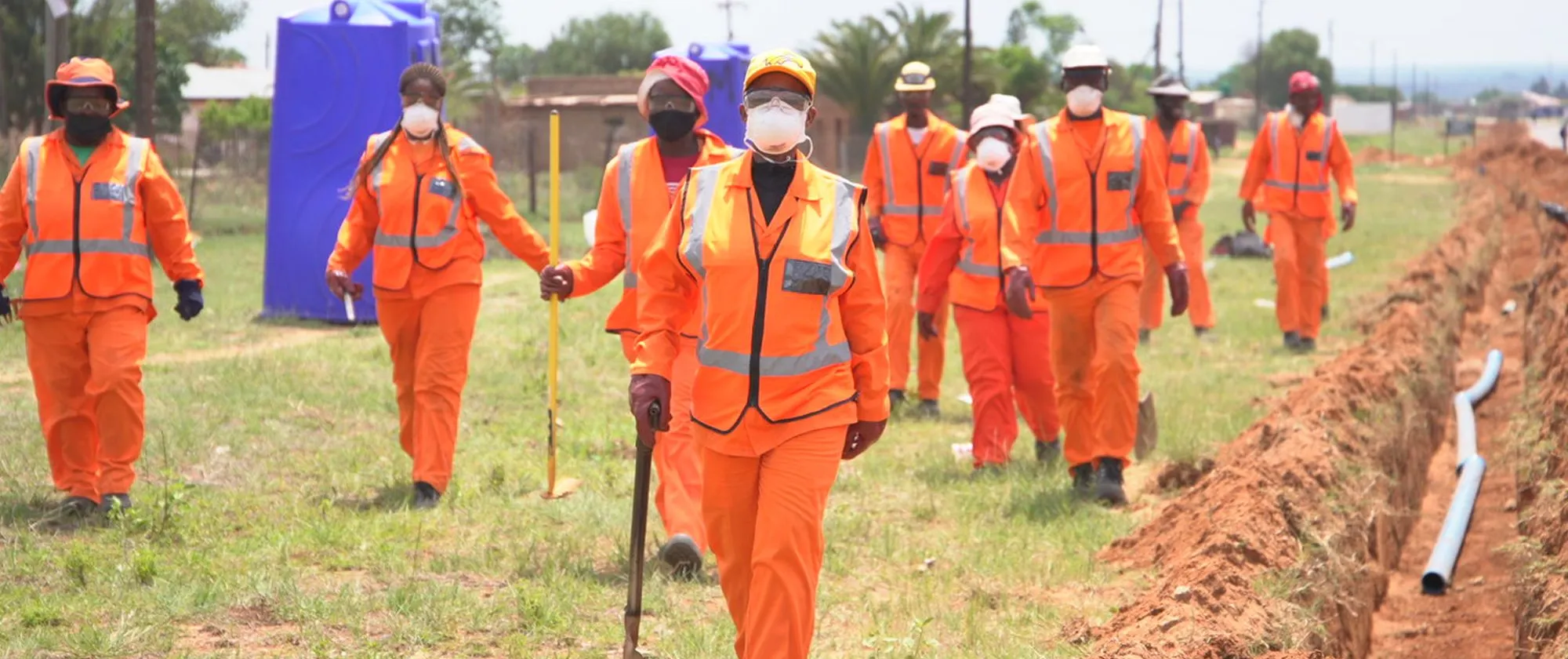
The EPWP was launched in 2004 with the goal of creating work opportunities for those unable to find employment in the formal economy. Over the past 20 years implemented in 5-year phases, it has transformed the lives of millions of South Africans. By the end of EPWP Phase 4 at the end of March 2024, the programme had created over 14 million work opportunities across its four sectors, benefiting numerous communities.
President Cyril Ramaphosa, speaking at the launch of EPWP Phase 5 on the 24th of April 2024, highlighted the programme’s impact: "For the past twenty years, the Expanded Public Works Programme has transformed the lives of millions of young South African men and women born into democracy."
Key areas of ILO support
The ILO support to the programme includes the following:
Policy development and promotion
The ILO has played a pivotal role in drafting and promoting policies that underpin the EPWP. This work includes the development of the EPWP Policy (currently under review by tripartite partners), which guide will guide the programme’s implementation and aligns it with national development goals. The ILO also assisted the Limpopo Department of Public Works Roads and Infrastructure (LDPWRI) to develop an Interim Provincial EPWP Policy in 2020 as a gap measure whilst awaiting the finalisation of the National EPWP Policy. Recent achievements include the approval of the EPWP Phase 5 Proposal by Cabinet, thanks to the collaborative efforts of the ILO’s team of specialists.
Advocacy and partnerships
The ILO has been instrumental in raising awareness about the EPWP’s benefits and garnering support from stakeholders. This includes showcasing the EPWP at international forums and arranging inbound and outbound study visits to share best practices. The ILO supported the holding of the 4th Limpopo EPWP Summit in March 2022 which brought together all EPWP Stakeholders to reflect on the COVID-19 impact and look forward on opportunities for Job Creation. Recently the ILO facilitated the participation and showcasing of the EPWP at the ILO Regional Seminar in Rwanda in 2023, which attracted over 1,000 participants from 49 countries.
The following recent documentary videos produced by the ILO to showcase the work of the EPWP:
- Umzinyathi Welisizwe Bridges Projects
- Eastern Cape Welisizwe Rural Bridges Project
- Environmental Furniture Innovation Project in Pietermaritzburg
Research and innovation
Through extensive research, the ILO has helped optimize labour-intensive methods and mainstream them in public employment programmes. This includes studies on green jobs and social audits, which have informed policy and practice. Innovative proposals, such as integrating labour-based technology into university curricula, are set to produce a new generation of engineers equipped to address both technical and socio-economic local challenges. The ILO has worked with LDPWRI and the Centre for Scientific and Industrial Research (CSIR) to map out materials and wastes in Limpopo Province that can potentially be exploited using low level technologies to produce alternative construction materials.
Skills and capacity development
The ILO has conducted extensive training for EPWP stakeholders, enhancing their capacity to deliver projects effectively. This includes training for government officials, consultants, and contractors in labour-intensive methods. Since 2005, almost 10,000 stakeholders have been trained, ensuring a skilled workforce capable of implementing EPWP projects to high standards.
Project management and technical support
The ILO has developed guidelines and provided technical assistance to ensure that EPWP projects are implemented efficiently and align with decent work principles. This support has included developing implementation tools and providing ongoing technical advisory support to public bodies. The ILO conducted research on the impediments to participation of Persons with Disabilities in the EPWP. The outcome of the research informed the current collaboration with the EPWP to produce Guidelines to Enhance the Participation of Persons with Disabilities in the EPWP.
Looking ahead: EPWP Phase 5
As we transition to EPWP Phase 5, the focus is on creating five million work opportunities over the next five years ending 31 March 2029. This phase emphasizes increased youth participation, strengthened skills development, and targeted exit strategies for participants. It aims to enhance the quality of work experiences and the services delivered to communities.
President Ramaphosa reiterated the government’s commitment to public employment: "Our continued commitment to public employment is part of the promise of democracy and freedom. A promise to rebuild South Africa together. A promise to leave no one behind."
The ILO is available to support the Partners in key areas of Policy implementation, advocacy, skills and enterprise development. The ILO, because of its global footprint, will assist the partners under the auspices of the South-South and Triangular Cooperation to interact with other programmes so that they are able to cross learn and benchmark from this exposure.
A call to action
The ILO calls on all stakeholders, including social partners and the private sector, to join forces in supporting the EPWP. By working together, we can create more jobs, improve service delivery, and build a better South Africa for all.
As we celebrate 20 years of impactful collaboration, the ILO remains dedicated to supporting the DPWI and the EPWP in their mission to transform lives and communities through creation of productive assets and delivery of services, whilst creating meaningful work opportunities. Here’s to the next phase of growth and success.