

Caribbean labour migration
CARICOM, ILO and IDB advance regional labour migration agenda
With support from the ILO and the IDB, the CARICOM Secretariat and regional tripartite partners are advancing practical steps to move labour migration policy from regional agreement to national implementation.
1 July 2026
PORT OF SPAIN, Trinidad and Tobago (ILO News) – Labour migration has long shaped Caribbean life. The challenge countries face now is how to govern the processes so that movement for work protects workers, meets skills needs, supports enterprises and helps countries build resilience amid demographic, economic and climate pressures.
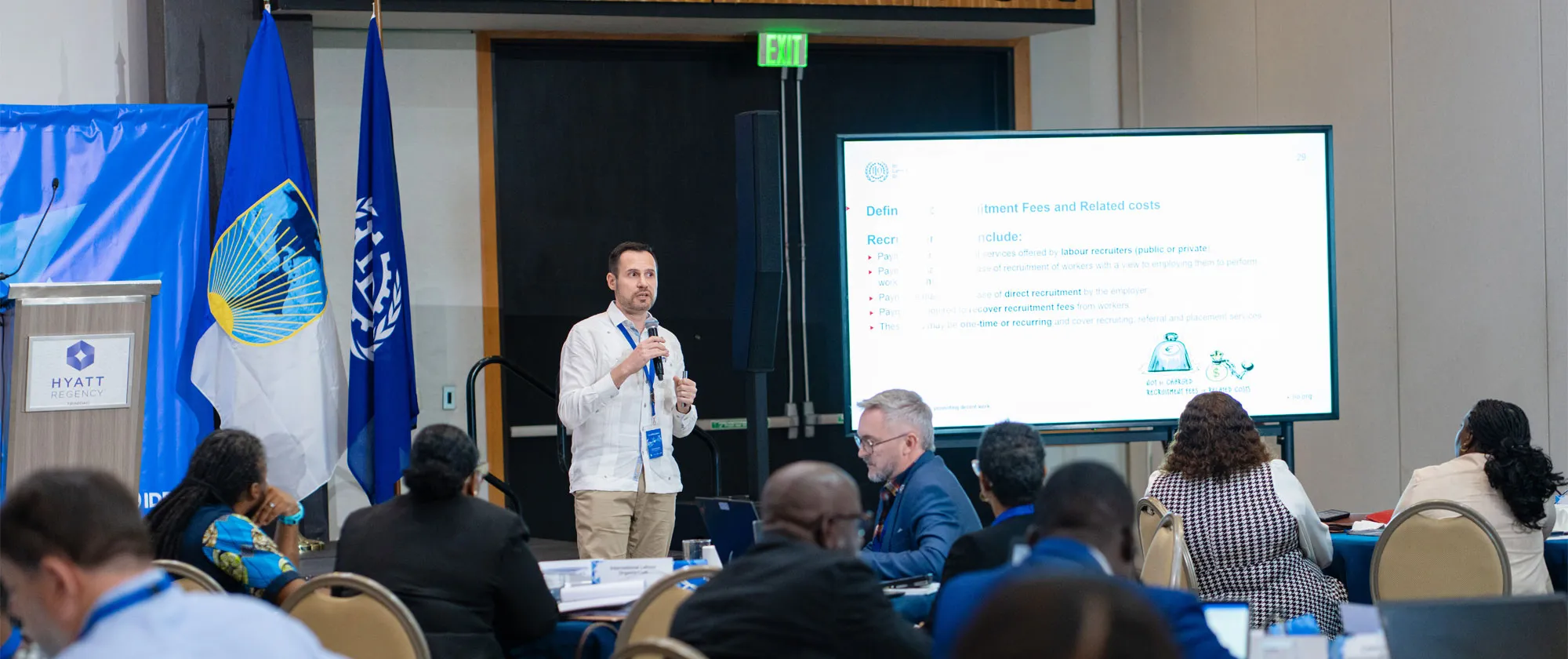
This was the central message of the Regional Tripartite Workshop on Labour Migration, held from 21 to 22 May 2026 in Port of Spain. Organized by the CARICOM Secretariat in collaboration with the Inter-American Development Bank (IDB) and the International Labour Organization, the workshop brought together government, employer and worker representatives, civil society, academia, regional institutions and development partners to focus on implementation.
For Joni Musabayana, Director of the ILO Decent Work Team and Office for the Caribbean, the issue is ultimately about people. He reminded the gathering, “it is for them and for the communities and economies that depend on their work, their remittances, their skills and their choices, that this workshop matters.”
CARICOM has prepared a draft Regional Labour Migration Policy Framework and Action Plan, developed with ILO technical assistance to advance the regional migration agenda and the CARICOM Single Market and Economy. It focuses on governance and policy coherence, fair and ethical recruitment, employment and working conditions, labour mobility and skills recognition and social protection and social cohesion.
Gladys Young, Director of the CARICOM Single Market at the CARICOM Secretariat, underlined the importance of free movement to regional development. “The movement of people for work is not a side issue. It is central to our development, to our competitiveness and to the kind of Community we are building,” she said.
From movement to resilience
Effective governance determines whether labour mobility becomes a pathway to decent work, skills development and growth, or a source of vulnerability and inequality.
The evidence presented showed the scale of the challenge. Around 9 million people of working age are in the labour force across CARICOM, while informality remains high and skills gaps persist in sectors such as nursing, teaching, healthcare and emerging green economy occupations. As Musabayana noted, “We are, in effect, importing the skills we are simultaneously exporting. That is a governance challenge. And it requires a governance response.”
Climate change adds urgency. Agriculture, tourism, construction and health – sectors that anchor livelihoods across the Caribbean – are already being disrupted by climate-related shocks. In this context, labour migration governance is not only a labour market issue. It is part of how small island developing States plan for adaptation, recovery and long-term resilience.
Workshop chairperson Gloria Joseph, Permanent Secretary in Dominica’s Ministry of Labour, Public Service Reform, Social Partnership, Entrepreneurship and Small Business Development, reflected this link to national resilience priorities. She said “well-governed migration can be a driver of prosperity, resilience, and sustainable development,” noting its relevance to Dominica’s National Resilient Development Strategy 2030 and Climate Resilience and Recovery Agenda.
Natalie Willis, Permanent Secretary in Trinidad and Tobago’s Ministry of Labour, Small and Micro Enterprise Development, also emphasized that effective management can make labour migration “a significant catalyst for sustainable development, regional integration and economic resilience”.
Turning policy into practice
The workshop was designed as a series of working sessions that allowed participants to deeply examine labour migration governance, migrant worker protections and decent work, labour migration data and monitoring, and South–South cooperation and partnerships. Countries were also introduced to tools to help identify national priorities and possible implementation road maps.
Julian Belgrave, IDB Group Country Representative for Trinidad and Tobago, said the task is now practical. “Our collective task is no longer only to agree on priorities. It is to translate those priorities into national actions, workplans, budgets, and coordination mechanisms that deliver results,” he said.
A key tool discussed was the Labour Migration Readiness Assessment Tool designed by the CARICOM Secretariat to help Member States assess existing systems, identify gaps and prioritize support needs. Member States officials welcomed it as “practical and effective” and capable of supporting evidence-based decision-making and stronger regional coordination.
By the close of the workshop, participants had agreed on the need to move from policy design to country-level action supported by data, stronger institutions, social dialogue and coordinated partnerships. Priorities included strengthening labour market information systems, improving data sharing, simplifying procedures, protecting migrant workers, addressing exploitation and integrating migration into wider development planning.
“Labour migration, well governed, can help the Caribbean meet skills gaps, strengthen resilience, deepen integration and expand opportunity,” Musabayana said. “Poorly governed, it can deepen vulnerability and inequality.”
As countries work to translate regional commitments and global fair migration principles into national reality, the ILO will continue working with the CARICOM Secretariat, the IDB, the International Organization for Migration (IOM) and other partners to promote labour migration policies and systems that place migrant workers’ rights, fair recruitment, social protection and decent work at the centre of regional development.