

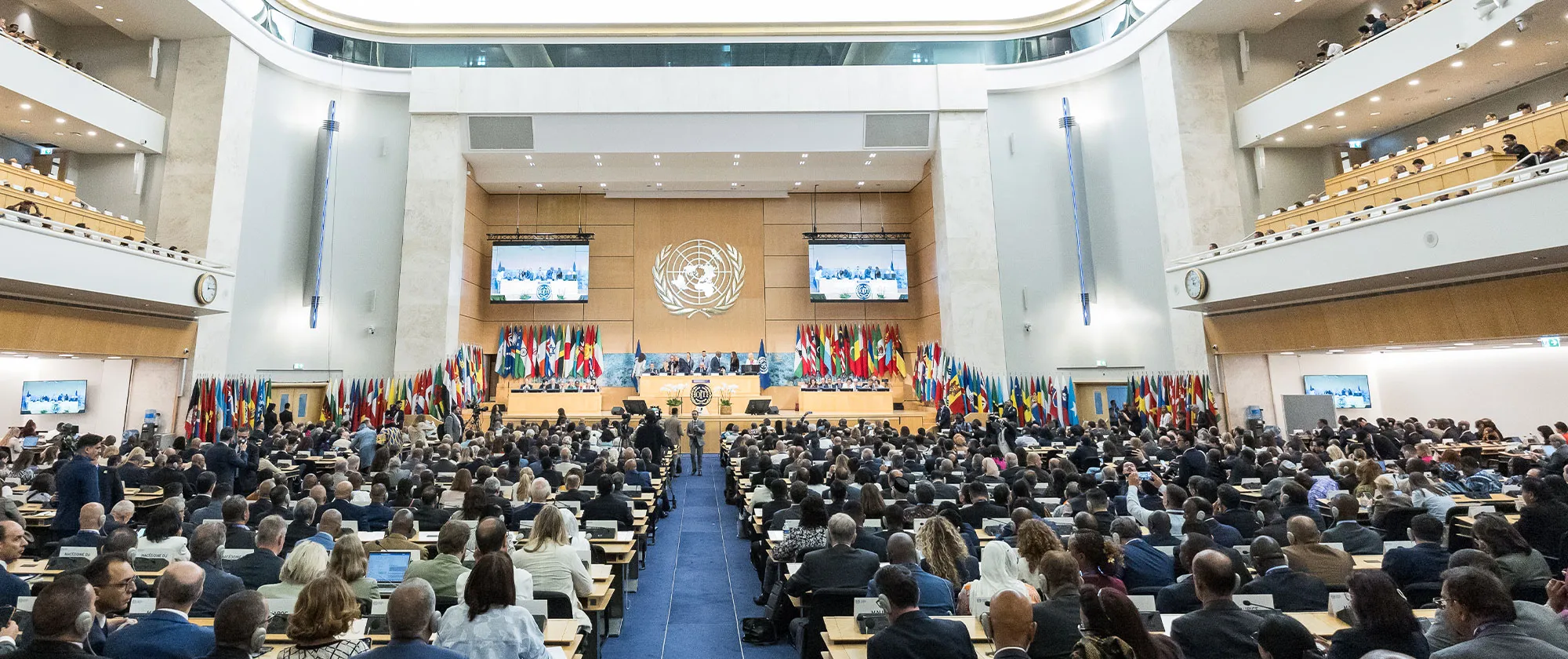
Caribbean workers' delegates to 114 session of the ILC
Caribbean unions prepare for decisive role at 114th session of the ILC
The Caribbean Congress of Labour and the ILO convened regional trade union leaders on 18 May to align priorities and prepare a coordinated Caribbean voice for the 114th International Labour Conference, which opens in Geneva on 1 June.
20 May 2026
Virtual - (ILO News) Caribbean trade unions have taken an important step toward coordinated and effective engagement at the 114th International Labour Conference (ILC), through a webinar jointly convened by the Caribbean Congress of Labour (CCL) and the International Labour Organization (ILO) on 18 May 2026. The session brought together regional trade union leaders and ILO officials to align priorities, review practical arrangements, and strengthen the Caribbean's collective voice ahead of the Conference, which opens in Geneva on 1 June.
A call for strategic Caribbean engagement
Opening the session, CCL General Secretary Michael Annisette stressed that Caribbean workers face rising inequality, insecure employment, attacks on rights, and the expansion of precarious platform work. He said the region's participation in the conference must be practical and strategic, not symbolic, and called for a common Caribbean front in Geneva.
Annisette underscored the urgency of that approach, saying that "Caribbean workers must enter these discussions organized, informed, united, and prepared to influence the global agenda on labour and social justice." He added that this means coordinating positions, engaging actively in committee work, and ensuring that the realities of small island and developing economies are reflected in global labour standard-setting.
ILO reaffirms support to workers' organizations
Delivering opening remarks on behalf of the ILO, Oliver Röpke, Director of the Bureau for Workers' Activities (ACTRAV), situated ILC 2026 within a complex global landscape marked by geopolitical tensions and ongoing institutional reforms within the ILO. He reaffirmed ACTRAV's commitment to supporting workers' organizations.
Röpke said the Caribbean has "an important voice in this global conversation," and stressed that those realities "must be heard in Geneva." He noted that the ILC remains a critical space for defending workers' rights and advancing social justice at the global level.
Issues such as climate vulnerability, migration, informality, and tourism-dependent labour markets were identified as areas where Caribbean trade unions can make valuable contributions to global discussions. The webinar also provided a practical overview of how the Conference works, including committee structures, venue arrangements, registration procedures, and the coordination required for workers' delegates in Geneva.
Priority issues for Caribbean delegates
The session highlighted several agenda items that are especially relevant to Caribbean workers. These included the proposed standard on decent work in the platform economy, the recurrent discussion on social dialogue and tripartism, the Committee on the Application of Standards, and the broader discussion on gender equality at work.
The platform economy debate was presented as one of the most important of the year, with emphasis on worker misclassification, algorithmic management, weak social protection, and the need for a strong international standard. Ida Le Blanc of the National Union of Domestic Employees in Trinidad and Tobago flagged a specifically Caribbean concern: domestic workers are increasingly being recruited through digital platforms under one set of terms, only to find themselves bound to another on arrival in destination countries.
Social dialogue was framed as a democratic tool that becomes even more important in times of crisis and change, with Röpke noting that it "is not a formality, it is a democratic tool" that enables workers to influence wages, labour law, social protection, and transition policies. Caribbean and Latin American voices feature prominently in the negotiating team for this discussion, a regional presence the Caribbean can build on.
Standards supervision was also described as central to making workers' rights real in practice. The Committee on the Application of Standards was presented as one of the ILO's key accountability mechanisms, where workers' interventions can help push governments toward meaningful compliance with international labour standards. The 2026 session also marks the Committee's centenary, a milestone that underscores the enduring importance of supervision to the credibility of international labour standards.
Regional coordination urged
A major theme throughout the webinar was the need for Caribbean unions to coordinate more tightly. Speakers encouraged delegations to agree on a limited set of shared priorities, assign people strategically to different committees, and maintain active communication before and during the conference.
Participants also raised practical concerns such as supporting domestic workers, protecting platform workers, and ensuring that small island and developing states are heard in Geneva. The overall sentiment was one of urgency, solidarity, and readiness to act together.
The webinar marked the start of a broader process to ensure Caribbean workers are well prepared, well represented, and united, with further preparatory activities to follow.