

Forced labour
"Cachorreo", the system used to exploit miners in La Rinconada
For decades, miners have been subjected to "cachorreo" in the highest gold mining area in the world, in the Peruvian region of Puno. This is a modality in which miners work for free for more than 20 days in favour of the operators, to earn the right to extract ore for their own benefit. This system of work violates all legal norms. Many cachorreros do not get the minimum to live on. In addition, they take risks. They do not have contracts, they can die in cave-ins, in explosions or killed by criminals. Those who survive accidents are left to fend for themselves.
14 July 2024
This report was produced by Elmer Mamani as part of the 2nd edition of the practical workshop 'Reporting on Forced Labour and Other Forms of Slavery', organized by the ILO through the BRIDGE Project in Peru. The report was published on Sala Negra platform. The ILO was not involved in the creation, development, fact-checking, or evaluation of this journalistic piece. The opinions, conclusions, and statements expressed are the sole responsibility of the authors and do not necessarily reflect the views, positions, or policies of the ILO.
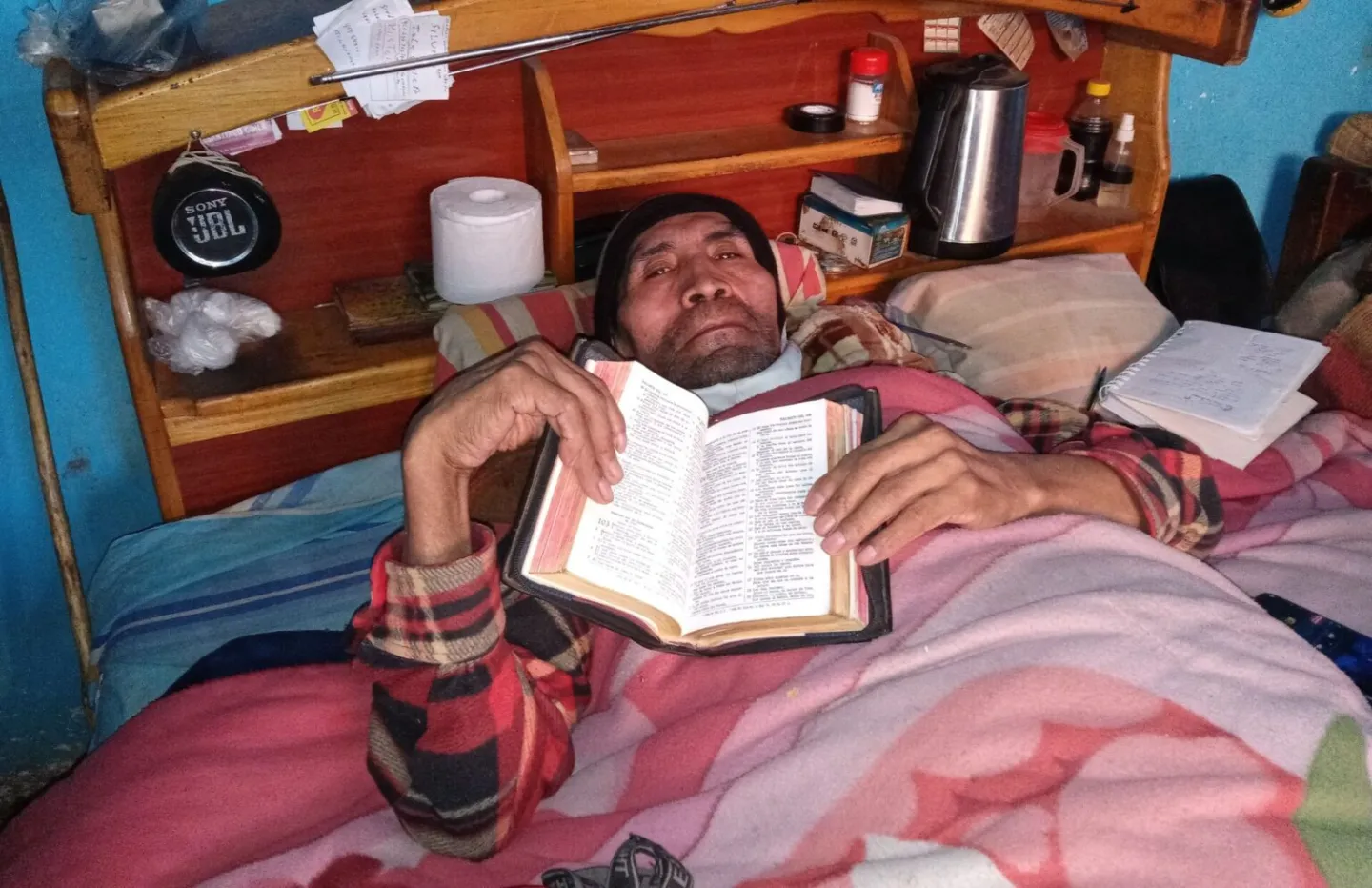
Teófilo Cutimbo Pacombía is 68 years old and has suffered from flaccid paraplegia for 14 years. Only through a screen can he see Ccotos, the town that has always been his home. His children installed cameras that point to the dirt road, to the barley fields, to Lake Titicaca. The crystalline blue waters of the reservoir only appear to him in cold images.
Ccotos belongs to one of the poorest regions of Peru: Puno. There, 41.6% are poor and 13.9% are at extreme levels. Like many children drowning in misery, Teófilo Cutimbo had to leave school and work in his childhood. From the age of 12 he was an assistant to a master bricklayer. In his youth he was part of the working class that built the Inca Manco Capac Airport in Puno and as an adult, to support his eight children, he worked as a security guard and miner.
One Holy Saturday, in the town of La Rinconada, the highest informal mining area in the world, the mobility of his legs was taken away. In a sinkhole in the San Andres sector, a landslide literally broke his spine in two around 10:00 a.m. on April 3, 2010. The medical conclusion was vertebro-spinal traumatism. The same rockslide killed his partner Pedro Pablo Pancca. The tragedy caught him sitting down.
- “Suddenly a big piece fell on us from above," recalls Teófilo in his bed and with his hands on a Bible.
When the rock was removed, Teofilo Cutimbo's legs collapsed as if they were springs. He tried to move and began to feel excruciating pain. He was taken to the nearest city, Juliaca, but they could not find care in private clinics because it was the weekend. He was taken to the Goyeneche hospital in Arequipa, another Peruvian region. Of that eight-hour journey, he only remembers passages because from time to time he would faint from pain.
Two years before the accident, Teófilo Cutimbo came to work at La Rinconada, in the Ananea district of Puno, at more than 5,200,000 meters above sea level and where the temperatures are freezing and turn everything liquid into ice. It was a verbal agreement, without a contract and with the condition that when there was gold, he could extract the mineral for himself. This modality is known as "cachorreo", a form of labor exploitation that has been allowed since the origins of the population center.
The majority of the miners of the lowest rank worked year after year in these precarious conditions. According to a survey conducted by the University of Antwerp in Belgium in the mining area, 87.2% of the workers in 2019 were "cachorreros". Rubén Rojas, Intendant of SUNAFIL Arequipa (labor inspection unit), indicates that it is very serious misconduct not to deliver contracts to employees or pay remunerations, according to the regulations of the General Law of Labor Inspection. This is also not in line with the fair recruitment standards protected by the International Labor Organization (ILO). In other words, not only is it not in compliance with Peruvian law, but it also does not respect human rights, nor does it take care of the vulnerable population exposed to abuses.
Teófilo Cutimbo endured two years without pay as a watchman for the San Francisco de Rinconada Mining Cooperative. Francisco Lima Mamani, partner of the then owner, Tomás Mullisaca Huanca, invited him to work. When there was gold, he was ordered to clean the sinkhole in exchange for extracting ore for himself and Pablo Pancca.
- “You're not going to denounce me," Lima told me. On the small floor he knelt down, at the foot of my bed. "You're not going to report me! How are we going to give you money if you do? We are going to give you everything, we are going to leave you healthy," he told me [...] - I will be delivered healthy, I trusted, he recalled. After the emergency, Lima disappeared. Only when he exposed his case on a radio station in Juliaca, with the warning to denounce them, did Tomás Mullisaca show up to negotiate. They agreed to pay him S/. 200 (USD 50) per month. They only paid him four months and then gave up.
- Now they don't remember anything. They left me like this: alive above, dead below.
Luck
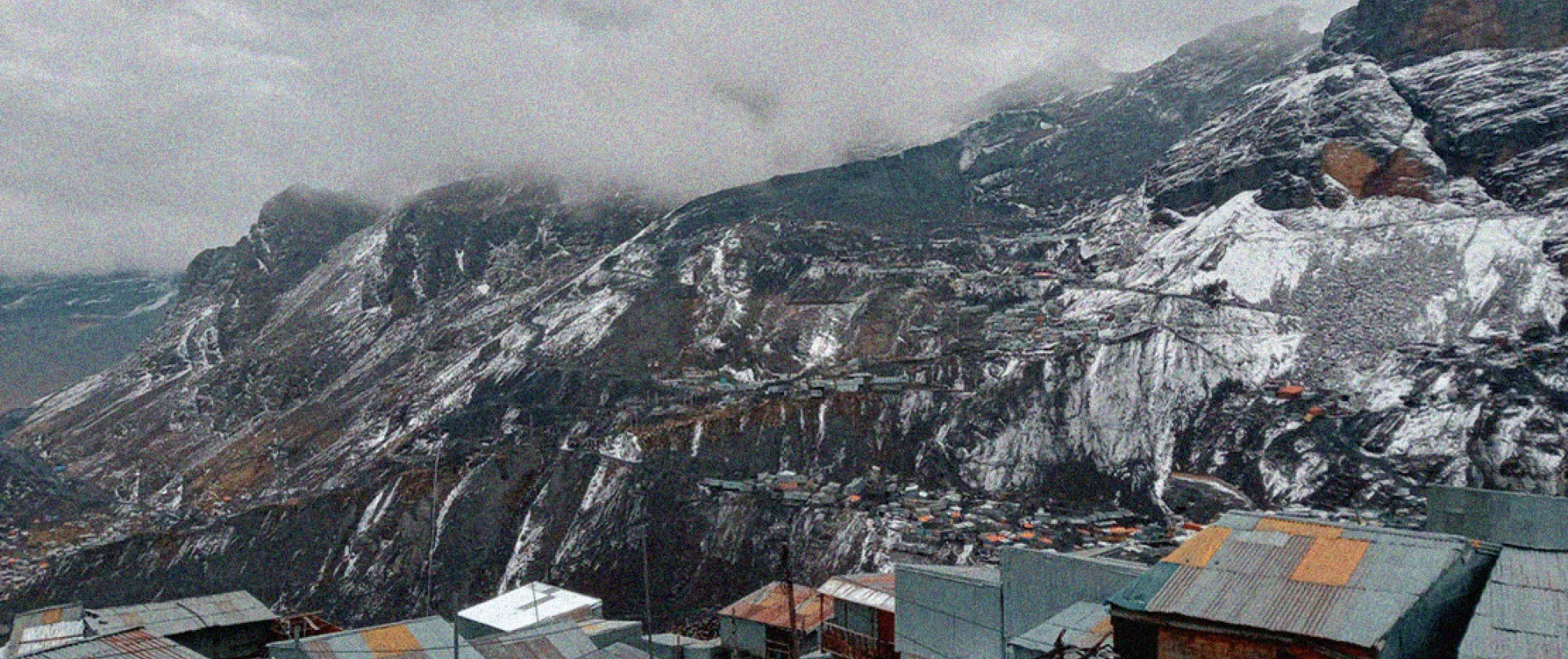
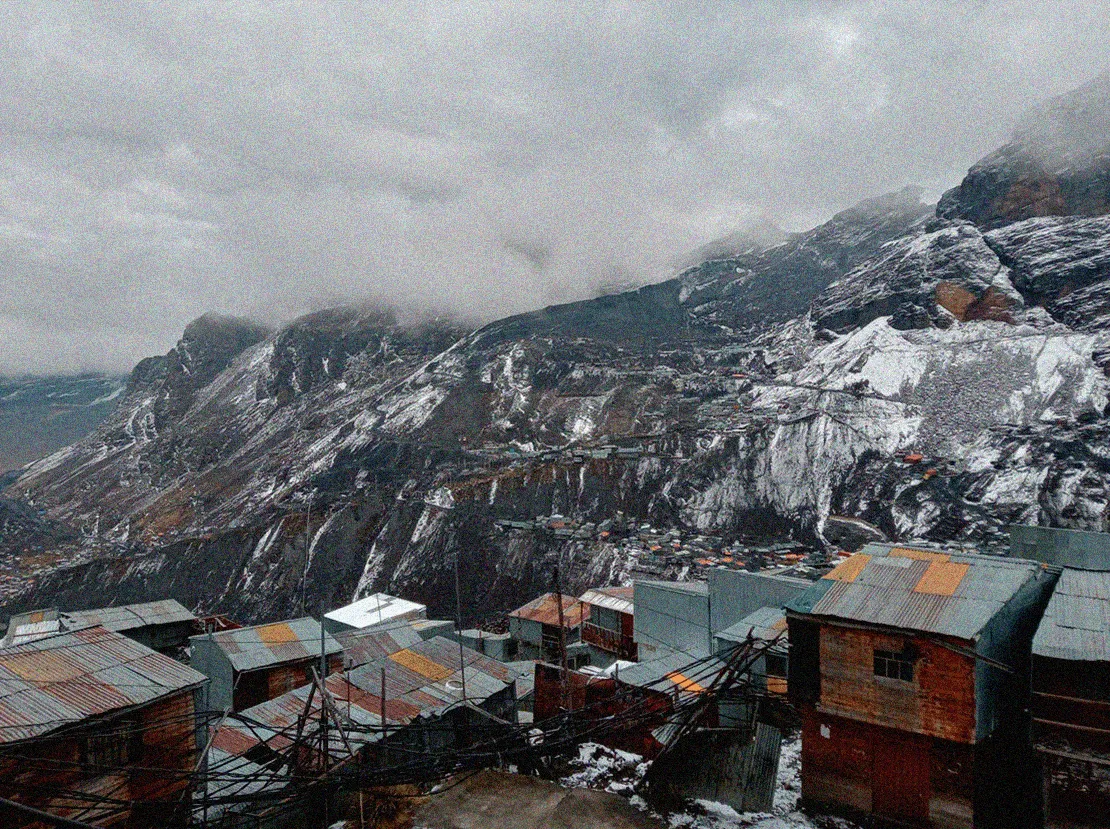
La Rinconada has muddy streets. Much of what the miners step on is also tailings. It comes down from the "trapiches" (stone grinding machines), which use mercury to extract the gold, and is confused with the melting ice. This poison eventually contaminates the Ramis River basin. The mining center is a swarm of hundreds of tiny houses, many of them made of calamine and abandoned; people drinking beer in the streets; sexual exploitation in plain sight; and extreme levels of crime and violence. At its peak it was inhabited by an estimated 60,000 people, 30,000 of them miners alone.
- I remember I was drinking (beer) and a miner walked by and pulled out his gun. Bang, he shot another miner. The killer walked away. Meters down he ran a little and got lost. Who's going to go after him? La Rinconada is a mousetrap, and you run the risk of being shot again," says Roberto Salcedo, a 39-year-old Arequipa native who visited this mining center in 2017 and was a storekeeper for a mining contract until the arrival of the pandemic (2020).

People from all corners of Peru, anchor in this point of the mountain range. From the Puna provinces of San Roman (Juliaca), Sandia, Azángaro, Ilave, for example. Also, from other regions such as Arequipa, Cusco, Madre de Dios. They arrive looking for that stroke of luck that should change their lives. But the reality is different: landslides, accidents, murders, explosions, are commonplace. In the last 6 years (2018-2023), the Police recorded 59 homicides. Only in 2021 there were 18.
"The cachorreo is the luck you have", Roberto Salcedo defines the system implemented for the lowest-ranking miners, such as helpers, tunnel cleaners, machinery operators, watchmen, etc. It consists, he explains, of working 25 days for free for the owner or house, and between 3 to 5 days for their own benefit. It consists, he explains, of working 25 days for free for the owner or house, and 3 to 5 days for their own benefit. La Rinconada's structure and operation is pyramidal and the cachorreros are at the bottom. Above them, there are 468 contractors that extract gold from the deposits. Above the contractors are the cooperatives Minera Lunar de Oro, Minera Cerro Francisco and Minera San Francisco La Rinconada, who deliver the exploitation contracts. And above them all is Corporación Minera Ananea S.A., holder of the concessions, which is at the top of the system.
Only once, Roberto Salcedo was lucky. He got S/. 14,000 (USD 3690) in one day of cachorreo. However, there are people who subsist and do not get anything. According to the dictionary of Peruvian terms, cachorreo "is a non-salaried job whose only compensation is the gold that the miner can find in a short period of days".
Raúl Ortega Pineda argues that the modality would have its foundations in the ayni, a system of reciprocity that crossed the pre-Inca and Inca times, up to the present day. "The ayni is nothing more than help. You do something and I help you. When I do something, you help me. It is a process of collaboration, of retribution in mining," describes the former deputy director of Mining of the Puno Regional Government. However, 55% of cachorreros felt dissatisfied with the form of payment, according to the University of Antwerp survey. The distribution of gold is considered unequal.
A survivor
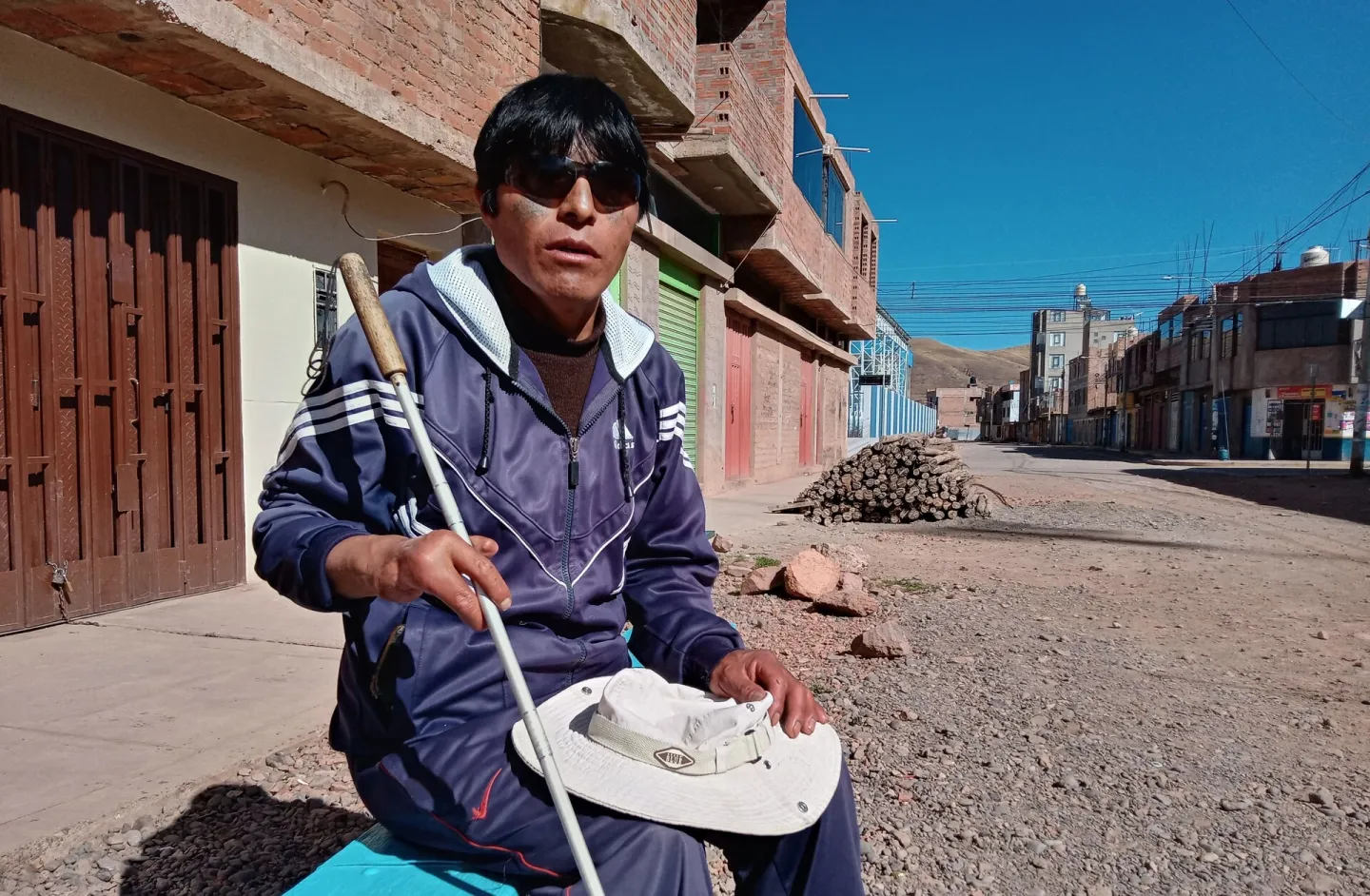
Before he lost both eyes and two fingers on his right hand, Inocencio Soncco Hanco was in a bad way. They could not find ore for themselves. It was as if the gold suddenly disappeared. Inocencio believes that they were made to enter the sinkhole on purpose, when the contractor lost track of the precious metal.
Traditionally they would leave them a cut (80 to 100 centimetres wide), with which they would take out 10 buckets of ore. With luck, each bucket contained between 2 to 3 grams of gold at the end of the process. But 50% of the profits went on dynamite, fuel, machinery, milling and mercury. The rest had to be divided among three to five miners.
- Which was the time you have won the most?
- Almost never. Sometimes not even a gram.
- So why were you still working?
- Hope, the luck factor. When a good cut appears, it rewards you. The ore is quite profitable and you get back everything you lost.
- Did it ever happen?
- Almost not. Some did get up to half a kilo of gold. It was their luck.
Inocencio Soncco is 43 years old and is from Azángaro, another poor Puno province. He is a computer technician, but decided to go mining because he could not make enough money. In addition, many of his relatives were going and his family's needs were pressing. He started working at La Rinconada in 2011 for various contractors and, like most, his agreements were verbal. He began by removing rocky material from the undercuts (cleaning), then moved on to surveillance and became an assistant driller.
On December 1, 2016, he worked for Multiservicios Ochoa Industria Comercio y Servicios E.I.R.L. Together with two of his colleagues, they were asked to drill 15 cuts and for them as a "reward" they would leave them 3. It was 5:30 a.m. and they had yet to drill and place dynamite in two cuts. While they were working on the last front, the explosion occurred.
- I saw it all when the dynamite exploded. Bang! And my whole face and eyes lit up. I didn't lose consciousness, but the drill master and the drill presser fainted. I started screaming, calling for help. “After half an hour they pulled me out in a blanket," recalls Inocencio Soncco. The drill blew up a remnant of the explosive they left behind. Not only did he lose his sight and fingers, but also part of his neck and head, which had to be reconstructed with platinum.
Inocencio Soncco was also promised support until his full recovery on the condition that he did not denounce them. In a private clinic in Juliaca, Huber Ochoa Lucana, brother of Honorato Ochoa, owner of Multiservicios Ochoa, told his wife, Albertina Machaca Chambi, that they would support them in everything, including giving them a motorcycle cab and laptop for their children. They paid for the operation, years later they gave him S/ 40,000 (USD 10,000) for complaining, and then again, they did not pay.
Faced with these abuses, Inocencio Soncco, with other survivors, formed the Association of Visually Impaired People Los Nevaditos La Rinconada Lunar de Oro in 2023. Their objective is that the State, through a law, recognizes with compensation that they acquired their disability working in the extractive sector.
- “The life I have, no one would want it. It's not the same. I used to work for my two children. Now I have no way to help them," she laments.
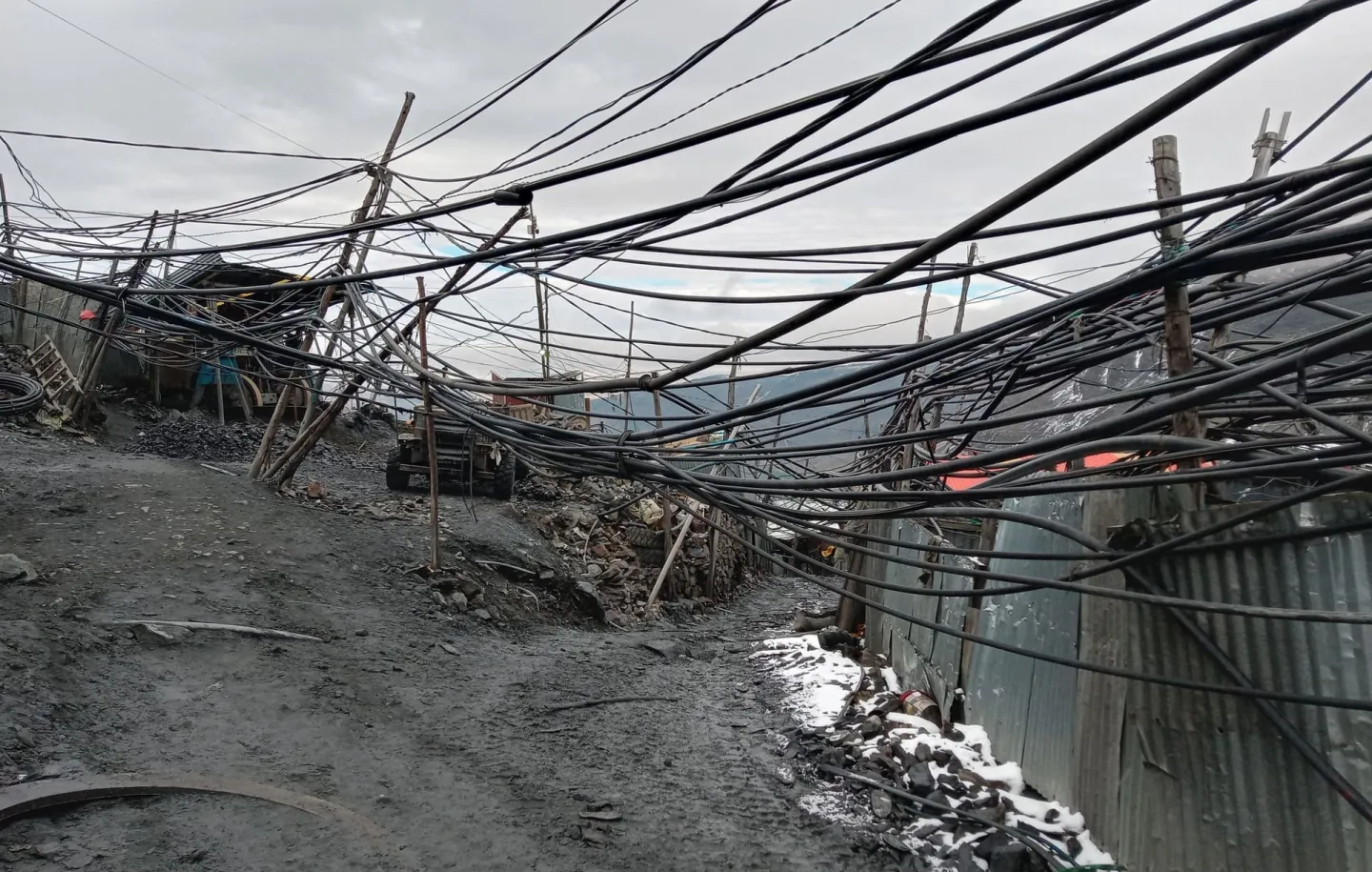
La mita and La Rinconada
Even with its differences, what has been happening for decades in La Rinconada, reminds us of the exploitation with the mining mita in colonial times. It was a system of compulsory labor. The Indians perished buried in the pits. Others died of malnutrition, epidemics, accidents, alcohol, says “Los trabajadores mineros en la época de Túpac Amaru”, an article by historian Juan José Vega.
Those who survived were in such poor health that they could not return to their villages of origin. Nor did they receive wages from their employers, who took advantage of them. The ore loaders, called apiris, would fall from high altitudes because of the weight of the burden on their backs. In Huancavelica, mothers preferred to cripple their children to avoid the punishment of the mita. "They preferred them to be invalids rather than in the mines (...), true sepulchers for the living," Vega wrote.
There is no record of accidents at La Rinconada and if there is, it is minimal, says Raul Ortega, a former official of the Regional Government of Puno. Article 164 of Supreme Decree N°024-2016-EM indicates that the operator must communicate an incident, emergency or fatal accident to the Ministry of Energy and Mines (MINEM) within 24 hours of occurrence. This does not always happen in the informal activity. Annual accident reports were requested from the Regional Directorate of Energy and Mines of Puno and there was no response. "The working conditions at La Rinconada are not legal. On the one hand, there is a need for employment. People go and offer themselves to the employer, to contractors. When they are admitted, they work in marginal conditions," Ortega added.
Pneumoconiosis in workers is a consequence of this marginality. The La Rinconada health center treats cases with this pulmonary problem. Melissa Esquivel, a medical serumist at the facility, explains that the inhalation of dust in the tunnels causes pneumoconiosis. "It is very difficult to treat them. The only solution is for them to leave the mine," she said. Mario Veliz Huaracallo, brother of Fermín Mayta Huaracallo, died of silicosis, one of the most common pneumoconiosis. He was a barretero in the 1990s.
Fermín Mayta, former cachorrero and former president of the Asociación de Trabajadores Mineros Base Cerro Lunar, tried to change the regulations that he considers to be an attack against miners before Congress. After the publication of Decree Legislative Decree N°1105, which initiates the process of formalization of small and artisanal mining, Legislative Decree N°027-2012 was issued. This norm labels the miners of La Rinconada and Cerro Lunar as third parties.

"However, our link has been direct with contractors. This regulation prevents us from having labor contracts with which we can denounce abuses before the Ministry of Labor or SUNAFIL. When there are accidents, the contractors refuse, they wash their hands like Pilate. They say that they don't work, that they are delinquents," Mayta questions.
Juvenal Gilt, representative of the workers at the La Rinconada and Cerro Lunar mines, also accuses the company of impunity. "If there is an accidental death and the operator acknowledges it, he compensates them. If not, he ignores it," he says. He adds that there is a great inequality since 95% of the gold is taken by the contractors and only the remaining 5% is distributed to the mining mass.
Finite gold
The number of workers at La Rinconada has decreased. Marcos Huaricaya, prosecutor of the La Rinconada Miners Association, estimates that there are 7,000 miners left. The reasons: higher crime and lower gold production. Raul Ortega, a former Puno official, points out that the resources have been depleted and what is left is for exploitation to increase to another scale. The workers who stayed behind are extracting llampo, the remaining marginal ore, from the pits. The agreement is that 50% of the gold extracted will go to the operators and 50% to them. However, there are no contracts and they assume the same costs and risks.
- It is no longer convenient to work here," says a trapichero (milling machine operator).
- We earn S/ 400 a week (USD 105) and it's only enough for food," says another miner.
- You have to be luckier to win well," adds the first.
Relevant projects
The Bridge Project – Phase II
From Protocol to Practice: A Bridge to Global Action on Forced Labour, Phase II (Bridge II)

Forced labour
From Protocol to Practice: A Bridge to Global Action on Forced Labour (The Bridge Project II)
Forced labour
From Protocol to Practice: A Bridge to Global Action on Forced Labour - Phase II (Bridge II) in Mongolia