Advancing social justice, promoting decent work
ILO is a specialized agency of the United Nations
English
BWI programme continue to support the implementation of labour compliance in garment industry
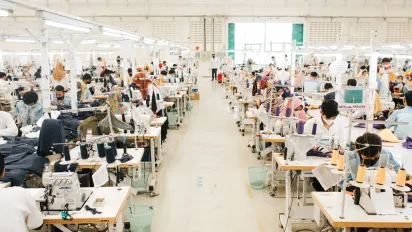
The ILO through its Better Work Indonesia (BWI) programme continue to improve working conditions and competitiveness in the global garment industry by strengthening its collaboration with the social partners.
Working together with government, employers, workers and international brands, BWI programme continue to provide technical supports to ensure the implementation of labour compliance, particularly in the garment industry of Indonesia. The following are some activities taken by BWI programme in supporting its national stakeholders:
Support to the implementation of employment contracts and Zero Tolerance Protocol
Employment contract for specific period of time (PKWT in Indonesia’s abbreviation) is a common type of employment contract used by many export-oriented garment factories in Indonesia. As a follow-up to the issuance of the Guidelines for the Implementation of Employment Contracts in the Export-Oriented Garment Sector in 2018, BWI programme continues to facilitate the dissemination of the Guidelines to the provincial manpower offices.
I hope there would be no longer different perception between mediators and inspectors in determining types of work that can be categorized as non-permanent work."
Lena Kurniawati, Head of Unit for International Relations and Law of the Directorate General of Labour Inspection and OSH, Ministry of Manpower
Together with the Directorate General of Labour Inspection of the Ministry of Manpower, BWI programme conducted a dissemination workshop in Bandung, West Java, in March 2019. The Bandung workshop was the continuity of the same event held in Semarang, Central Java, last year. The ILO-BWI programme has aimed to conduct the dissemination programme in three regions covering five provinces.
The Bandung workshop was attended by 17 mediators and inspectors as well as six representative of provincial manpower office of West Java. Lena Kurniawati, Head of Unit for International Relations and Law of the Directorate General of Labour Inspection and OSH, Ministry of Manpower, emphasized the importance of clearer understanding about works that can be categorized as non-permanent work. “I hope there would be no longer different perception between mediators and inspectors in determining types of work that can be categorized as non-permanent work,” she said.
Meanwhile Albert Y. Bonasahat, the ILO-BWI National Project Coordinator, said that the Guideline was the example of using social dialogue in solving compliance issues in the garment sector. “Improvements in compliance to labour standards not only improve factories competitiveness, but also provide better working conditions for garment workers,” he said.
In addition the ILO-BWI programme introduced the Zero Tolerance Protocol (ZTP). The ZTP was launched in March 2018, stipulating key procedures and coordination mechanisms that should be taken by both Ministry of Manpower and the ILO through its Better Work Indonesia (BWI) programme in handling reported non-tolerable violations at BWI’s participating export-oriented garment factories.
Strengthening the coordination with local government
The ILO-BWI Programme organized a courtesy meeting with the Head of Local Manpower Office of Central Java Province in the beginning of May. The event was used to introduce the work of BWI and its staff at the factory level.
Dra. Wika Bintang, MM, the Head of Local Manpower Office of Central Java Province, appraised the collaboration conducted with the ILO-BWI programme. “Garment is part of the labour intensive industry in Central Java and it plays an important role for our economy and development. Therefore, I greatly welcome the cooperation with BWI programme to better protect both the industry and the workers,” he added.
The courtesy meeting was followed with visits to two factories members of BWI: PT Sam Sam Jaya Garments and PT Semarang Garment. The visits were appraised by the factories as they provided an opportunity for the factories to have a dialogue on OSH related issues with the relevant governmental officials from both national and provincial level.
“We often feel uncertain if we already implement the OSH Management System as there are many requirements to follow. This visit has given us an opportunity to discuss issues related to OSH with relevant government’s representatives,” said Abdul Jamil, Compliance Officer of PT Sam Sam Jaya Garments
Be confident. The key is to put OSH as one of the focuses of the factory and to work together to protect the factory and workers."
Ahmad Romdhoni, Labour Inspector from Manpower Office of Central Java
Meanwhile Valen Ardita, the Compliance Officer of PT Semarang Garment, stated that the management of the company paid a good attention to OSH related issues. “We have requested more funding to upgrade safety equipment and facilities for our factory. It is good to have management with a good commitment on OSH,” stated Valen.
Ahmad Romdhoni, Labour Inspector from Manpower Office of Central Java, appraised the efforts taken by the factories. “Be confident. The key is to put OSH as one of the focuses of the factory and to work together to protect the factory and workers,” he concluded.
Better Work is a flagship programme of the UN’s International Labour Organization, jointly managed by the International Finance Corporation, a member of the World Bank Group. Better Work brings together government, employers, workers and international brands to improve working conditions and competitiveness in the global garment industry.