

Benefits of productivity ecosystems highlighted by ILO at conferences in Jamaica and Trinidad and Tobago
Both events explored how to address barriers to better jobs and economic growth.
17 June 2024
Key insights from ILO Caribbean were featured at conferences hosted in Trinidad and Tobago as well as Jamaica to emphasize that decent work must be central to strategies for economic productivity.
At the Human Resource Management Association of Trinidad and Tobago (HRMATT) C-Suite Conversation on Productivity, held on 12 June 2024 to promote strengthened productivity through learning and collaboration, ILO Caribbean Specialist for Sustainable Enterprise Development and Job Creation John Bliek outlined an intervention strategy for productivity ecosystems and decent work.
“The data show that productivity in this region lags behind the countries such as United States, Korea, Poland and Türkiye. However, Caribbean governments, the private sector and workers can come together to close these gaps through human-centred policy leads that are coordinated and systemic; introduce employment policy frameworks; integrate workforce skills upgrading tailored to employer and worker needs; and enhance managerial skills through training, mentoring and coaching,” said John Bliek at the HRMATT event.
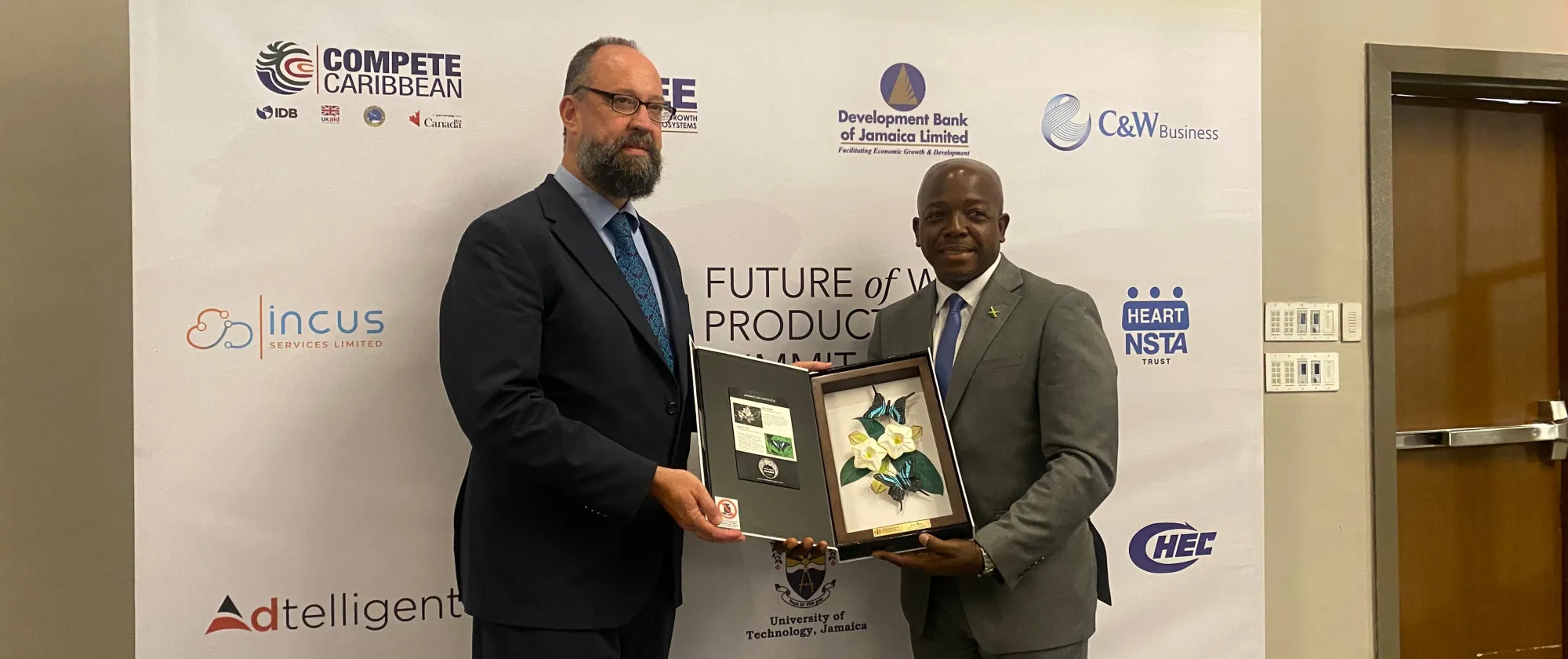
The ILO Caribbean Specialist was also a featured speaker at the Jamaica Future of Work and Productivity Summit, which was co-hosted by the Ministry of Labour and Social Security and the Jamaica Productivity Centre on from 19 to June 2024, to address how changes in the world of work affect productivity. During his presentation, he outlined that micro-, small-, and medium-sized enterprises (MSMEs) account for 97.6 per cent of all registered companies in Jamaica and account for 80 per cent of jobs across the country.
“Most jobs are created by one-person enterprises as almost 40 per cent of working Jamaicans are self-employed which can be generally characterized by high informality and lower productivity,” he explained. “In this reality, MSMEs focus on survival and ensuring that their businesses remain operational and profitable, which hampers their ability to do more strategic planning to enhance productivity and competitiveness.”
During his presentation, John Bliek explained that a productivity ecosystem for decent work framework in Jamaica can help MSMEs to overcome these challenges by increasing access to financial capital and financial literacy; providing training in business development; creating opportunities for innovation; and promoting more use of technology.
“With decent work at its foundation, the ideal productivity ecosystem can drive policies for better measurement of labour and multi-factor productivity; capacity development of employers’ and workers’; industrial policies; and enterprise formalization. At the enterprise level, the ecosystem should promote the modernization of production processes; strengthen the skills of workers and managers; and improve working conditions,” he said.
Productivity ecosystems for decent work is an ILO methodology to address barriers to better jobs and productivity growth. Through this framework, enterprises and their workers are at the core of an “ecosystem” that links productivity growth and decent work across three levels: national (macro), sectoral (meso) and enterprise (micro). The productivity ecosystems for decent work approach works across these three levels to strengthen key productivity and job creation drivers.
More information on the connection between productivity and decent work is available on the ILO website.