

Decent work
Barbados signs Decent Work Country Programme 2025–2030
Barbados officially launched its DWCP 2025–2030, uniting Government, employers, and workers in a shared commitment to promoting inclusive, sustainable employment and social justice. The Programme outlines strategic priorities aligned with national development goals and the 2030 Agenda, aiming to transform the world of work through collaboration, reform, and accountability.
3 July 2025
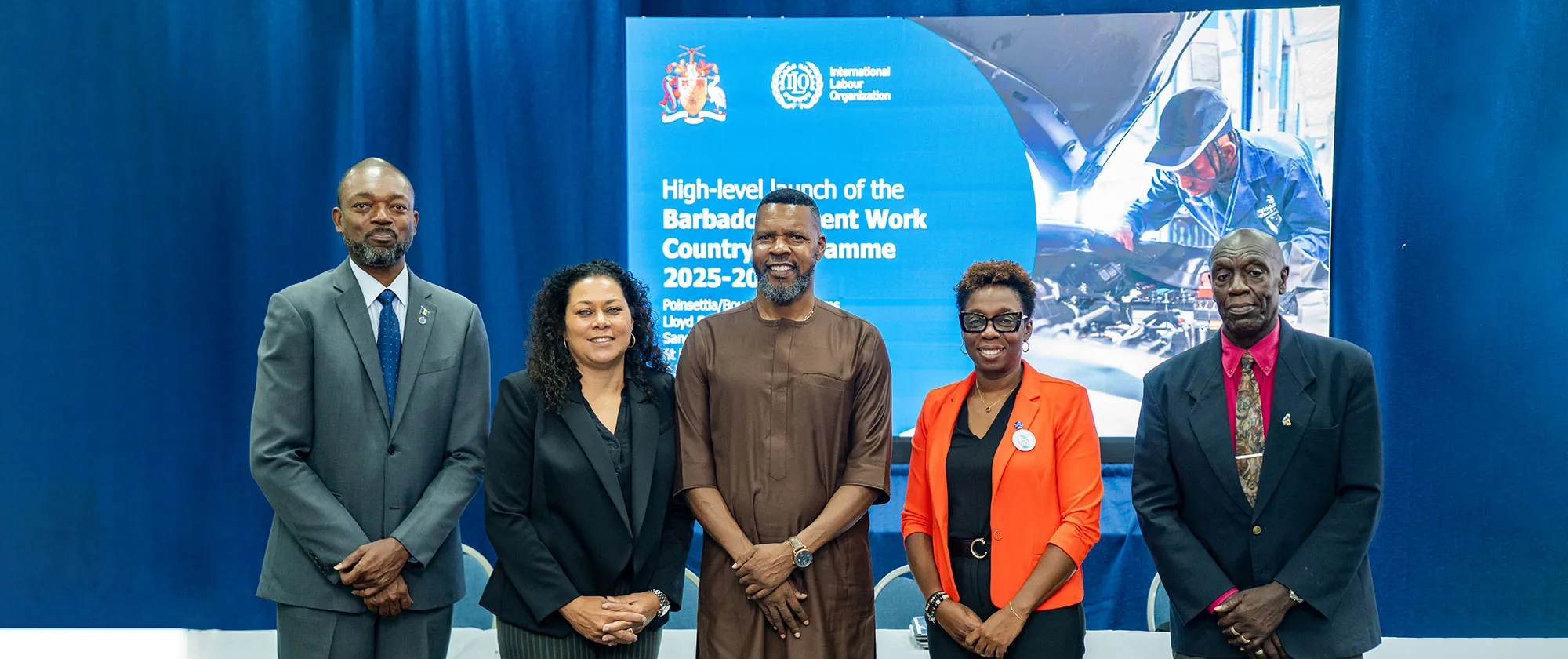
BRIDGETOWN, Barbados (ILO News) - On 2 July 2025, the Government of Barbados, alongside its social partners and the International Labour Organization (ILO), launched the 2025–2030 Decent Work Country Programme (DWCP), a strategic framework that sets out national priorities to advance inclusive and sustainable employment, social dialogue, rights at work, and social protection.
The signing ceremony marked a collective commitment to promoting decent work and human rights in alignment with the National Strategic Plan of Barbados 2006–2025, Mission Barbados, the Barbados Economic Recovery and Transformation (BERT) Plan, and the 2030 Agenda for Sustainable Development.
A vision for national development
Delivering the feature address, Hon. Colin E. Jordan, M.P., Minister of Labour, Social Security and the Third Sector, hailed the launch of the DWCP as a landmark moment for Barbados' labour and social landscape: “This Decent Work Country Programme is a reflection of our shared vision, a Barbados where economic growth is matched by social justice and where every citizen is empowered through dignified, productive work.”
Minister Jordan underscored the alignment of the DWCP with Mission Barbados 2030, noting that its objectives are critical to the country’s transformation: “Decent work is fundamental to national development, and our commitment must be measured not just in plans, but in implementation that delivers real change for real people.”
The DWCP identifies three strategic priorities:
- Strengthening national capacities for integrated policy and institutional responses to decent work.
- Enhancing national systems for skills development, employment services, and support for sustainable enterprises.
- Advancing social dialogue, rights at work, and social protection for all.
Voices from the tripartite partnership
Representing workers, Mr. Dennis De Peiza, General Secretary of the Congress of Trade Unions and Staff Associations of Barbados (CTUSAB), described the Programme as a vital step in national development: “The success of the DWCP must be conditioned on a programme of action that positively influences social protection systems and uplifts living standards.” De Peiza stressed that contract employment and underpayment could undermine the decent work agenda, calling for proper enforcement and robust monitoring mechanisms.
Ms. Toni Moore, General Secretary of the Barbados Workers’ Union and Member of Parliament, reflected on the evolution of the DWCP since 2009: “We must never surrender to being the lowest common denominator. The issues the DWCP targets remain fundamental to labour and national development. This Programme is about strengthening what we have—to ensure it doesn’t become broken.” Moore championed the consolidation of Barbados’ labour laws under a single Labour Code and underscored the need to strengthen institutions like the Labour Department to ensure timely access to justice for workers.
Speaking on behalf of employers, Mrs. Lisa Ridley-Paul, 1st Vice President of the Barbados Employers’ Confederation, remarked: “We do not want a museum document—well-crafted but gathering dust. What we want is sustained change… Decent work is not just a theoretical goal. It is an operational necessity.” She emphasized the private sector’s need for skilled labour, productive dialogue, and accountable implementation to ensure the DWCP drives real-world outcomes.
Mr. Joni Musabayana, Director of the ILO Decent Work Team and Office for the Caribbean, applauded Barbados’ leadership: “Barbados is the only Caribbean country currently representing workers, employers, and government on the ILO Governing Body. With that comes the burden and the opportunity of leadership.” Musabayana announced that the Caribbean is now leading globally in the rate of DWCP adoption this biennium and committed the ILO’s full support to the Programme’s implementation: “These programmes are more than plans. They are declarations of intent—collective action to reinforce stability and create better opportunities for all. The real work begins now.”
Looking ahead
The Decent Work Country Programme 2025–2030 sets a bold course for inclusive growth, equity, and resilience. By fostering a culture of collaboration, transparency, and accountability, Barbados is not only reaffirming its leadership in the Caribbean but also positioning itself as a global example of how tripartism can drive sustainable development. With shared commitment and determined action, the DWCP promises to transform the world of work in Barbados one policy, one partnership, and one person at a time.
Related content

Decent work
Barbados Decent Work Country Programme 2025-2030